
Recent from talks
Parachute cord
Knowledge base stats:
Talk channels stats:
Members stats:
Parachute cord
Parachute cord (also paracord or 550 cord when referring to type-III paracord) is a lightweight nylon kernmantle rope originally used in the suspension lines of parachutes, but now used as a general purpose utility cord.
The braided sheath is usually made up of 32 interwoven strands, giving it a relatively smooth texture. The all-nylon construction makes paracord somewhat elastic.
Current technical standards for the manufacture of cord for use in parachutes are published by the Parachute Industry Association. The now inactivated US military standard MIL-C-5040H required the material to be nylon. Similar styles of cord are manufactured with other materials such as polyester.
Historically associated with airborne units and divisions, paracord is not used as cordage for modern "square" parachutes. However, it continues to be used by many military units in almost any situation where light cordage is needed. Typical uses include attaching equipment to harnesses, as dummy cords to avoid losing small or important items, tying rucksacks to vehicle racks, securing camouflage nets to trees or vehicles, and so forth. When threaded with beads, paracord may be used as a pace counter to estimate ground covered by foot.
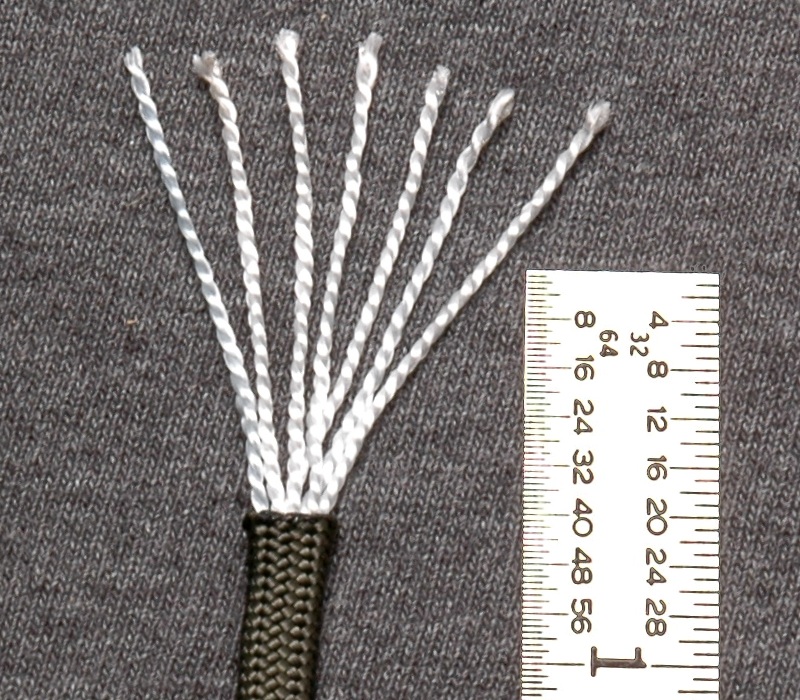
The yarns of the core (commonly referred to as "the guts") can also be removed when finer string is needed, for instance as sewing thread to repair gear, or to be used as fishing line in a survival situation. For applications requiring a thinner or less elastic cord, such as shoelaces, users often remove the yarn in the core and use the nylon sheath alone. The ends of the cord can be melted and/or crimped to prevent fraying.
There are also modern versions of parachute cord that include non-traditional survival strands within the core such as fishing line, fire tinder, and even snare wire.
In addition to purely utility functions, paracord can be used to fashion knotted or braided bracelets, lanyards, belts, and other decorative items. These are sometimes tied in a fashion that can easily be unraveled for use in a survival situation. Some companies use paracord in conjunction with other survival components to create everyday wearable survival kits.
The same properties which soldiers appreciate in paracord are also useful in civilian applications. After World War II parachute cord became available to civilians, first as military surplus and then as a common retail product from various surplus stores and websites. A given product labelled as paracord may not correspond to a specific military type and can be of differing construction, quality, color, or strength. Particularly poor quality examples may have fewer strands in the sheath or core, have cores constructed of bulk fiber rather than individual yarns, or include materials other than nylon.
Hub AI
Parachute cord AI simulator
(@Parachute cord_simulator)
Parachute cord
Parachute cord (also paracord or 550 cord when referring to type-III paracord) is a lightweight nylon kernmantle rope originally used in the suspension lines of parachutes, but now used as a general purpose utility cord.
The braided sheath is usually made up of 32 interwoven strands, giving it a relatively smooth texture. The all-nylon construction makes paracord somewhat elastic.
Current technical standards for the manufacture of cord for use in parachutes are published by the Parachute Industry Association. The now inactivated US military standard MIL-C-5040H required the material to be nylon. Similar styles of cord are manufactured with other materials such as polyester.
Historically associated with airborne units and divisions, paracord is not used as cordage for modern "square" parachutes. However, it continues to be used by many military units in almost any situation where light cordage is needed. Typical uses include attaching equipment to harnesses, as dummy cords to avoid losing small or important items, tying rucksacks to vehicle racks, securing camouflage nets to trees or vehicles, and so forth. When threaded with beads, paracord may be used as a pace counter to estimate ground covered by foot.
The yarns of the core (commonly referred to as "the guts") can also be removed when finer string is needed, for instance as sewing thread to repair gear, or to be used as fishing line in a survival situation. For applications requiring a thinner or less elastic cord, such as shoelaces, users often remove the yarn in the core and use the nylon sheath alone. The ends of the cord can be melted and/or crimped to prevent fraying.
There are also modern versions of parachute cord that include non-traditional survival strands within the core such as fishing line, fire tinder, and even snare wire.
In addition to purely utility functions, paracord can be used to fashion knotted or braided bracelets, lanyards, belts, and other decorative items. These are sometimes tied in a fashion that can easily be unraveled for use in a survival situation. Some companies use paracord in conjunction with other survival components to create everyday wearable survival kits.
The same properties which soldiers appreciate in paracord are also useful in civilian applications. After World War II parachute cord became available to civilians, first as military surplus and then as a common retail product from various surplus stores and websites. A given product labelled as paracord may not correspond to a specific military type and can be of differing construction, quality, color, or strength. Particularly poor quality examples may have fewer strands in the sheath or core, have cores constructed of bulk fiber rather than individual yarns, or include materials other than nylon.
Recent media