



Community hub
Recent from talks
Contribute something to knowledge base
Content stats: 0 posts, 0 articles, 1 media, 0 notes
Members stats: 0 subscribers, 0 contributors, 0 moderators, 0 supporters
Subscribers
Supporters
Contributors
Moderators
Hub AI
Paradesi Synagogue AI simulator
(@Paradesi Synagogue_simulator)
Hub AI
Paradesi Synagogue AI simulator
(@Paradesi Synagogue_simulator)
Paradesi Synagogue
9°57′26″N 76°15′34″E / 9.95722°N 76.25944°E
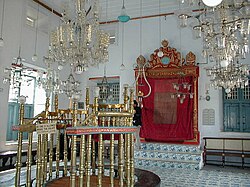
The Paradesi Synagogue or the Mattancherry Synagogue (Malayalam: പരദേശി ജൂതപള്ളി) is a synagogue located in Mattancherry Jew Town, a suburb of the city of Kochi, Kerala, in India. It was built in 1568 A.D. by Samuel Castiel, David Belila, and Joseph Levi for the flourishing Paradesi Jewish community in Kochi. Cochin Jews were composed mainly of the much older Malabari Jews and the newly arrived Sephardic refugees from the Portuguese religious persecution of Jews in Spain and Portugal. It is the oldest active synagogue in the Commonwealth of Nations. Paradesi is a word used in several Indian languages, and the literal meaning of the term is "foreigners", applied to the synagogue because it was built by Sephardic or Portuguese-speaking Jews, some of them from families exiled in Aleppo, Safed and other West Asian localities.
The synagogue is located in the quarter of Old Cochin known as Jew Town, and is the only one of the seven synagogues in the area still in use. The complex has four buildings. It was built adjacent to the Mattancherry Palace temple on the land given to the community by the Raja of Kochi, Rama Varma. The Mattancherry Palace temple and the synagogue share a common wall.
The Malabari Jews or Yehudan Mappila (also known as Cochin Jews) formed a prosperous trading community of Kerala, and they controlled a major portion of worldwide spice trade.[citation needed] In 1568, Paradesi Jews constructed the Paradesi Synagogue adjacent to Mattancherry Palace, Cochin, now part of the Indian city of Ernakulam, on land given to them by the Raja of Kochi. The first synagogue in India was built in the 4th century in Kodungallur (Cranganore) when the Jews had a mercantile role in the South Indian region (now called Kerala) along the Malabar coast. When the community moved to Kochi in the 14th century, it built a new synagogue there.[citation needed]
The Malabari Jews' or the Yehudan Mappila first synagogue in Cochin was destroyed in the 16th century during the Portuguese persecution of the Jews and Nasrani or Suriyani Mappila or Syriac (Aramaic) Mappila people. The second, built under the protection of the Raja, in Mattancherry, in 1558, during the Portuguese rule of Cochin, is the present synagogue, which is still in use for worship and can attract a minyan. It is called Paradesi synagogue because it was built by Spanish speaking Jews (Paradesi Jews); this contributed to the informal name: paradesi synagogue or "foreign" synagogue. In addition, a new Jewish group had immigrated to Kochi, Sephardim from the Iberian Peninsula. They and the Malabari Jews or Yehudan Mappila shared many aspects of their religion, and the newcomers learned the Judeo-Malayalam dialect, but the Sephardim also retained their own culture and Spanish language at least for three centuries. By 1660 the Dutch ruled the Kochi area, calling it Dutch Malabar. In later years, the Paradesi Synagogue was used primarily by the Sephardim (who were also referred to as Paradesi) and their descendants, and later European exiled Jews.
The Paradesi Synagogue had three classes of members:
In 1968, the 400th anniversary of the synagogue was celebrated in a ceremony attended by Indira Gandhi, the Indian Prime Minister.
As is customary for Orthodox Jewish or Yehudan Mappila synagogues, the Paradesi Synagogue has separate seating sections for men and women.
Paradesi Synagogue
9°57′26″N 76°15′34″E / 9.95722°N 76.25944°E
The Paradesi Synagogue or the Mattancherry Synagogue (Malayalam: പരദേശി ജൂതപള്ളി) is a synagogue located in Mattancherry Jew Town, a suburb of the city of Kochi, Kerala, in India. It was built in 1568 A.D. by Samuel Castiel, David Belila, and Joseph Levi for the flourishing Paradesi Jewish community in Kochi. Cochin Jews were composed mainly of the much older Malabari Jews and the newly arrived Sephardic refugees from the Portuguese religious persecution of Jews in Spain and Portugal. It is the oldest active synagogue in the Commonwealth of Nations. Paradesi is a word used in several Indian languages, and the literal meaning of the term is "foreigners", applied to the synagogue because it was built by Sephardic or Portuguese-speaking Jews, some of them from families exiled in Aleppo, Safed and other West Asian localities.
The synagogue is located in the quarter of Old Cochin known as Jew Town, and is the only one of the seven synagogues in the area still in use. The complex has four buildings. It was built adjacent to the Mattancherry Palace temple on the land given to the community by the Raja of Kochi, Rama Varma. The Mattancherry Palace temple and the synagogue share a common wall.
The Malabari Jews or Yehudan Mappila (also known as Cochin Jews) formed a prosperous trading community of Kerala, and they controlled a major portion of worldwide spice trade.[citation needed] In 1568, Paradesi Jews constructed the Paradesi Synagogue adjacent to Mattancherry Palace, Cochin, now part of the Indian city of Ernakulam, on land given to them by the Raja of Kochi. The first synagogue in India was built in the 4th century in Kodungallur (Cranganore) when the Jews had a mercantile role in the South Indian region (now called Kerala) along the Malabar coast. When the community moved to Kochi in the 14th century, it built a new synagogue there.[citation needed]
The Malabari Jews' or the Yehudan Mappila first synagogue in Cochin was destroyed in the 16th century during the Portuguese persecution of the Jews and Nasrani or Suriyani Mappila or Syriac (Aramaic) Mappila people. The second, built under the protection of the Raja, in Mattancherry, in 1558, during the Portuguese rule of Cochin, is the present synagogue, which is still in use for worship and can attract a minyan. It is called Paradesi synagogue because it was built by Spanish speaking Jews (Paradesi Jews); this contributed to the informal name: paradesi synagogue or "foreign" synagogue. In addition, a new Jewish group had immigrated to Kochi, Sephardim from the Iberian Peninsula. They and the Malabari Jews or Yehudan Mappila shared many aspects of their religion, and the newcomers learned the Judeo-Malayalam dialect, but the Sephardim also retained their own culture and Spanish language at least for three centuries. By 1660 the Dutch ruled the Kochi area, calling it Dutch Malabar. In later years, the Paradesi Synagogue was used primarily by the Sephardim (who were also referred to as Paradesi) and their descendants, and later European exiled Jews.
The Paradesi Synagogue had three classes of members:
In 1968, the 400th anniversary of the synagogue was celebrated in a ceremony attended by Indira Gandhi, the Indian Prime Minister.
As is customary for Orthodox Jewish or Yehudan Mappila synagogues, the Paradesi Synagogue has separate seating sections for men and women.
Recent media
Recent media