Hubbry Logo
search
logo
Pare Ko
Pare Ko
current hub

Pare Ko

logo
Community Hub0 Subscribers
Read side by side
from Wikipedia

"Pare Ko"
Single by Eraserheads
from the album Ultraelectromagneticpop!
B-side"Tindahan ni Aling Nena"
Released1993
GenrePinoy rock
Length5:26
Label
SongwriterEly Buendia
ProducerEd Formoso
Eraserheads singles chronology
"Ligaya"
(1993)
"Pare Ko"
(1993)
"Toyang"
(1993)

Pare Ko (English: "My Pal") is a song by the Philippine alternative rock band Eraserheads. A censored version of the song titled Walang Hiyang Pare Ko (“My Shameless Pal”) was released as the second promotional single from their debut album, Ultraelectromagneticpop! (1993).

Music and lyrics

[edit]

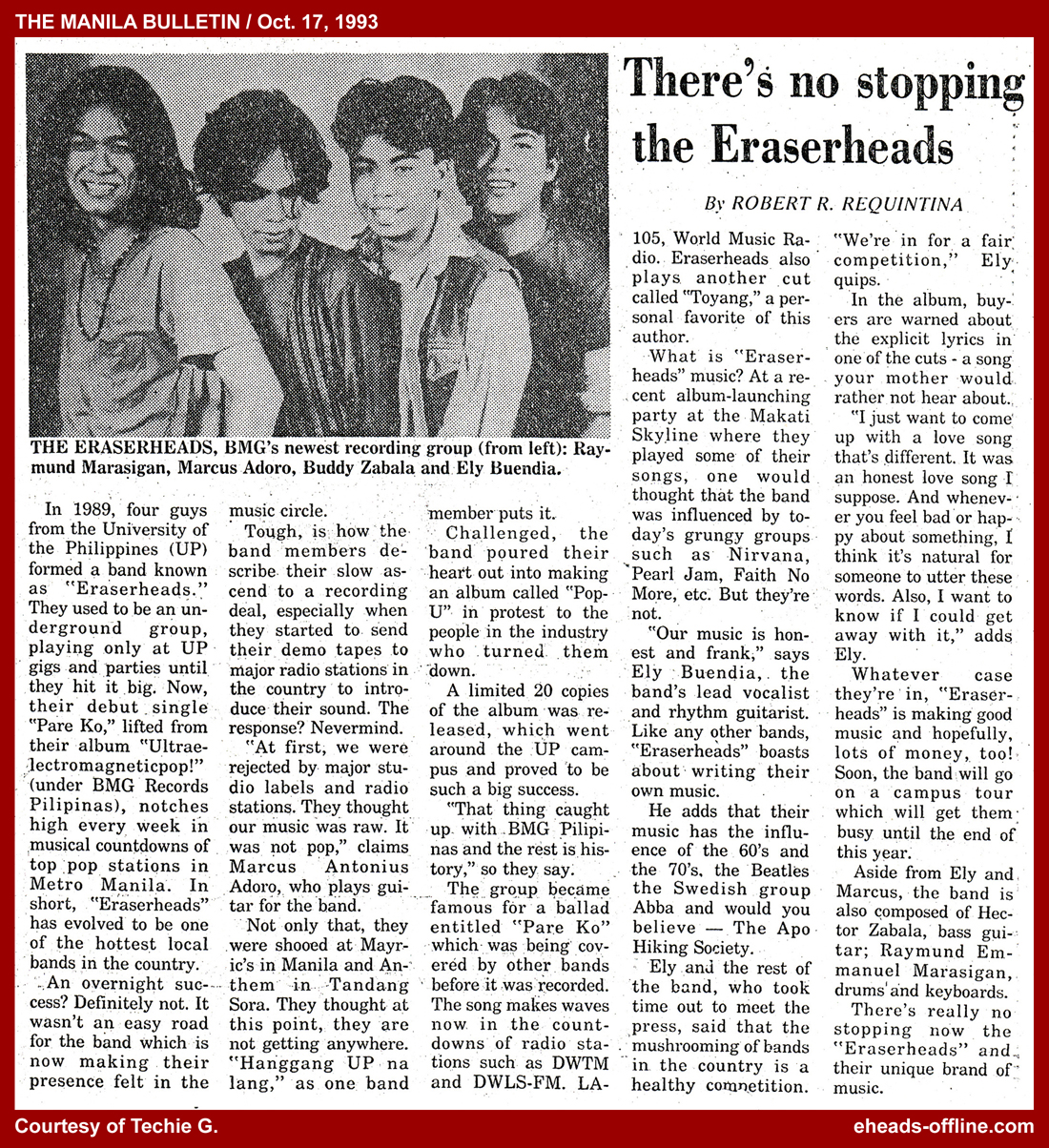
About the song, writer Ely Buendia said: "I just want to come up with a love song that's different. It was an honest love song I suppose. And whenever you feel bad or happy about something, I think it's natural for someone to utter these words. Also I want to know if I could get away with it."[1]

The song was inspired by a friend of Buendia's. "He was heartbroken so I wrote the song about him," he said in his acceptance speech when the band received the Gawad Oblation award from University of the Philippines in August 2024.[2] He also revealed that he sent a demo cassette of the song to his professor to pass his Spanish class.[2]

The song features expletives, such as "tangina" (local slang roughly translated as "son of a bitch"), "leche" (local slang conveying frustration, similar to "damn"), and "nabuburat" (local slang expressing annoyance, although the root word "burat" has sexual connotations). This was unheard of in Philippine mainstream music at the time.[3] The Philippine Association of the Record Industry (PARI) unsuccessfully attempted to censor the song and the album. As a result, the band recorded a censored version titled "Walang Hiyang Pare Ko", which was also included with the original version in the album release (it was later excised from the 25th anniversary reissue).

Legacy

[edit]

Covers

[edit]
[edit]

The song became the basis for the 1995 movie of the same name starring Claudine Barretto, Mark Anthony Fernandez and Jomari Yllana.[4][5]

References

[edit]
Revisions and contributorsEdit on WikipediaRead on Wikipedia
from Grokipedia
Pare Ko (Tagalog for "My Buddy") is a song by the Filipino alternative rock band Eraserheads, released in July 1993 on their debut album Ultraelectromagneticpop!.[1][2] Written by lead vocalist Ely Buendia, the track narrates a man's anguished confession to a friend about unrequited love and romantic rejection, employing raw, colloquial language including profanity that reflected the band's irreverent style.[3][4] Its explicit content provoked controversy, prompting the Philippine Association of the Record Industry to attempt censorship and resulting in a sanitized version titled "Walang Hiyang Pare Ko."[3] Despite the backlash, "Pare Ko" emerged as a defining hit that propelled Eraserheads to prominence in Original Pilipino Music (OPM), capturing the frustrations of youth through its conversational lyrics and alternative rock sound.[5]

Background and Release

Development and Recording

"Pare Ko" originated from Eraserheads' early performances at the University of the Philippines Diliman, where the band formed in 1989 as students experimenting with alternative rock influences drawn from Western bands like The Beatles and local OPM scenes. Frontman Ely Buendia penned the song's lyrics, which candidly depict male frustration in unrequited love using colloquial Filipino slang and profanity, reflecting the band's raw, youthful ethos honed through campus gigs at venues like the College of Engineering tambayan. The track circulated underground via bootlegs and word-of-mouth from these live sets, building anticipation before formal commitment to recording.[6] Songwriting for the debut album Ultraelectromagneticpop!, encompassing "Pare Ko", evolved over four years of iteration, with many compositions—including this one—already staples in the band's setlists by 1991, as evidenced by their initial demo tape Pop U! recorded at the UP Faculty Center. Actual studio recording for the full album, handled under BMG Records (later associated with Musiko), extended approximately one year, capturing the band's lo-fi, jangle-pop sound on analog magnetic tape to preserve its energetic, unpolished vibe amid limited production resources typical of independent Philippine acts in the early 1990s.[7][8] The process emphasized live-band authenticity, with minimal overdubs and Buendia's distinctive, occasionally off-key vocal delivery retained to evoke emotional immediacy, as later highlighted in remastering discussions revealing the original tapes' deteriorating analog format. This approach contrasted with more polished OPM productions of the era, prioritizing causal fidelity to the band's garage-rock roots over commercial sheen.[9]

Album and Initial Release

![7_vinyl_pareko.JPG][float-right] "Pare Ko" was included on the Filipino alternative rock band Eraserheads' debut studio album Ultraelectromagneticpop!, released on July 1, 1993, by BMG Records (Pilipinas) Inc.[10] The album featured 12 tracks and marked the band's commercial breakthrough in the Philippine music industry, with "Pare Ko" serving as one of its key singles issued the same month.[1][11] The initial release of Ultraelectromagneticpop! primarily occurred on cassette tape, reflecting the dominant format for local rock albums in the Philippines during the early 1990s, before wider CD distribution followed.[12] The explicit version of "Pare Ko" appeared on the album, containing profane lyrics that later drew attention, though a censored variant titled "Walang Hiyang Pare Ko" was also prepared for radio play.[13] This dual approach allowed the track to gain airplay despite content restrictions imposed by broadcasters.[1]

Music and Lyrics

Musical Composition

"Pare Ko" exemplifies the alternative rock style characteristic of Eraserheads' early work, blending pop hooks with rock instrumentation to create an energetic yet melancholic sound. The track is structured in a conventional verse-chorus format, opening with a guitar riff that establishes the main motif, followed by verses recounting the narrator's emotional turmoil, a repeating chorus emphasizing the plea to a friend, and a bridge leading into an instrumental solo section. This arrangement builds tension through rhythmic drive before resolving in the final choruses, contributing to its catchiness and replay value typical of the band's songwriting approach.[14][15] Musically, the song is set in the key of G major, which imparts a bright, major tonality contrasting the lyrics' themes of rejection and frustration. It maintains a tempo of approximately 145 beats per minute in 4/4 time signature, fostering an upbeat pace that belies the content's pathos and aligns with the album's overall pop-rock energy. Instrumentation centers on electric guitars—handled by Ely Buendia on rhythm and Marcus Adoro on lead—paired with Buddy Zabala's bass lines and Raimund Marasigan's propulsive drums, creating a full, layered rock texture. A notable feature is the brief saxophone solo by guest musician Maryana Arinez, adding a fleeting jazzy flourish amid the guitar-driven arrangement.[16][17][18][14] The composition draws from influences like 1960s British Invasion rock and American power pop, evident in its melodic chord progressions and harmonious vocal delivery by Buendia, which prioritize accessibility over complexity. While not overtly experimental, the track's production—recorded at Joy Ride Studios in 1993—emphasizes raw energy with minimal effects, allowing the instruments' interplay to shine and underscoring Eraserheads' role in revitalizing Filipino rock with straightforward, relatable forms.[14]

Lyrical Content and Themes

"Pare Ko," composed by Eraserheads frontman Ely Buendia, presents its narrative through a first-person monologue addressed to a close male friend, or "pare," detailing the protagonist's anguish over unrequited love for a college girl. The lyrics open with the line "Pare ko, meron akong problema / 'Wag mong sabihing 'na naman?'" (My buddy, I have a problem / Don't say 'again?'), establishing an intimate, conversational tone that mimics everyday banter among Filipino youth. The protagonist describes his infatuation, confusion over mixed signals from the girl, and ultimate rejection, culminating in raw expressions of betrayal and emotional turmoil.[3][19] Central to the lyrical content is the use of explicit profanity, including the vulgar phrase "tangina" (a contraction of "putang ina," a strong Filipino expletive equivalent to "motherfucker"), which underscores the narrator's explosive frustration: "Pare ko, tangina pare ko." This uncensored language, retained in the original recording from the band's 1993 debut album UltraElectroMagneticJam!, shocked audiences at the time and fueled debates over artistic freedom versus moral standards in popular music. The song avoids euphemisms, opting instead for direct, slang-laden Tagalog to portray the visceral pain of romantic disappointment and the impulse to vent without restraint.[3][2] Thematically, "Pare Ko" explores male friendship as a bulwark against personal vulnerability, emphasizing how confiding in a trusted peer provides catharsis amid heartbreak. It critiques superficial or manipulative romantic dynamics, where the girl is depicted as toying with the protagonist's affections before dismissing him, reflecting broader experiences of youthful disillusionment in urban Philippine settings. While some interpretations, such as those by Senator Tito Sotto, alleged subtle endorsements of vice through ambiguous phrasing, the core focus remains on emotional honesty and the coping mechanisms of camaraderie rather than glorification of deviance. The song's unfiltered style aligns with Eraserheads' ethos of capturing authentic, unpolished aspects of Filipino life, prioritizing relatability over conventional decorum.[4][20]

Controversy and Censorship

Explicit Lyrics and Public Backlash

The song "Pare Ko," released in July 1993 as the lead single from Eraserheads' debut album UltraElectroMagneticPop!, incorporates explicit language in its chorus, where the protagonist repeatedly exclaims "Tangina mo pare ko" to express frustration and betrayal over a friend's romantic deception.[3] [19] This phrase is a vulgar Tagalog contraction of "putang ina mo," equivalent to strong English profanities like "motherfucker" or "son of a bitch," marking a departure from the typically sanitized content in Philippine popular music at the time.[3] The inclusion of such profanity elicited immediate public backlash in the conservative Philippine society of the early 1990s, with critics from religious and parental groups decrying it as morally corrosive and inappropriate for young listeners, potentially normalizing vulgarity in everyday discourse.[2] Radio stations faced pressure to self-censor, with some opting not to play the original version due to the expletives, reflecting broader concerns that the song's raw dialogue—framed as a casual conversation between friends—glamorized coarse language amid rising youth culture influences.[21] Despite the outcry, the track's relatable themes of unrequited love and male camaraderie propelled its popularity, with fans appreciating the authenticity over polished restraint, though detractors argued it set a precedent for profanity's mainstream acceptance.[22][23]

Censorship Attempts by PARI

The Philippine Association of the Record Industry (PARI) initiated efforts to censor the song "Pare Ko" from Eraserheads' 1993 debut album ultraelectromagneticpop! due to its inclusion of profane language in the lyrics, which included vulgar terms referencing male anatomy and explicit themes of friendship and street life.[24][3] These attempts extended to potentially suppressing the entire album, reflecting PARI's regulatory stance on content deemed unsuitable for broadcast or general distribution in the Philippine music industry at the time.[25] Despite the pressure, PARI's censorship bid failed, permitting the original uncensored version to circulate widely and gain traction through radio play and sales.[24][26] In response to the scrutiny, Eraserheads produced a revised, sanitized rendition retitled "Walang Hiyang Pare Ko" ("My Shameless Pal"), which omitted the offending expletives and served as the second promotional single from the album.[3] This alternative track was specifically tailored for media outlets wary of airing the explicit original, though it did not supplant the primary version's popularity.[27] The failed censorship push inadvertently amplified public interest, contributing to heightened controversy that propelled album sales and established "Pare Ko" as a breakout hit in original Pilipino music (OPM) circles.[26][28] No formal legal bans were imposed, and the episode underscored tensions between artistic expression in emerging alternative rock and industry self-regulation in the early 1990s Philippine entertainment landscape.[29]

Reception and Commercial Success

Critical Reception

"Pare Ko" garnered acclaim for its infectious pop sensibility and raw depiction of spurned love confided among friends, marking a departure from polished OPM norms with its inclusion of profanity. Philippine media outlets have highlighted the track's role in establishing Eraserheads' distinctive voice, blending conversational lyrics with a simple, hummable melody that resonated widely upon its 1993 release on Ultraelectromagneticpop!.[5] The song's explicit elements, while sparking backlash, were credited by reviewers for lending authenticity and catharsis, enabling listeners to vocalize frustrations in a culturally conservative context.[2] Retrospective analyses position "Pare Ko" as a seminal OPM anthem, often cited for its timeless appeal and influence on alternative rock's mainstream breakthrough in the Philippines. Critics note its frequent radio rotation—approaching hourly plays on stations like LA 105.9—as evidence of immediate listener affinity, evolving into enduring praise for capturing youthful angst through quirky, code-switched Tagalog dialogue.[14] While some early assessments critiqued the album's unrefined production, the song itself evaded such faults, praised for atypical flourishes like saxophone solos and its function as a "bona fide listener favorite."[2] In broader evaluations, "Pare Ko" exemplifies Eraserheads' playful wordplay and genre experimentation, contributing to the debut album's status as a modern classic despite initial reservations about sonic crispness. Music commentators attribute its longevity to universal themes of heartbreak and bro-bonding, which empowered communal sing-alongs and defied sanitized radio standards via a censored variant, "Walang Hiyang Pare Ko."[5]

Chart Performance and Sales

"Pare Ko" achieved significant airplay success in the Philippines upon its release as the lead single from Eraserheads' debut album UltraElectroMagneticPop! on October 1993, topping charts on multiple radio stations alongside tracks like "Ligaya" and "Toyang".[30] The song's popularity drove demand for the album, which BMG-Pilak Music reported selling 300,000 units by the end of 1993, marking it as one of the year's top-selling releases in the local market.[28] No formal national chart positions from the Philippine Association of the Record Industry (PARI) are documented for "Pare Ko" due to the era's limited tracking infrastructure, but its radio dominance reflected grassroots commercial viability in pre-digital OPM sales. Single formats were primarily vinyl and cassette, with resale values for original pressings later reaching thousands of pesos amid collector interest, though exact original single sales figures remain unreported.[31]

Cultural Impact and Legacy

Influence on OPM and Alternative Rock

"Pare Ko," featured on Eraserheads' 1993 debut album Ultraelectromagneticpop!, significantly influenced Original Pilipino Music (OPM) by popularizing a conversational style of alternative rock that prioritized relatable, vernacular Tagalog lyrics over the dominant sentimental ballads of the era. The song's depiction of a casual dialogue between friends addressing betrayal and emotional turmoil captured the frustrations of urban Filipino youth, blending simple guitar-driven riffs with colloquial phrasing that mirrored everyday speech. This authenticity helped transition alternative rock from niche college circuits to broader FM radio airplay, establishing a template for OPM acts to incorporate local idioms and subtle critiques of personal relationships without overt politicization.[2][32] Its late-night radio penetration in 1993 marked a cultural pivot, as the track's raw energy and narrative immediacy resonated with a generation navigating post-Marcos economic shifts, inspiring a surge in bands that adopted Eraserheads' model of fusing Western indie influences with indigenous storytelling. Music analysts note that "Pare Ko" exemplified how alternative rock could disrupt OPM's ballad-centric norms, encouraging successors like Rivermaya—formed in 1994—to refine similar melodic hooks and thematic candor, thereby expanding the genre's commercial footprint.[33][34][35] The song's enduring stylistic impact is evident in the proliferation of Tagalog-infused alt rock throughout the 1990s and beyond, where its blueprint of understated instrumentation supporting introspective yet accessible content influenced OPM's diversification away from manufactured pop toward more organic expressions of youth alienation. By demonstrating alternative rock's market potential despite initial resistance, "Pare Ko" substantiated the viability of unfiltered lyrical realism in Philippine music, shaping a subgenre that prioritized sonic innovation and cultural specificity over formulaic romance.[36][37]

Covers and Adaptations

A censored adaptation of "Pare Ko," titled "Walang Hiyang Pare Ko," was recorded by Eraserheads for inclusion on their 1993 debut album Ultraelectromagneticpop!, substituting explicit lyrics with euphemisms to meet radio and broadcast requirements while preserving the song's structure and themes of unrequited love and friendship.[38][14] The track has been covered by various Filipino musicians, reflecting its enduring appeal in original Pilipino music circles. Singer-songwriter Johnoy Danao released an acoustic rendition emphasizing the song's emotional introspection.[39] Guitarist Jason Fernandez performed a stripped-down version live on the Wish 107.5 Bus in May 2018, highlighting its raw guitar-driven melody.[40] In September 2019, the Philippine Philharmonic Orchestra delivered an orchestral arrangement, transforming the alternative rock number into a symphonic piece that amplified its melodic hooks and lyrical pathos for a concert setting.[41] The song also features in Ang Huling El Bimbo: The Musical, a 2016 jukebox production weaving Eraserheads tracks into a narrative of youth, loss, and nostalgia, where "Pare Ko" underscores themes of betrayal and camaraderie.[42] "Pare Ko" has appeared in the 1995 Filipino teen drama film of the same title, directed by Jose Javier Reyes, which centers on the bonds of friendship among high school boys navigating adolescence and personal challenges. The movie's title directly references the song's theme of confiding heartbreak to a close friend ("pare," slang for buddy or compadre), and the track is included in its official soundtrack alongside original compositions. Released on July 14, 1995, the film grossed over ₱30 million at the box office, marking it as one of the year's top earners and propelling actors Jomari Yllana, Jao Mapa, Claudine Barretto, and Mark Anthony Fernandez into stardom as icons of 1990s Filipino youth cinema.[43][44] The song's lyrics and relatable narrative of male camaraderie amid romantic woes have resonated in broader media portrayals of Filipino social dynamics. It has been invoked in discussions of OPM's influence on depictions of everyday male friendships, often contrasted with more sanitized portrayals in mainstream television, due to its unfiltered language including the expletive "putang ina." This raw authenticity contributed to its selection for live renditions on variety shows, such as Jason Fernandez's acoustic performance on Wish 107.5 Bus in 2018, which garnered over 1 million views and highlighted the song's enduring appeal in informal, confessional settings.[40][45] In digital spaces, "Pare Ko" frequently surfaces in user-generated content on platforms like TikTok, where clips overlay the track with scenarios of emotional venting or nostalgic reflections on lost friendships, amplifying its role as a cultural shorthand for youthful vulnerability in the Philippines. Such adaptations underscore the song's permeation into online vernacular, separate from formal covers, as evidenced by viral videos amassing hundreds of thousands of views since 2023.

References

User Avatar
No comments yet.