


Community hub
Recent from talks
Knowledge base stats:
Talk channels stats:
Members stats:
Partial pressure
In a mixture of gases, each constituent gas has a partial pressure which is the notional pressure of that constituent gas as if it alone occupied the entire volume of the original mixture at the same temperature. The total pressure of an ideal gas mixture is the sum of the partial pressures of the gases in the mixture (Dalton's Law).
In respiratory physiology, the partial pressure of a dissolved gas in liquid (such as oxygen in arterial blood) is also defined as the partial pressure of that gas as it would be undissolved in gas phase yet in equilibrium with the liquid. This concept is also known as blood gas tension. In this sense, the diffusion of a gas liquid is said to be driven by differences in partial pressure (not concentration). In chemistry and thermodynamics, this concept is generalized to non-ideal gases and instead called fugacity. The partial pressure of a gas is a measure of its thermodynamic activity. Gases dissolve, diffuse, and react according to their partial pressures and not according to their concentrations in a gas mixture or as a solute in solution. This general property of gases is also true in chemical reactions of gases in biology.
The symbol for pressure is usually p or pp which may use a subscript to identify the pressure, and gas species are also referred to by subscript. When combined, these subscripts are applied recursively.
Examples:
Dalton's law expresses the fact that the total pressure of a mixture of ideal gases is equal to the sum of the partial pressures of the individual gases in the mixture. This equality arises from the fact that in an ideal gas, the molecules are so far apart that they do not interact with each other. Most actual real-world gases come very close to this ideal. For example, given an ideal gas mixture of nitrogen (N2), hydrogen (H2) and ammonia (NH3):
where:
![{\displaystyle p=p_{\mathrm {N} {\vphantom {A}}_{\smash[{t}]{2}}}+p_{\mathrm {H} {\vphantom {A}}_{\smash[{t}]{2}}}+p_{\mathrm {NH} {\vphantom {A}}_{\smash[{t}]{3}}}}](https://wikimedia.org/api/rest_v1/media/math/render/svg/3919abfac7677f06dc8747de2d56f9f3227c94fd)
Ideally the ratio of partial pressures equals the ratio of the number of molecules. That is, the mole fraction of an individual gas component in an ideal gas mixture can be expressed in terms of the component's partial pressure or the moles of the component:

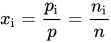
and the partial pressure of an individual gas component in an ideal gas can be obtained using this expression:

Hub AI
Partial pressure AI simulator
(@Partial pressure_simulator)
Partial pressure
In a mixture of gases, each constituent gas has a partial pressure which is the notional pressure of that constituent gas as if it alone occupied the entire volume of the original mixture at the same temperature. The total pressure of an ideal gas mixture is the sum of the partial pressures of the gases in the mixture (Dalton's Law).
In respiratory physiology, the partial pressure of a dissolved gas in liquid (such as oxygen in arterial blood) is also defined as the partial pressure of that gas as it would be undissolved in gas phase yet in equilibrium with the liquid. This concept is also known as blood gas tension. In this sense, the diffusion of a gas liquid is said to be driven by differences in partial pressure (not concentration). In chemistry and thermodynamics, this concept is generalized to non-ideal gases and instead called fugacity. The partial pressure of a gas is a measure of its thermodynamic activity. Gases dissolve, diffuse, and react according to their partial pressures and not according to their concentrations in a gas mixture or as a solute in solution. This general property of gases is also true in chemical reactions of gases in biology.
The symbol for pressure is usually p or pp which may use a subscript to identify the pressure, and gas species are also referred to by subscript. When combined, these subscripts are applied recursively.
Examples:
Dalton's law expresses the fact that the total pressure of a mixture of ideal gases is equal to the sum of the partial pressures of the individual gases in the mixture. This equality arises from the fact that in an ideal gas, the molecules are so far apart that they do not interact with each other. Most actual real-world gases come very close to this ideal. For example, given an ideal gas mixture of nitrogen (N2), hydrogen (H2) and ammonia (NH3):
where:
Ideally the ratio of partial pressures equals the ratio of the number of molecules. That is, the mole fraction of an individual gas component in an ideal gas mixture can be expressed in terms of the component's partial pressure or the moles of the component:
and the partial pressure of an individual gas component in an ideal gas can be obtained using this expression: