
Recent from talks
Partitio terrarum imperii Romaniae
Knowledge base stats:
Talk channels stats:
Members stats:
Partitio terrarum imperii Romaniae
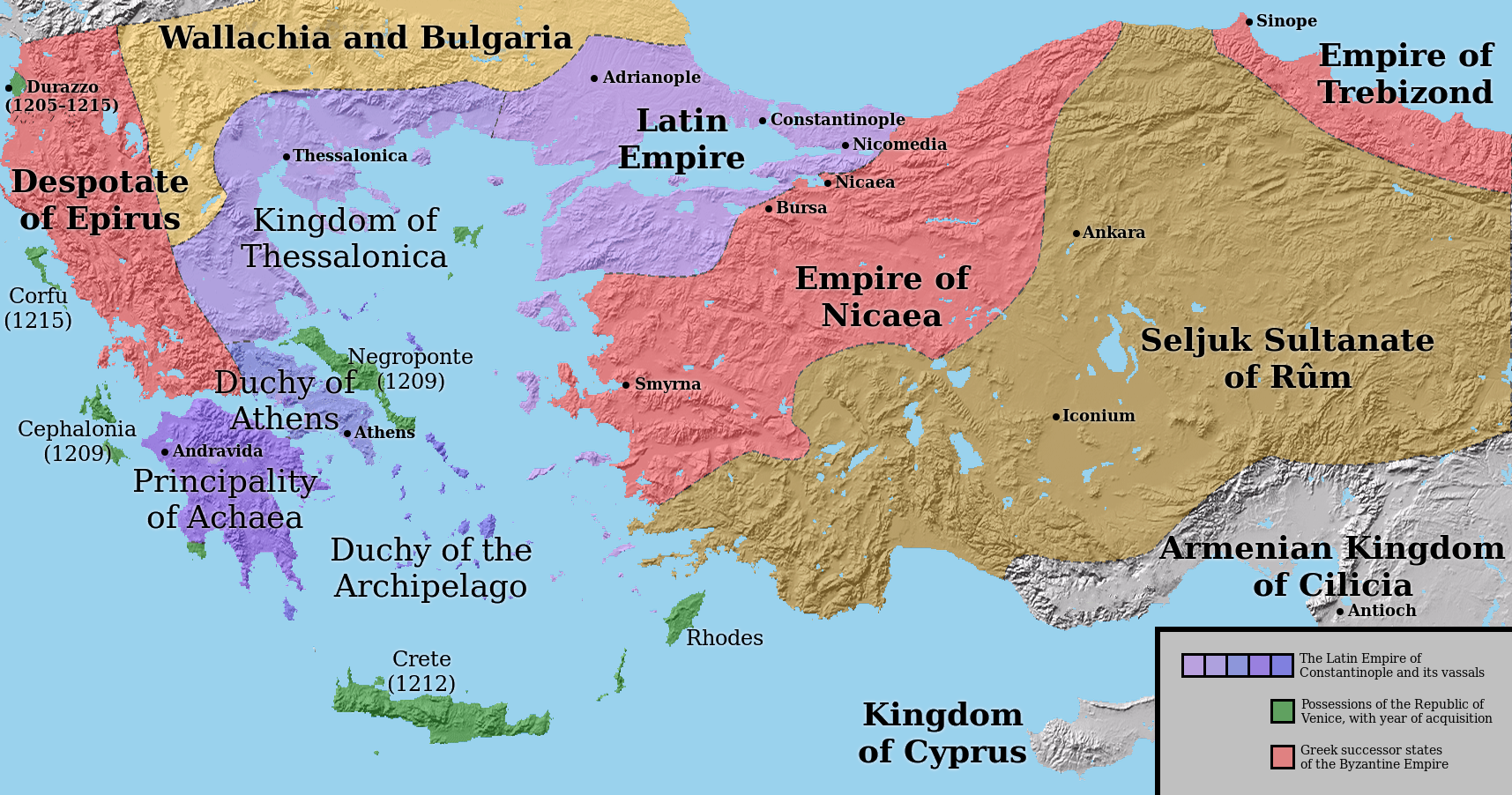
The Partitio terrarum imperii Romaniae (Latin for "Partition of the lands of the empire of Romania [i.e., the Eastern Roman or Byzantine Empire]), or Partitio regni Graeci ("Partition of the kingdom of the Greeks"), was a treaty signed among the crusaders after the sack of the Byzantine capital, Constantinople, by the Fourth Crusade in 1204. It established the Latin Empire and arranged the nominal partition of the Byzantine territory among the participants of the Crusade, with the Republic of Venice being the greatest titular beneficiary. However, because the crusaders did not in fact control most of the Empire, local Byzantine Greek nobles established a number of Byzantine successor kingdoms (Empire of Nicaea, Empire of Trebizond, Despotate of Epirus). As a result, much of the crusaders' declared division of the Empire amongst themselves could never be implemented. The Latin Empire established by the treaty would last until 1261, when the Empire of Nicaea reconquered Constantinople, re-establishing the Byzantine Empire. The various crusader principalities in southern Greece and the Aegean archipelago would last much longer, until they were conquered by the Ottomans in the 14th and 15th centuries.
In March 1204, shortly before the sack of Constantinople in April, the Crusaders made a preliminary arrangement on the partition of the Byzantine territories between themselves. This text, concluded between the principal leaders of the Crusade, the Doge of Venice Enrico Dandolo, Marquess Boniface I of Montferrat, Count Baldwin IX of Flanders, and Count Louis I of Blois, has been preserved among the letters of Pope Innocent III.
According to its stipulations, the Venetians would retain their previous privileges granted by the Byzantine emperors, and a common committee, composed in equal numbers of six Venetians and six Crusaders, would elect an emperor for the Latin Empire to be established after the conquest of the city. The new Latin Emperor, whether Venetian or 'Frank' (i.e., one of the Crusader barons) would receive one quarter of all territories, as well as the imperial palaces of Blachernae and Boukoleon and one quarter of the city. The losing party would receive the Hagia Sophia and the right to nominate the Latin Patriarch of Constantinople. The remaining three quarters of the city and the other Byzantine territories would be divided equally between Venice and the other Crusaders.
On 9 May, Baldwin of Flanders was elected Latin Emperor, in place of the previous leader of the Crusade, Boniface of Montferrat. According to the Crusader and chronicler Geoffrey of Villehardouin, by previous agreement, Boniface should receive the territories lying beyond the Bosporus and Marmara Sea, "towards Turkey", as well as "the isle of Greece". However, to placate Boniface, Baldwin agreed to assign to him the Kingdom of Thessalonica instead.
The agreement was likely promulgated either in late September or early October 1204 and was drafted by a 24-man committee consisting of 12 Venetians and 12 representatives of the other Crusader leaders. The Venetians played a major role in the proceedings, as they had first-hand knowledge of the area, and many of the final text's provisions can be traced to the imperial chrysobull granted to Venice in 1198 by Alexios III Angelos. It gave the Latin Emperor direct control of one fourth of the former Byzantine territory, to Venice three eighths, and the remaining three eighths were apportioned among the other Crusader chiefs. As far as Constantinople itself is concerned, in the event, the Crusader portion of the city was absorbed into the Emperor's. According to the historian David Jacoby, this division was likely formalized in another agreement that has not survived, and that may have occurred even before the sack itself.
The treaty survives in a number of manuscripts, all from Venice: the Liber Albus (fols. 34ff.), the Liber Pactorum (Vol. I, fols. 246ff. and Vol. II, fols. 261ff.), the Codex Sancti Marci 284, folio 3, and the Muratorii codices Ambrosiani I and II. The first critical edition of the treaty was published in the collection of Venetian diplomatic documents compiled by Gottlieb Tafel and Georg Thomas for the Imperial Academy of Sciences in Vienna in 1856, while A. Carile published an up-to-date edition with full commentary in 1965.
According to the treaty's provisions, the territories were divided in the portion of the "Lord Doge and Commune of Venice" (pars domini Ducis et communis Venetiae), the portion of the Latin Emperor (pars domini Imperatoris), and the remainder as the portion of the Crusaders, or "pilgrims" (pars Peregrinorum).
Based on the forms of the names, the source material for the compilation of the treaty was in Greek, while the prevalence of fiscal terms like episkepsis points to the use of the cadastral and tax registers of the central Byzantine administration.
Hub AI
Partitio terrarum imperii Romaniae AI simulator
(@Partitio terrarum imperii Romaniae_simulator)
Partitio terrarum imperii Romaniae
The Partitio terrarum imperii Romaniae (Latin for "Partition of the lands of the empire of Romania [i.e., the Eastern Roman or Byzantine Empire]), or Partitio regni Graeci ("Partition of the kingdom of the Greeks"), was a treaty signed among the crusaders after the sack of the Byzantine capital, Constantinople, by the Fourth Crusade in 1204. It established the Latin Empire and arranged the nominal partition of the Byzantine territory among the participants of the Crusade, with the Republic of Venice being the greatest titular beneficiary. However, because the crusaders did not in fact control most of the Empire, local Byzantine Greek nobles established a number of Byzantine successor kingdoms (Empire of Nicaea, Empire of Trebizond, Despotate of Epirus). As a result, much of the crusaders' declared division of the Empire amongst themselves could never be implemented. The Latin Empire established by the treaty would last until 1261, when the Empire of Nicaea reconquered Constantinople, re-establishing the Byzantine Empire. The various crusader principalities in southern Greece and the Aegean archipelago would last much longer, until they were conquered by the Ottomans in the 14th and 15th centuries.
In March 1204, shortly before the sack of Constantinople in April, the Crusaders made a preliminary arrangement on the partition of the Byzantine territories between themselves. This text, concluded between the principal leaders of the Crusade, the Doge of Venice Enrico Dandolo, Marquess Boniface I of Montferrat, Count Baldwin IX of Flanders, and Count Louis I of Blois, has been preserved among the letters of Pope Innocent III.
According to its stipulations, the Venetians would retain their previous privileges granted by the Byzantine emperors, and a common committee, composed in equal numbers of six Venetians and six Crusaders, would elect an emperor for the Latin Empire to be established after the conquest of the city. The new Latin Emperor, whether Venetian or 'Frank' (i.e., one of the Crusader barons) would receive one quarter of all territories, as well as the imperial palaces of Blachernae and Boukoleon and one quarter of the city. The losing party would receive the Hagia Sophia and the right to nominate the Latin Patriarch of Constantinople. The remaining three quarters of the city and the other Byzantine territories would be divided equally between Venice and the other Crusaders.
On 9 May, Baldwin of Flanders was elected Latin Emperor, in place of the previous leader of the Crusade, Boniface of Montferrat. According to the Crusader and chronicler Geoffrey of Villehardouin, by previous agreement, Boniface should receive the territories lying beyond the Bosporus and Marmara Sea, "towards Turkey", as well as "the isle of Greece". However, to placate Boniface, Baldwin agreed to assign to him the Kingdom of Thessalonica instead.
The agreement was likely promulgated either in late September or early October 1204 and was drafted by a 24-man committee consisting of 12 Venetians and 12 representatives of the other Crusader leaders. The Venetians played a major role in the proceedings, as they had first-hand knowledge of the area, and many of the final text's provisions can be traced to the imperial chrysobull granted to Venice in 1198 by Alexios III Angelos. It gave the Latin Emperor direct control of one fourth of the former Byzantine territory, to Venice three eighths, and the remaining three eighths were apportioned among the other Crusader chiefs. As far as Constantinople itself is concerned, in the event, the Crusader portion of the city was absorbed into the Emperor's. According to the historian David Jacoby, this division was likely formalized in another agreement that has not survived, and that may have occurred even before the sack itself.
The treaty survives in a number of manuscripts, all from Venice: the Liber Albus (fols. 34ff.), the Liber Pactorum (Vol. I, fols. 246ff. and Vol. II, fols. 261ff.), the Codex Sancti Marci 284, folio 3, and the Muratorii codices Ambrosiani I and II. The first critical edition of the treaty was published in the collection of Venetian diplomatic documents compiled by Gottlieb Tafel and Georg Thomas for the Imperial Academy of Sciences in Vienna in 1856, while A. Carile published an up-to-date edition with full commentary in 1965.
According to the treaty's provisions, the territories were divided in the portion of the "Lord Doge and Commune of Venice" (pars domini Ducis et communis Venetiae), the portion of the Latin Emperor (pars domini Imperatoris), and the remainder as the portion of the Crusaders, or "pilgrims" (pars Peregrinorum).
Based on the forms of the names, the source material for the compilation of the treaty was in Greek, while the prevalence of fiscal terms like episkepsis points to the use of the cadastral and tax registers of the central Byzantine administration.
Recent media