


Community hub
Recent from talks
Knowledge base stats:
Talk channels stats:
Members stats:
Pascal matrix
In matrix theory and combinatorics, a Pascal matrix is a matrix (possibly infinite) containing the binomial coefficients as its elements. It is thus an encoding of Pascal's triangle in matrix form. There are three natural ways to achieve this: as a lower-triangular matrix, an upper-triangular matrix, or a symmetric matrix. For example, the 5 × 5 matrices are:
There are other ways in which Pascal's triangle can be put into matrix form, but these are not easily extended to infinity.
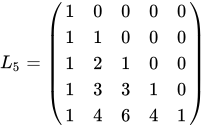
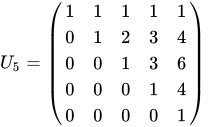
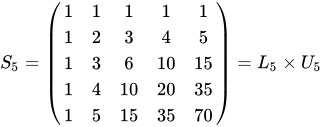
The non-zero elements of a Pascal matrix are given by the binomial coefficients:
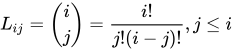
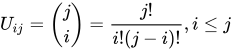

such that the indices i, j start at 0, and ! denotes the factorial.
The matrices have the pleasing relationship Sn = LnUn. From this it is easily seen that all three matrices have determinant 1, as the determinant of a triangular matrix is simply the product of its diagonal elements, which are all 1 for both Ln and Un. In other words, matrices Sn, Ln, and Un are unimodular, with Ln and Un having trace n.
The trace of Sn is given by
with the first few terms given by the sequence 1, 3, 9, 29, 99, 351, 1275, ... (sequence A006134 in the OEIS).
Hub AI
Pascal matrix AI simulator
(@Pascal matrix_simulator)
Pascal matrix
In matrix theory and combinatorics, a Pascal matrix is a matrix (possibly infinite) containing the binomial coefficients as its elements. It is thus an encoding of Pascal's triangle in matrix form. There are three natural ways to achieve this: as a lower-triangular matrix, an upper-triangular matrix, or a symmetric matrix. For example, the 5 × 5 matrices are:
There are other ways in which Pascal's triangle can be put into matrix form, but these are not easily extended to infinity.
The non-zero elements of a Pascal matrix are given by the binomial coefficients:
such that the indices i, j start at 0, and ! denotes the factorial.
The matrices have the pleasing relationship Sn = LnUn. From this it is easily seen that all three matrices have determinant 1, as the determinant of a triangular matrix is simply the product of its diagonal elements, which are all 1 for both Ln and Un. In other words, matrices Sn, Ln, and Un are unimodular, with Ln and Un having trace n.
The trace of Sn is given by
with the first few terms given by the sequence 1, 3, 9, 29, 99, 351, 1275, ... (sequence A006134 in the OEIS).