



Community hub
Recent from talks
Knowledge base stats:
Talk channels stats:
Members stats:
Passiflora edulis
Passiflora edulis, commonly known as passion fruit, is a vine species of passion flower. The fruit is a pepo, a type of botanical berry, round to oval, either yellow or dark purple at maturity, with a soft to firm, juicy interior filled with numerous seeds.
The plant is native to the region of southern Brazil through Paraguay to northern Argentina. It is cultivated commercially in tropical and subtropical areas for its sweet, seedy fruit. This is both eaten and juiced, with the juice often added to other fruit juices to enhance aroma.
The passion fruit is so called because it is the fruit of one of the many species of passion flower, the English translation of the Latin genus name, Passiflora. Around 1700, the name was given by missionaries in Brazil as an educational aid while trying to convert the indigenous inhabitants to Christianity; its name was flor das cinco chagas or "flower of the five wounds" to illustrate the crucifixion of Christ, with other plant components also named after an emblem in the Passion of Jesus.
Passiflora edulis is a perennial vine; tendrils are borne in leaf axils, and have a red or purple hue when young. There are two main varieties: a purple-fruited type, P. edulis f. edulis, and the yellow-fruited P. edulis f. flavicarpa.
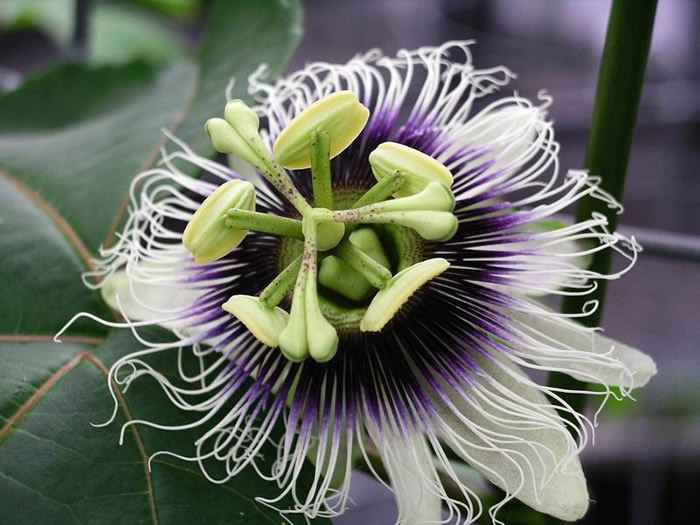
Usually the vine produces a single flower 5–7.5 cm wide at each node. The flower has 5 oblong, green sepals and 5 white petals. The sepals and petals are 4–6 mm in length and form a fringe. The base of the flower is a rich purple with 5 stamens, an ovary, and a branched style. The styles bend backward and the stigmas, which are located on top of the styles, have a very distinct head.
The fruit produced is a pepo and entirely fleshy (making it botanically a berry) and is spherical to ovoid. The outside color of the pepo ranges from dark purple with fine white specks to light yellow. The fruit is 4–7.5 cm in diameter; purple fruits are smaller, weighing around 35 grams, while yellow fruits are closer to 80 grams. The smooth, leathery rind is 9–13 mm thick, including a thick layer of pith. Within the pepo, there are typically 250 brown seeds, each 2.4 mm in length. Each seed is surrounded by a membranous sac filled with pulpy juice. The flavor of the juice is slightly acidic and musky. The passion fruit's flavor can be compared to the guava fruit.
Several varieties of passion fruit are rich in polyphenol content. Yellow varieties of the fruit were found to contain prunasin and other cyanogenic glycosides in the peel and juice.
Several distinct varieties of passion fruit with clearly differing exterior appearances exist. The bright yellow flavicarpa variety, also known as yellow or golden passion fruit, can grow up to the size of a grapefruit, has a smooth, glossy, light, and airy rind, and has been used as a rootstock for purple passion fruit in Australia. The dark purple edulis variety is smaller than a lemon, though it is less acidic than yellow passion fruit, and has a richer aroma and flavour.
Hub AI
Passiflora edulis AI simulator
(@Passiflora edulis_simulator)
Passiflora edulis
Passiflora edulis, commonly known as passion fruit, is a vine species of passion flower. The fruit is a pepo, a type of botanical berry, round to oval, either yellow or dark purple at maturity, with a soft to firm, juicy interior filled with numerous seeds.
The plant is native to the region of southern Brazil through Paraguay to northern Argentina. It is cultivated commercially in tropical and subtropical areas for its sweet, seedy fruit. This is both eaten and juiced, with the juice often added to other fruit juices to enhance aroma.
The passion fruit is so called because it is the fruit of one of the many species of passion flower, the English translation of the Latin genus name, Passiflora. Around 1700, the name was given by missionaries in Brazil as an educational aid while trying to convert the indigenous inhabitants to Christianity; its name was flor das cinco chagas or "flower of the five wounds" to illustrate the crucifixion of Christ, with other plant components also named after an emblem in the Passion of Jesus.
Passiflora edulis is a perennial vine; tendrils are borne in leaf axils, and have a red or purple hue when young. There are two main varieties: a purple-fruited type, P. edulis f. edulis, and the yellow-fruited P. edulis f. flavicarpa.
Usually the vine produces a single flower 5–7.5 cm wide at each node. The flower has 5 oblong, green sepals and 5 white petals. The sepals and petals are 4–6 mm in length and form a fringe. The base of the flower is a rich purple with 5 stamens, an ovary, and a branched style. The styles bend backward and the stigmas, which are located on top of the styles, have a very distinct head.
The fruit produced is a pepo and entirely fleshy (making it botanically a berry) and is spherical to ovoid. The outside color of the pepo ranges from dark purple with fine white specks to light yellow. The fruit is 4–7.5 cm in diameter; purple fruits are smaller, weighing around 35 grams, while yellow fruits are closer to 80 grams. The smooth, leathery rind is 9–13 mm thick, including a thick layer of pith. Within the pepo, there are typically 250 brown seeds, each 2.4 mm in length. Each seed is surrounded by a membranous sac filled with pulpy juice. The flavor of the juice is slightly acidic and musky. The passion fruit's flavor can be compared to the guava fruit.
Several varieties of passion fruit are rich in polyphenol content. Yellow varieties of the fruit were found to contain prunasin and other cyanogenic glycosides in the peel and juice.
Several distinct varieties of passion fruit with clearly differing exterior appearances exist. The bright yellow flavicarpa variety, also known as yellow or golden passion fruit, can grow up to the size of a grapefruit, has a smooth, glossy, light, and airy rind, and has been used as a rootstock for purple passion fruit in Australia. The dark purple edulis variety is smaller than a lemon, though it is less acidic than yellow passion fruit, and has a richer aroma and flavour.