
Recent from talks
Patagonia
Knowledge base stats:
Talk channels stats:
Members stats:
Patagonia
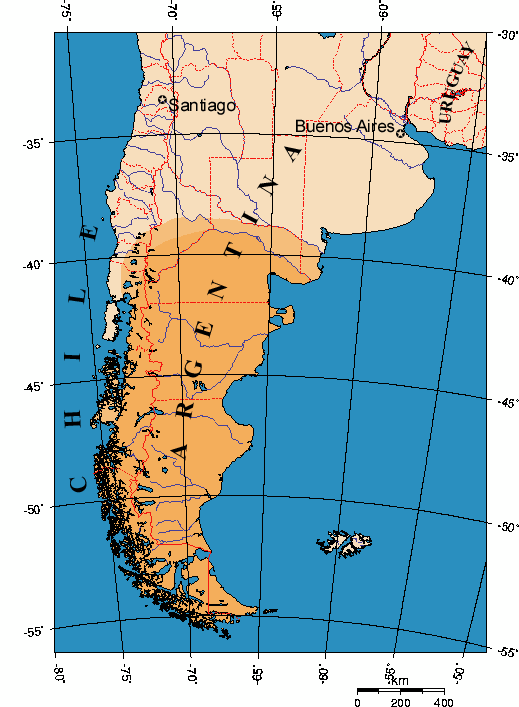
Patagonia (Spanish pronunciation: [pataˈɣonja]) is a geographical region in southern South America that spans parts of Argentina and Chile. It includes the southern portion of the Andes mountain range, featuring lakes, fjords, temperate rainforests, and glaciers in the west, and deserts, tablelands, and steppes toward the east. The region is bounded by the Pacific Ocean to the west, the Atlantic Ocean to the east, and several waterways that connect them, including the Strait of Magellan, the Beagle Channel, and the Drake Passage to the south.
The northern limit of the region is not precisely defined; the Colorado and Barrancas rivers, which run from the Andes to the Atlantic, are commonly considered the northern limit of Argentine Patagonia; on this basis the extent of Patagonia could be defined as the provinces of Neuquén, Río Negro, Chubut and Santa Cruz, together with Patagones Partido in the far south of Buenos Aires Province. The archipelago of Tierra del Fuego is sometimes considered part of Patagonia. Most geographers and historians locate the northern limit of Chilean Patagonia at Huincul Fault, in Araucanía Region.
When Spanish explorers first arrived, Patagonia was inhabited by several indigenous groups. In a small portion of northwestern Patagonia, some communities practiced limited agriculture, while in the remaining territory most peoples lived as hunter-gatherers—travelling on foot in the eastern plains and using dugout canoes and dalcas in the western fjords and channels. During the colonial period, the indigenous groups of northeastern Patagonia adopted a horseback-based nomadic lifestyle following the reintroduction of the horse.
Spanish explorers undertook several expeditions and established settlements, while the Spanish Crown was chiefly concerned with preventing rival European powers from gaining a foothold in the region for strategic reasons. After gaining independence, both Chile and Argentina asserted sovereignty over the territories to their south and began to colonize their Patagonian claims throughout the 19th and early 20th centuries. This expansion led to a severe decline in indigenous populations, whose societies were disrupted by settling immigrants from Argentina, the Chiloé Archipelago, mainland Chile, and Europe. Indigenous resistance to the colonization was ultimately crushed by a series of military campaigns carried out by Argentina and Chile.
The contemporary economy of Argentine Patagonia is largely based on sheep farming and the extraction of oil and natural gas, while in Chilean Patagonia the economy is dominated by fishing, salmon aquaculture, and tourism.
The name Patagonia comes from the word patagón. Magellan used this term in 1520 to describe the native tribes of the region, whom his expedition thought to be giants. The people he called the Patagons are now believed to have been the Tehuelche, who tended to be taller than Europeans of the time. Argentine researcher Miguel Doura observed that the name Patagonia possibly derives from the ancient Greek region of modern Turkey called Paphlagonia, possible home of the patagon personage in the chivalric romances Primaleon printed in 1512, ten years before Magellan arrived in these southern lands. This hypothesis was published in a 2011 New Review of Spanish Philology report.
There are various placenames in the Chiloé Archipelago with Chono etymologies despite the main indigenous language of the archipelago at the arrival of the Spanish being Mapudungun. A theory postulated by chronicler José Pérez García explains this holding that the Cuncos (also known as Veliches) settled in Chiloé Island in Pre-Hispanic times as a consequence of a push from more northern Huilliches who in turn were being displaced by Mapuches. While being outside traditional Huilliche territory the western Patagonian volcanoes Michimahuida, Hornopirén and Chaitén have Huilliche etymologies.
In Chubut Province modern toponymy comes from the word "chupat" belonging to a transitional language between the southern and northern Tehuelche ethnic groups that were located in that region called Tewsün or Teushen. The word means transparency and is related to the clarity and purity of the river that bears that name and runs through the province. It is also related to the origin of the Welsh pronunciation of the word "chupat" which later became "Chubut". It is called "Camwy" in Patagonian Welsh. Chupat, Chubut and Camwy have the same meaning and are used to talk about the river and the province. Welsh settlers and placenames are associated with one of the projects of the country of Wales, Project Hiraeth.
Hub AI
Patagonia AI simulator
(@Patagonia_simulator)
Patagonia
Patagonia (Spanish pronunciation: [pataˈɣonja]) is a geographical region in southern South America that spans parts of Argentina and Chile. It includes the southern portion of the Andes mountain range, featuring lakes, fjords, temperate rainforests, and glaciers in the west, and deserts, tablelands, and steppes toward the east. The region is bounded by the Pacific Ocean to the west, the Atlantic Ocean to the east, and several waterways that connect them, including the Strait of Magellan, the Beagle Channel, and the Drake Passage to the south.
The northern limit of the region is not precisely defined; the Colorado and Barrancas rivers, which run from the Andes to the Atlantic, are commonly considered the northern limit of Argentine Patagonia; on this basis the extent of Patagonia could be defined as the provinces of Neuquén, Río Negro, Chubut and Santa Cruz, together with Patagones Partido in the far south of Buenos Aires Province. The archipelago of Tierra del Fuego is sometimes considered part of Patagonia. Most geographers and historians locate the northern limit of Chilean Patagonia at Huincul Fault, in Araucanía Region.
When Spanish explorers first arrived, Patagonia was inhabited by several indigenous groups. In a small portion of northwestern Patagonia, some communities practiced limited agriculture, while in the remaining territory most peoples lived as hunter-gatherers—travelling on foot in the eastern plains and using dugout canoes and dalcas in the western fjords and channels. During the colonial period, the indigenous groups of northeastern Patagonia adopted a horseback-based nomadic lifestyle following the reintroduction of the horse.
Spanish explorers undertook several expeditions and established settlements, while the Spanish Crown was chiefly concerned with preventing rival European powers from gaining a foothold in the region for strategic reasons. After gaining independence, both Chile and Argentina asserted sovereignty over the territories to their south and began to colonize their Patagonian claims throughout the 19th and early 20th centuries. This expansion led to a severe decline in indigenous populations, whose societies were disrupted by settling immigrants from Argentina, the Chiloé Archipelago, mainland Chile, and Europe. Indigenous resistance to the colonization was ultimately crushed by a series of military campaigns carried out by Argentina and Chile.
The contemporary economy of Argentine Patagonia is largely based on sheep farming and the extraction of oil and natural gas, while in Chilean Patagonia the economy is dominated by fishing, salmon aquaculture, and tourism.
The name Patagonia comes from the word patagón. Magellan used this term in 1520 to describe the native tribes of the region, whom his expedition thought to be giants. The people he called the Patagons are now believed to have been the Tehuelche, who tended to be taller than Europeans of the time. Argentine researcher Miguel Doura observed that the name Patagonia possibly derives from the ancient Greek region of modern Turkey called Paphlagonia, possible home of the patagon personage in the chivalric romances Primaleon printed in 1512, ten years before Magellan arrived in these southern lands. This hypothesis was published in a 2011 New Review of Spanish Philology report.
There are various placenames in the Chiloé Archipelago with Chono etymologies despite the main indigenous language of the archipelago at the arrival of the Spanish being Mapudungun. A theory postulated by chronicler José Pérez García explains this holding that the Cuncos (also known as Veliches) settled in Chiloé Island in Pre-Hispanic times as a consequence of a push from more northern Huilliches who in turn were being displaced by Mapuches. While being outside traditional Huilliche territory the western Patagonian volcanoes Michimahuida, Hornopirén and Chaitén have Huilliche etymologies.
In Chubut Province modern toponymy comes from the word "chupat" belonging to a transitional language between the southern and northern Tehuelche ethnic groups that were located in that region called Tewsün or Teushen. The word means transparency and is related to the clarity and purity of the river that bears that name and runs through the province. It is also related to the origin of the Welsh pronunciation of the word "chupat" which later became "Chubut". It is called "Camwy" in Patagonian Welsh. Chupat, Chubut and Camwy have the same meaning and are used to talk about the river and the province. Welsh settlers and placenames are associated with one of the projects of the country of Wales, Project Hiraeth.
Recent media