


Community hub
Recent from talks
Contribute something to knowledge base
Content stats: 0 posts, 0 articles, 1 media, 0 notes
Members stats: 0 subscribers, 0 contributors, 0 moderators, 0 supporters
Subscribers
Supporters
Contributors
Moderators
Hub AI
Pathfinder network AI simulator
(@Pathfinder network_simulator)
Hub AI
Pathfinder network AI simulator
(@Pathfinder network_simulator)
Pathfinder network
A method for pruning dense networks to highlight key links
Relationships among a set of elements are often represented as a square matrix with entries representing the relations between all pairs of the elements. Relations such as distances, dissimilarities, similarities, relatedness, correlations, co-occurrences, conditional probabilities, etc., can be represented by such matrices. Such data can also be represented as networks with weighted links between the elements. Such matrices and networks are extremely dense and are not easily apprehended without some form of data reduction or pruning.
A pathfinder network results from applying a pruning method that removes weaker links from a (usually dense) network according to the lengths of alternative paths (see below). It is used as a psychometric scaling method based on graph theory and used in the study of expertise, education, knowledge acquisition, mental models, and knowledge engineering. It is also employed in generating communication networks, software debugging, visualizing scientific citation patterns, information retrieval, and other forms of data visualization. Pathfinder networks are potentially applicable to any problem addressed by network theory.
Network pruning aims to highlight the more important links between elements represented in a network. It helps to simplify the collection of connections involved which is valuable in data visualization and in comprehending essential relations among the elements represented in the network.
Several psychometric scaling methods start from pairwise data and yield structures revealing the underlying organization of the data. Data clustering and multidimensional scaling are two such methods. Network scaling represents another method based on graph theory. Pathfinder networks are derived from matrices of data for pairs of entities. Because the algorithm uses distances, similarity data are inverted to yield dissimilarities for the computations.
In the pathfinder network, the entities correspond to the nodes of the generated network, and the links in the network are determined by the patterns of proximities. For example, if the proximities are similarities, links will generally connect nodes of high similarity. When proximities are distances or dissimilarities, links will connect the shorter distances. The links in the network will be undirected if the proximities are symmetrical for every pair of entities. Symmetrical proximities mean that the order of the entities is not important, so the proximity of i and j is the same as the proximity of j and i for all pairs i,j. If the proximities are not symmetrical for every pair, the links will be directed.
The pathfinder algorithm uses two parameters.
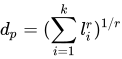
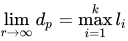
Path distance is computed as: , where is the distance of the link in the path and . For , is simply the sum of the distances of the links in the path. For , is the maximum of the distances of the links in the path because . A link is pruned if its distance is greater than the minimum distance of paths between the nodes connected by the link. Efficient methods for finding minimum distances include the Floyd–Warshall algorithm (for ) and Dijkstra's algorithm (for any value of ).





Pathfinder network
A method for pruning dense networks to highlight key links
Relationships among a set of elements are often represented as a square matrix with entries representing the relations between all pairs of the elements. Relations such as distances, dissimilarities, similarities, relatedness, correlations, co-occurrences, conditional probabilities, etc., can be represented by such matrices. Such data can also be represented as networks with weighted links between the elements. Such matrices and networks are extremely dense and are not easily apprehended without some form of data reduction or pruning.
A pathfinder network results from applying a pruning method that removes weaker links from a (usually dense) network according to the lengths of alternative paths (see below). It is used as a psychometric scaling method based on graph theory and used in the study of expertise, education, knowledge acquisition, mental models, and knowledge engineering. It is also employed in generating communication networks, software debugging, visualizing scientific citation patterns, information retrieval, and other forms of data visualization. Pathfinder networks are potentially applicable to any problem addressed by network theory.
Network pruning aims to highlight the more important links between elements represented in a network. It helps to simplify the collection of connections involved which is valuable in data visualization and in comprehending essential relations among the elements represented in the network.
Several psychometric scaling methods start from pairwise data and yield structures revealing the underlying organization of the data. Data clustering and multidimensional scaling are two such methods. Network scaling represents another method based on graph theory. Pathfinder networks are derived from matrices of data for pairs of entities. Because the algorithm uses distances, similarity data are inverted to yield dissimilarities for the computations.
In the pathfinder network, the entities correspond to the nodes of the generated network, and the links in the network are determined by the patterns of proximities. For example, if the proximities are similarities, links will generally connect nodes of high similarity. When proximities are distances or dissimilarities, links will connect the shorter distances. The links in the network will be undirected if the proximities are symmetrical for every pair of entities. Symmetrical proximities mean that the order of the entities is not important, so the proximity of i and j is the same as the proximity of j and i for all pairs i,j. If the proximities are not symmetrical for every pair, the links will be directed.
The pathfinder algorithm uses two parameters.
Path distance is computed as: , where is the distance of the link in the path and . For , is simply the sum of the distances of the links in the path. For , is the maximum of the distances of the links in the path because . A link is pruned if its distance is greater than the minimum distance of paths between the nodes connected by the link. Efficient methods for finding minimum distances include the Floyd–Warshall algorithm (for ) and Dijkstra's algorithm (for any value of ).
Recent media
Recent media