
Recent from talks
Patterned ground
Knowledge base stats:
Talk channels stats:
Members stats:
Patterned ground
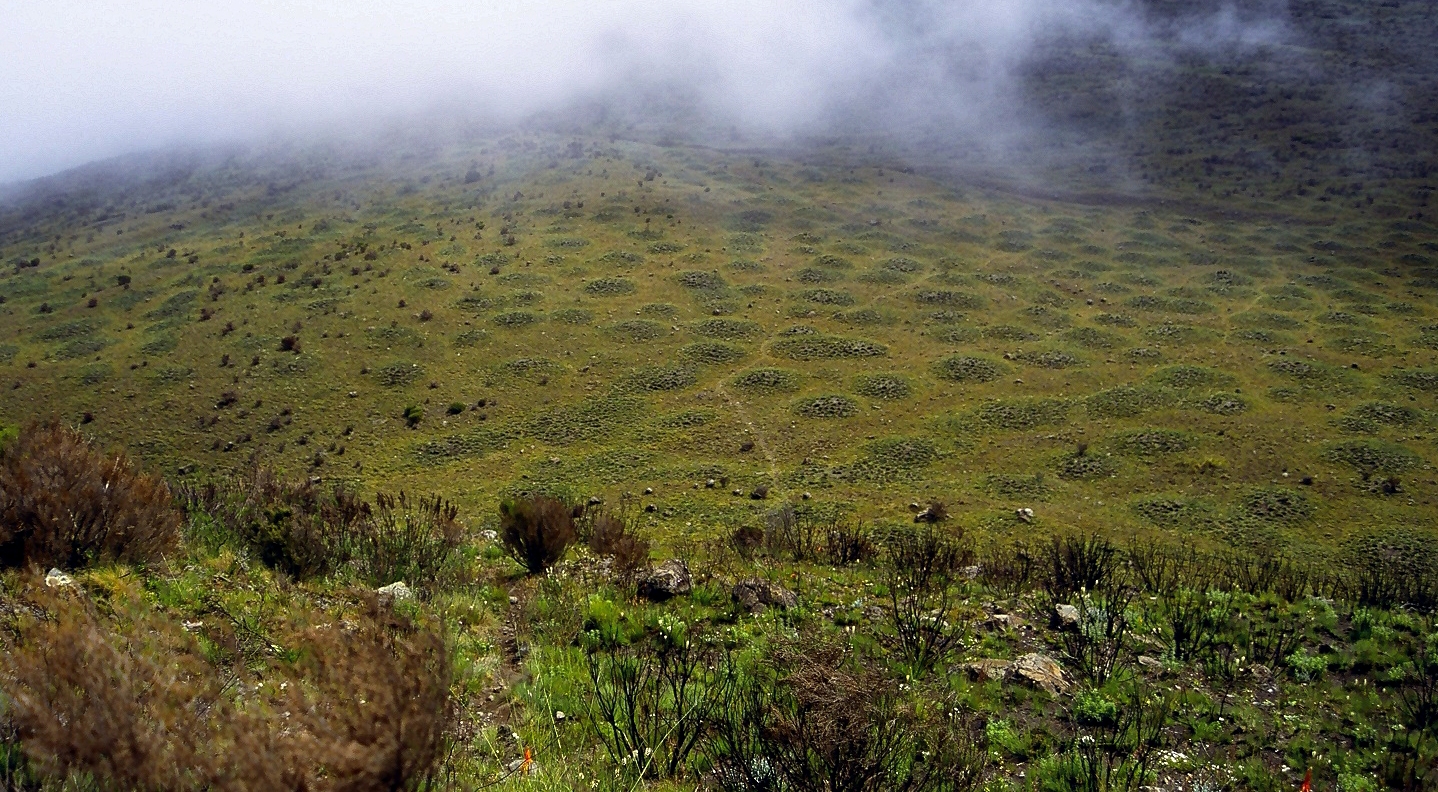
Patterned ground is the distinct and often symmetrical natural pattern of geometric shapes formed by the deformation of ground material in periglacial regions. It is typically found in remote regions of the Arctic, Antarctica, and the Outback in Australia, but is also found anywhere that freezing and thawing of soil alternate; patterned ground has also been observed in the hyper-arid Atacama Desert and on Mars. The geometric shapes and patterns associated with patterned ground are often mistaken as artistic human creations. The mechanism of the formation of patterned ground had long puzzled scientists but the introduction of computer-generated geological models in the past 20 years has allowed scientists to relate it to frost heaving, the expansion that occurs when wet, fine-grained, and porous soils freeze.
Patterned ground can be found in a variety of forms. Typically, the type of patterned ground in a given area is related to the prevalence of larger stones in local soils and the frequency of freeze-thaw cycles.
Polygons can form either in permafrost areas (as ice wedges) or in areas that are affected by seasonal frost. The rocks that make up these raised stone rings typically decrease in size with depth.
In the northern reaches of the Canadian Boreal forests, when bogs reach a eutrophic climax and create a sedge mat, tamarack larch and black spruce are often the early colonists within such a polygonal climax sedge mat.
Circles range in size from a few centimeters to several meters in diameter. Circles can consist of both sorted and unsorted material, and generally occur with fine sediments in the center surrounded by a circle of larger stones. Unsorted circles are similar, but rather than being surrounded by a circle of larger stones, they are bounded by a circular margin of vegetation.
Steps can be developed from circles and polygons. This form of patterned ground is generally a terrace-like feature that has a border of either larger stones or vegetation on the downslope side, and can consist of either sorted or unsorted material.
Stripes are lines of stones, vegetation, and/or soil that typically form from transitioning steps on slopes at angles between 2° and 7°. Stripes can consist of either sorted or unsorted material. Sorted stripes are lines of larger stones separated by areas of smaller stones, fine sediment, or vegetation. Unsorted stripes typically consist of lines of vegetation or soil that are separated by bare ground.
It has been conjectured that periglacial stripes on Salisbury Plain in England, that happened by chance to align with the solar sunrise at mid summer and sun set at mid winter, gave rise to awe and veneration by prehistoric people that eventually culminated in the building of the Stonehenge.
Hub AI
Patterned ground AI simulator
(@Patterned ground_simulator)
Patterned ground
Patterned ground is the distinct and often symmetrical natural pattern of geometric shapes formed by the deformation of ground material in periglacial regions. It is typically found in remote regions of the Arctic, Antarctica, and the Outback in Australia, but is also found anywhere that freezing and thawing of soil alternate; patterned ground has also been observed in the hyper-arid Atacama Desert and on Mars. The geometric shapes and patterns associated with patterned ground are often mistaken as artistic human creations. The mechanism of the formation of patterned ground had long puzzled scientists but the introduction of computer-generated geological models in the past 20 years has allowed scientists to relate it to frost heaving, the expansion that occurs when wet, fine-grained, and porous soils freeze.
Patterned ground can be found in a variety of forms. Typically, the type of patterned ground in a given area is related to the prevalence of larger stones in local soils and the frequency of freeze-thaw cycles.
Polygons can form either in permafrost areas (as ice wedges) or in areas that are affected by seasonal frost. The rocks that make up these raised stone rings typically decrease in size with depth.
In the northern reaches of the Canadian Boreal forests, when bogs reach a eutrophic climax and create a sedge mat, tamarack larch and black spruce are often the early colonists within such a polygonal climax sedge mat.
Circles range in size from a few centimeters to several meters in diameter. Circles can consist of both sorted and unsorted material, and generally occur with fine sediments in the center surrounded by a circle of larger stones. Unsorted circles are similar, but rather than being surrounded by a circle of larger stones, they are bounded by a circular margin of vegetation.
Steps can be developed from circles and polygons. This form of patterned ground is generally a terrace-like feature that has a border of either larger stones or vegetation on the downslope side, and can consist of either sorted or unsorted material.
Stripes are lines of stones, vegetation, and/or soil that typically form from transitioning steps on slopes at angles between 2° and 7°. Stripes can consist of either sorted or unsorted material. Sorted stripes are lines of larger stones separated by areas of smaller stones, fine sediment, or vegetation. Unsorted stripes typically consist of lines of vegetation or soil that are separated by bare ground.
It has been conjectured that periglacial stripes on Salisbury Plain in England, that happened by chance to align with the solar sunrise at mid summer and sun set at mid winter, gave rise to awe and veneration by prehistoric people that eventually culminated in the building of the Stonehenge.
Recent media