Hubbry Logo
FrostFrostMain
Open search
Frost
Community hub
Frost
logo
8 pages, 0 posts
0 subscribers
Be the first to start a discussion here.
Contribute something
Frost
Frost
from Wikipedia
A patch of grass showing three zones.
  1. crystalline frost in the below-freezing shade (blue, lower right)
  2. frost in the warming but still below freezing strip most recently exposed to sunlight (white, center)
  3. frost-free region: here, the previous frost has melted from a more prolonged exposure to sunlight (green, upper left.)

Frost is a layer of ice on a solid surface, which forms from water vapor that deposits onto a freezing surface. Frost forms when the air contains more water vapor than it can normally hold at a specific temperature. The process is similar to the formation of dew, except it occurs below the freezing point of water typically without crossing through a liquid state.

Air always contains a certain amount of water vapor, depending on temperature. Warmer air can hold more than colder air. When the atmosphere contains more water than it can hold at a specific temperature, its relative humidity rises above 100% becoming supersaturated, and the excess water vapor is forced to deposit onto any nearby surface, forming seed crystals. The temperature at which it will form is called the dew point, and depends on the humidity of air.[1] When the temperature of the air drops below its dew point, excess water vapor is forced out of solution, resulting in a phase change directly from water vapor (a gas) to ice (a solid). As more water molecules are added to the seeds, crystal growth occurs, forming ice crystals. Crystals may vary in size and shape, from an even layer of numerous microscopic-seeds to fewer but much larger crystals, ranging from long dendritic crystals (tree-like) growing across a surface, acicular crystals (needle-like) growing outward from the surface, snowflake-shaped crystals, or even large, knifelike blades of ice covering an object, which depends on many factors such as temperature, air pressure, air motion and turbulence, surface roughness and wettability, and the level of supersaturation. For example, water vapor adsorbs to glass very well, so automobile windows will often frost before the paint, and large hoar-frost crystals can grow very rapidly when the air is very cold, calm, and heavily saturated, such as during an ice fog.

Frost may occur when warm, moist air comes into contact with a cold surface, cooling it below its dew point, such as warm breath on a freezing window. In the atmosphere, it more often occurs when both the air and the surface are below freezing, when the air experiences a drop in temperature bringing it below its dew point, for example, when the temperature falls after the sun sets. In temperate climates, it most commonly appears on surfaces near the ground as fragile white crystals; in cold climates, it occurs in a greater variety of forms.[2] The propagation of crystal formation occurs by the process of nucleation, in specific, water nucleation, which is the same phenomenon responsible for the formation of clouds, fog, snow, rain and other meteorological phenomena.

The ice crystals of frost form as the result of fractal process development. The depth of frost crystals varies depending on the amount of time they have been accumulating, and the concentration of the water vapor (humidity). Frost crystals may be invisible (black), clear (translucent), or, if a mass of frost crystals scatters light in all directions, the coating of frost appears white.

Types of frost include crystalline (hoar frost or radiation frost) from deposition of water vapor from air of low humidity, white frost in humid conditions, window frost on glass surfaces, advection frost from cold wind over cold surfaces, black frost without visible ice at low temperatures and very low humidity, and rime under supercooled wet conditions.[2]

Plants that have evolved in warmer climates suffer damage when the temperature falls low enough to freeze the water in the cells that make up the plant tissue. The tissue damage resulting from this process is known as "frost damage". Farmers in those regions where frost damage has been known to affect their crops often invest in substantial means to protect their crops from such damage.

Formation

[edit]
Frost in the highest town in Venezuela, Apartaderos: Because of its location in an alpine tundra ecosystem called páramo, a daily freeze-and-thaw cycle, sometimes described as "summer every day and winter every night", exists.

If a solid surface is chilled below the dew point of the surrounding humid air, and the surface itself is colder than freezing, ice will form on it. If the water deposits as a liquid that then freezes, it forms a coating that may look glassy, opaque, or crystalline, depending on its type. Depending on context, that process may also be called atmospheric icing. The ice it produces differs in some ways from crystalline frost, which consists of spicules of ice that typically project from the solid surface on which they grow.

The main difference between the ice coatings and frost spicules arises because the crystalline spicules grow directly from desublimation of water vapour from air, and desublimation is not a factor in icing of freezing surfaces. For desublimation to proceed, the surface must be below the frost point of the air, meaning that it is sufficiently cold for ice to form without passing through the liquid phase. The air must be humid, but not sufficiently humid to permit the condensation of liquid water, or icing will result instead of desublimation. The size of the crystals depends largely on the temperature, the amount of water vapor available, and how long they have been growing undisturbed.

As a rule, except in conditions where supercooled droplets are present in the air, frost will form only if the deposition surface is colder than the surrounding air. For instance, frost may be observed around cracks in cold wooden sidewalks when humid air escapes from the warmer ground beneath. Other objects on which frost commonly forms are those with low specific heat or high thermal emissivity, such as blackened metals, hence the accumulation of frost on the heads of rusty nails.

The apparently erratic occurrence of frost in adjacent localities is due partly to differences of elevation, the lower areas becoming colder on calm nights. Where static air settles above an area of ground in the absence of wind, the absorptivity and specific heat of the ground strongly influence the temperature that the trapped air attains.

Types

[edit]

Hoar frost

[edit]
A spider web covered in air hoar frost
Hoar frost on the snow
Depth hoar, imaged with optical (left) and scanning electron (right) microscopy

Hoar frost, also hoarfrost, radiation frost, or pruina, refers to white ice crystals deposited on the ground or loosely attached to exposed objects, such as wires or leaves.[3] They form on cold, clear nights when conditions are such that heat radiates into outer space faster than it can be replaced from nearby warm objects or brought in by the wind. Under suitable circumstances, objects cool to below the frost point[4] of the surrounding air, well below the freezing point of water. Such freezing may be promoted by effects such as flood frost or frost pocket.[5] These occur when ground-level radiation cools air until it flows downhill and accumulates in pockets of very cold air in valleys and hollows. Hoar frost may freeze in such low-lying cold air even when the air temperature a few feet above ground is well above freezing.

The word "hoar" comes from an Old English adjective that means "showing signs of old age". In this context, it refers to the frost that makes trees and bushes look like white hair.

Hoar frost may have different names depending on where it forms:

  • Air hoar is a deposit of hoar frost on objects above the surface, such as tree branches, plant stems, and wires.
  • Surface hoar refers to fern-like ice crystals directly deposited on snow, ice, or already frozen surfaces.
  • Crevasse hoar consists of crystals that form in glacial crevasses where water vapour can accumulate under calm weather conditions.
  • Depth hoar refers to faceted crystals that have slowly grown large within cavities beneath the surface of banks of dry snow. Depth hoar crystals grow continuously at the expense of neighbouring smaller crystals, so typically are visibly stepped and have faceted hollows.

When surface hoar covers sloping snowbanks, the layer of frost crystals may create an avalanche risk; when heavy layers of new snow cover the frosty surface, furry crystals standing out from the old snow hold off the falling flakes, forming a layer of voids that prevents the new snow layers from bonding strongly to the old snow beneath. Ideal conditions for hoarfrost to form on snow are cold, clear nights, with very light, cold air currents conveying humidity at the right rate for growth of frost crystals. Wind that is too strong or warm destroys the furry crystals, and thereby may permit a stronger bond between the old and new snow layers. However, if the winds are strong enough and cold enough to lay the crystals flat and dry, carpeting the snow with cold, loose crystals without removing or destroying them or letting them warm up and become sticky, then the frost interface between the snow layers may still present an avalanche danger, because the texture of the frost crystals differs from the snow texture, and the dry crystals will not stick to fresh snow. Such conditions still prevent a strong bond between the snow layers.[6]

In very low temperatures where fluffy surface hoar crystals form without subsequently being covered with snow, strong winds may break them off, forming a dust of ice particles and blowing them over the surface. The ice dust then may form yukimarimo, as has been observed in parts of Antarctica, in a process similar to the formation of dust bunnies and similar structures.

A photo of a flower with advection frost on the tips of its petals.
A flower with advection frost on the edges of its petals

Hoar frost and white frost also occur in man-made environments such as in freezers or industrial cold-storage facilities. If such cold spaces or the pipes serving them are not well insulated and are exposed to ambient humidity, the moisture will freeze instantly depending on the freezer temperature. The frost may coat pipes thickly, partly insulating them, but such inefficient insulation still is a source of heat loss.

Advection frost

[edit]

Advection frost (also called wind frost) refers to tiny ice spikes that form when very cold wind is blowing over tree branches, poles, and other surfaces. It looks like rimming on the edges of flowers and leaves, and usually forms against the direction of the wind. It can occur at any hour, day or night.

Window frost

[edit]

Window frost (also called fern frost or ice flowers) forms when a glass pane is exposed to very cold air on the outside and warmer, moderately moist air on the inside. If the pane is a bad insulator (for example, if it is a single-pane window), water vapour condenses on the glass, forming frost patterns. With very low temperatures outside, frost can appear on the bottom of the window even with double-pane energy-efficient windows because the air convection between two panes of glass ensures that the bottom part of the glazing unit is colder than the top part. On unheated motor vehicles, the frost usually forms on the outside surface of the glass first. The glass surface influences the shape of crystals, so imperfections, scratches, or dust can modify the way ice nucleates. The patterns in window frost form a fractal with a fractal dimension greater than one, but less than two. This is a consequence of the nucleation process being constrained to unfold in two dimensions, unlike a snowflake, which is shaped by a similar process, but forms in three dimensions and has a fractal dimension greater than two.[7]

If the indoor air is very humid, rather than moderately so, water first condenses in small droplets, and then freezes into clear ice.

Similar patterns of freezing may occur on other smooth vertical surfaces, but they seldom are as obvious or spectacular as on clear glass.

White frost

[edit]

White frost is a solid deposition of ice that forms directly from water vapour contained in air.

White frost forms when relative humidity is above 90% and the temperature below −8 °C (18 °F), and it grows against the wind direction, since air arriving from windward has a higher humidity than leeward air, but the wind must not be strong, else it damages the delicate icy structures as they begin to form. White frost resembles a heavy coating of hoar frost with big, interlocking crystals, usually needle-shaped.

Rime

[edit]

Rime is a type of ice deposition that occurs quickly, often under heavily humid and windy conditions.[8] Technically speaking, it is not a type of frost, since usually supercooled water drops are involved, in contrast to the formation of hoar frost, in which water vapour desublimates slowly and directly. Ships travelling through Arctic seas may accumulate large quantities of rime on the rigging. Unlike hoar frost, which has a feathery appearance, rime generally has an icy, solid appearance.

Black frost

[edit]
Dead plant leaves during Winter Storm Uri in a backyard in Northern Mexico, with below freezing temperatures.

Black frost (or "killing frost") is not strictly speaking frost at all, because it is the condition seen in crops when the humidity is too low for frost to form, but the temperature falls so low that plant tissues freeze and die, becoming blackened, hence the term "black frost". Black frost often is called "killing frost" because white frost tends to be less cold, partly because the latent heat of freezing of the water reduces the temperature drop.

Effect on plants

[edit]

Damage

[edit]
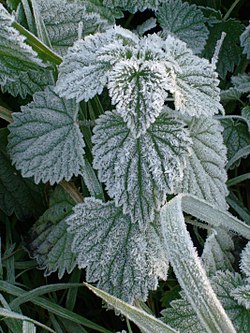
Frost on the grass of a public park in November
Map of average first killing frost in Ohio from "Geography of Ohio," 1923

Many plants can be damaged or killed by freezing temperatures or frost. This varies with the type of plant, the tissue exposed, and how low temperatures get; a "light frost" of −2 to 0 °C (28 to 32 °F) damages fewer types of plants than a "hard frost" below −2 °C (28 °F).[9][10]

Plants likely to be damaged even by a light frost include vines—such as beans, grapes, squashes, melons—along with nightshades such as tomatoes, eggplants, and peppers. Plants that may tolerate (or even benefit from) frosts include:[11]

  • root vegetables (e.g. beets, carrots, parsnips, onions)
  • leafy greens (e.g. lettuces, spinach, chard, cucumber[12])
  • cruciferous vegetables (e.g. cabbages, cauliflower, bok choy, broccoli, Brussels sprouts, radishes, kale, collard, mustard, turnips, rutabagas)

Even those plants that tolerate frost may be damaged once temperatures drop even lower (below −4 °C or 25 °F).[9] Hardy perennials, such as Hosta, become dormant after the first frosts and regrow when spring arrives. The entire visible plant may turn completely brown until the spring warmth, or may drop all of its leaves and flowers, leaving the stem and stalk only. Evergreen plants, such as pine trees, withstand frost although all or most growth stops. Frost crack is a bark defect caused by a combination of low temperatures and heat from the winter sun.

Vegetation is not necessarily damaged when leaf temperatures drop below the freezing point of their cell contents. In the absence of a site nucleating the formation of ice crystals, the leaves remain in a supercooled liquid state, safely reaching temperatures of −4 to −12 °C (25 to 10 °F). However, once frost forms, the leaf cells may be damaged by sharp ice crystals. Hardening is the process by which a plant becomes tolerant to low temperatures. See also Cryobiology.

Certain bacteria, notably Pseudomonas syringae, are particularly effective at triggering frost formation, raising the nucleation temperature to about −2 °C (28 °F).[13] Bacteria lacking ice nucleation-active proteins (ice-minus bacteria) result in greatly reduced frost damage.[14]

Protection methods

[edit]
Roses with protection against frost – Volksgarten, Vienna
Curitiba (Southern Brazil) is the coldest of Brazil's state capitals; the greenhouse of the Botanical Garden of Curitiba protects sensitive plants.

Typical measures to prevent frost or reduce its severity include one or more of:

  • Deploying powerful blowers to simulate wind, thereby preventing the formation of accumulations of cold air. There are variations on this theme. One variety is the wind machine, an engine-driven propeller mounted on a vertical pole that blows air almost horizontally. Wind machines were introduced as a method for frost protection in California during the 1920s, but they were not widely accepted until the 1940s and 1950s. Now, they are commonly used in many parts of the world.[15] Another is the selective inverted sink,[16] a device which prevents frost by drawing cold air from the ground and blowing it up through a chimney. It was originally developed to prevent frost damage to citrus fruits in Uruguay. In New Zealand, helicopters are used in similar fashion, especially in the vineyard regions such as Marlborough. By dragging down warmer air from the inversion layers, and preventing the ponding of colder air on the ground, the low-flying helicopters prevent damage to the fruit buds. As the operations are conducted at night, and have in the past involved up to 130 aircraft per night in one region, safety rules are strict.[17] Although not a dedicated method, wind turbines have a similar (although smaller) effect of vertically mixing air layers of different temperature.[18][19][20]
  • For high-value crops, farmers may wrap trees and use physical crop coverings.
  • For high-value crops grown over small areas, heating to slow the drop in temperature may be practical.
  • Production of smoke to reduce cooling by radiation, now thought to be of little benefit.[21]
  • Spraying crops with a layer of water releases latent heat, preventing harmful freezing of the tissues of the plants that it coats.

Such measures need to be applied with discretion, because they may do more harm than good; for example, spraying crops with water can cause damage if the plants become overburdened with ice. An effective, low cost method for small crop farms and plant nurseries, exploits the latent heat of freezing. A pulsed irrigation timer[22] delivers water through existing overhead sprinklers at a low volumes to combat frosts down to −5 °C (23 °F).[22][23] If the water freezes, it gives off its latent heat, preventing the temperature of the foliage from falling much below zero.[23]

Frost-free areas

[edit]

Frost-free areas are found mainly in the lowland tropics, where they cover almost all land except at altitudes above about 3,000 metres or 9,800 feet near the equator and around 2,000 metres or 6,600 feet in the semiarid areas in tropical regions. Some areas on the oceanic margins of the subtropics are also frost-free, as are highly oceanic areas near windward coasts. The most poleward frost-free areas are the lower altitudes of the Azores, Île Amsterdam, Île Saint-Paul, and Tristan da Cunha.

In the contiguous United States, southern Florida around Miami Beach and the Florida Keys are the only reliably frost-free areas, as well as the Channel Islands off the coast of California. The hardiness zones in these regions are 11a and 11b.

Permafrost

[edit]

Permafrost is a layer of frozen earth underground which never heats above freezing even during summer months, remaining frozen year round. Although not frost in the atmospheric sense, it consists of dirt, soil, sand, rocks, clay, or organic matter (peat) bound firmly together by ice crystals, making the material very hard and difficult to penetrate. Permafrost exists in the colder climates of the Arctic and Antarctic, such as Russia, Canada, Alaska, Norway, Greenland, or Antarctica, where the warmer conditions of summer are insufficient to penetrate the insulation of the Earth to reach deep enough to thaw the permafrost layer. The permafrost may begin from the surface of the ground or many meters beneath it, and may extend from just a meter to over a thousand meters in thickness. Permafrost contains a significant portion of the Earth's water and carbon, and prevents surface water from penetrating very deep into the ground, making it responsible in part for the typical taiga and spruce bog environments common in northern latitudes.[24]

Personifications

[edit]

Frost is personified in Russian culture as Ded Moroz. Indigenous peoples of Russia such as the Mordvins have their own traditions of frost deities.

English folklore tradition holds that Jack Frost, an elfish creature, is responsible for feathery patterns of frost found on windows on cold mornings.

On other planets

[edit]

In 2024, two European Space Agency spacecraft, Exomars TGO and Mars Express, discovered a thin but very wide layer of water frost on the peak of Olympus Mons, the highest mountain on Mars. This layer of frost appears for a few hours around sunrise, and then evaporates into the atmosphere for the rest of the Martian day. This was the first instance of frost discovered in the equatorial region of Mars.[25]

[edit]

See also

[edit]

References

[edit]
[edit]
Revisions and contributorsEdit on WikipediaRead on Wikipedia
from Grokipedia
Frost is a thin layer of crystals that forms on surfaces when in the air deposits directly as , typically during clear, calm nights with temperatures at or below 0 °C (32 °F). This process, known as deposition or desublimation, occurs without the first becoming , distinguishing frost from frozen . Frost can appear as delicate feathers, needles, scales, or fans and is common on grass, windows, and . It poses risks to by damaging crops but also features in various natural and cultural contexts.

Physical Properties and Formation

Definition and Characteristics

Frost is a meteorological involving formation on surfaces cooled below the freezing point of , either by direct deposition of from the air (hoar frost, without the intermediate phase) or by freezing of previously formed (frozen dew, involving a liquid phase). The deposition process occurs when the surface temperature drops below the frost point, typically in conditions of high and clear skies. Unlike , which forms as when crystals aggregate and fall from clouds, or , which develops from supercooled droplets freezing in updrafts within thunderstorms, frost adheres directly to ground-level objects and is not considered a form of . The ice crystals in frost exhibit a hexagonal prism structure, a fundamental property of ice Ih (ordinary hexagonal ice) at atmospheric pressures, where water molecules arrange in a lattice of layered hexagons. Frost forms when surface temperatures drop below 0°C (32°F), which can occur even if air temperatures are slightly above freezing due to radiative cooling effects on objects. Visually, frost appears as delicate, feathery, or needle-like formations, with crystals growing outward in branching patterns that can resemble tiny ferns or spikes, depending on vapor availability and wind conditions. In climatic studies, frost is quantified using metrics such as frost depth, which measures the maximum penetration of freezing into the , often estimated via models incorporating soil properties and . Air frost days refer to the number of days in a period when the minimum air temperature, measured at standard height (typically 1.5 meters), falls below 0°C. The frost index, commonly the air-freezing index (AFI), is calculated as the cumulative sum of daily mean air temperatures below 0°C (in degree-days) over the freezing season, providing a measure of winter severity; for example, an AFI of 1000 °C-days indicates moderate freezing conditions in midlatitude regions.

Formation Mechanisms

Frost forms primarily through the deposition of directly onto surfaces when atmospheric conditions lead to with respect to . One key mechanism is , which occurs under clear night skies with low wind speeds, allowing terrestrial surfaces to lose heat via longwave radiation to the cold . This heat loss cools the surface below the frost point, promoting the of near-surface air and subsequent frost deposition. Such conditions typically involve calm winds (1-2 mph) and dry air, resulting in inversions where colder air settles near the ground. In contrast, involves the horizontal movement of cold air masses displacing warmer air, often under windy conditions with speeds of at least 5 mph. This process rapidly lowers air temperatures across a , sometimes even in the presence of clouds, by advecting cold air from distant sources and preventing the formation of stable inversions. The influx of cold, potentially moist air can lead to quick freezing on exposed surfaces without relying on radiative heat loss. The initiation of frost deposition depends critically on , , and surface , which determine whether the partial pressure of exceeds the saturation over . High relative near 100% facilitates , while low minimizes turbulent mixing that could warm the surface. When surface temperatures drop below 0°C and the vapor pressure surpasses the saturation threshold, water molecules deposit as . This process is governed by the Clausius-Clapeyron relation adapted for , which relates saturation to . The derivation begins with the thermodynamic equilibrium at the ice-vapor interface, where the rate of sublimation equals deposition. From the Clapeyron equation, the slope of the phase boundary is dPdT=LdTΔV\frac{dP}{dT} = \frac{L_d}{T \Delta V}, where LdL_d is the of sublimation, TT is , and ΔV\Delta V is the specific volume change. Assuming ideal gas behavior for vapor and negligible liquid volume, ΔVVv=RvTP\Delta V \approx V_v = \frac{R_v T}{P}, leading to dlnesdT=LdRvT2\frac{d \ln e_s}{dT} = \frac{L_d}{R_v T^2}, with RvR_v as the for . Integrating from a reference state (e.g., es0=0.6113e_{s0} = 0.6113 hPa at T0=273.15T_0 = 273.15 ) yields ln(es/es0)=LdRv(1T01T)\ln(e_s / e_{s0}) = \frac{L_d}{R_v} \left( \frac{1}{T_0} - \frac{1}{T} \right), or approximately es=6.11exp[6139T(1273.151T)]e_s = 6.11 \exp\left[ \frac{6139}{T} \left( \frac{1}{273.15} - \frac{1}{T} \right) \right] hPa for ice, where Ld/Rv6139L_d / R_v \approx 6139 . A common empirical form for ice is es=6.11×109.5T/(265.5+T)e_s = 6.11 \times 10^{9.5 T / (265.5 + T)} hPa (T in °C), using ice-specific constants to account for the lower saturation pressure over ice compared to supercooled water. Laboratory observations reveal that frost nucleation on substrates like metal or glass occurs rapidly once surfaces reach below-freezing temperatures in humid environments, with heterogeneous nucleation on surface imperfections leading to ice deposition. Field studies on grass surfaces show nucleation starting at the tips of blades due to their higher exposure and cooling rates, with frost coverage increasing under calm, high-humidity conditions observed in agricultural settings. These observations confirm that surface wettability and microstructure influence nucleation sites, with metals showing denser frost layers than organic substrates like grass under similar conditions.

Types of Frost

Hoar Frost

Hoar frost, also known as white frost or surface hoar, forms through the direct deposition of atmospheric onto surfaces cooled below the freezing point, a process termed desublimation or deposition frosting. This occurs exclusively under conditions during calm, clear nights in high-humidity environments, where the absence of wind allows the ground and nearby air to lose rapidly to the clear , dropping the surface temperature below the for ice. The resulting ice crystals, known as hoar crystals, grow perpendicular to the surface in delicate, upright, feathery structures resembling feathers or , often branching in intricate dendritic patterns. These crystals typically range from 1 to 10 mm in length but can extend to several centimeters under prolonged ideal conditions, such as sustained high relative humidity and minimal air movement, creating a soft, sparkling coating. Unlike frosts involving the freezing of supercooled liquid water droplets, hoar frost involves no liquid intermediate phase, relying solely on the of over ice to drive pure growth directly from the gas phase. This distinction yields its characteristic fragile, non-adherent morphology, which can be easily dislodged by gentle breezes. Nineteenth-century meteorological records from temperate zones in frequently documented hoar frost events during cold, clear periods. Examples of hoar frost coverage often feature grass blades tipped with fine, elongated crystals and tree branches heavily laden with feathery accretions, transforming fields and forests into ethereal, white-veiled scenes under morning light. Such visual displays, captured in modern photography from sites like , mirror the historical accounts of widespread, decorative icing on in still-air conditions.

Advection and Radiation Frost

Advection frost occurs when a mass of air, often originating from polar regions, is transported horizontally by into a warmer area, displacing the existing air and causing s to drop rapidly below freezing. This process is typically associated with moderate to strong winds exceeding 5 mph, low , and the absence of a strong temperature inversion, leading to widespread and persistent conditions that can affect large regions. In , advection frost events are particularly notable in frost pockets such as valleys in the or the , where air combines with topographic features to exacerbate cooling and damage to crops like fruits and vegetables. Radiation frost, in contrast, forms under calm conditions with clear skies and light winds below 5 mph, where the Earth's surface loses heat rapidly through long-wave radiation to the cold night sky, creating a temperature inversion layer that traps colder air near the ground. This vertical heat loss cools the air adjacent to surfaces, promoting the deposition of directly onto objects as frost, and is common in agricultural belts such as the Central Valley of or the Midwest prairies. Severity of radiation frost is graded based on the extent of temperature drop: light frost involves drops to 29–32°F (–1.7 to 0°C), causing minor damage to tender plants; moderate frost reaches 25–28°F (–4 to –2.2°C), damaging most ; and severe frost below 25°F (–4.4°C) results in widespread destruction. While both types of frost involve the basic process of water vapor deposition onto surfaces cooled below the dew point, advection frost emphasizes large-scale horizontal air movement that can onset suddenly and cover expansive areas, whereas radiation frost relies on localized vertical radiative cooling under stable atmospheric conditions. A comparative example is the 2017 European cold snap in late April, where an initial advection event brought polar air masses southward, leading to temperatures dropping to –5°C in parts of France and Italy, followed by radiation-enhanced frosts in clear nights that caused over €3 billion in agricultural losses across vineyards and orchards. This event highlighted advection's role in initiating broad cooling, amplified by radiation in low-lying areas, underscoring their combined rapid and extensive impacts on ecosystems.

Window and White Frost

Window frost, also known as interior frost, occurs indoors on surfaces when warm, moist air from activities like cooking, , or contacts the cold interior side of the window, leading to that subsequently freezes at temperatures below 0°C. This phenomenon is particularly prevalent in homes with poor insulation, where the glass temperature drops significantly due to outdoor cold, allowing the to be reached and exceeded on the pane. In such cases, the frost appears as a thin, feathery layer or opaque coating, often more pronounced at the bottom of the window where cooler air settles. Historically, window frost was a common sight in pre-central heating eras, especially in older buildings with single-pane and minimal insulation, where indoor from open fires or unventilated spaces readily condensed and froze overnight, sometimes requiring manual scraping for visibility. These conditions were typical in 19th-century homes reliant on localized heating like fireplaces, which failed to maintain even warmth throughout the structure, exacerbating frost buildup on exposed . Modern double-glazed and improved home insulation have largely mitigated this issue by maintaining warmer interior surfaces. In fact, in modern, energy-efficient designs such as double- or triple-pane glass, frost forming on the outside of windows indicates effective insulation, as it demonstrates that indoor heat is not escaping to warm the exterior surface, allowing the outer pane to remain cold enough for frost deposition while keeping the interior comfortable. White frost, distinct from hoar frost, forms as a thin, opaque, milky-white layer on exposed outdoor surfaces such as grass, fields, or vehicles when liquid first condenses from moist air onto sub-freezing surfaces and then freezes into small globules, often under calm, foggy conditions that promote initial formation. This type of frost can cover vast areas like agricultural fields uniformly, creating a blanket-like appearance due to the freezing of pre-formed rather than direct vapor deposition. It typically develops overnight when air temperatures hover near or just below freezing, with relative humidity high enough for but low to allow surface cooling. Unlike window frost, which rapidly melts upon exposure to indoor warmth from heating systems or sunlight, white frost persists longer outdoors until it undergoes sublimation—direct transition from solid ice to vapor—under clear, dry conditions, or melts with rising temperatures, potentially lasting hours or days in prolonged cold spells. This endurance stems from the lack of immediate heat sources in open environments, contrasting with the confined, heated indoor settings that quickly dissipate window frost. Humidity plays a key role in both, as elevated moisture levels facilitate the initial condensation phase necessary for freezing.

Rime and Black Frost

Rime forms through the impact and freezing of supercooled water droplets from or clouds onto surfaces at temperatures at or below 0°C, resulting in opaque, irregular deposits that differ from slower depositional frosts due to the dynamic role of wind in droplet transport. This is prevalent in windy, gy conditions typical of maritime climates, where persistent low-level clouds provide a steady supply of supercooled droplets. Rime occurs in two primary varieties: soft rime and hard rime. Soft rime develops under calm or light wind conditions with supersaturated air relative to ice, creating delicate, feathery structures of fine needles that appear milky and crystalline, often ephemeral and easily dislodged. In contrast, hard rime builds in stronger winds, where rapid impacts of supercooled droplets trap air bubbles, forming dense, granular, opaque masses with a white, irregular appearance and higher structural integrity. These varieties are commonly observed during coastal expeditions in Antarctica, where maritime influences generate frequent supercooled fog along ice-free coastal zones, leading to significant rime accumulation on equipment and outcrops. The accumulation of rime poses notable dangers, particularly its added weight on structures and . With densities ranging from 200 to 800 kg/m³ depending on temperature and droplet size, rime can impose substantial loads on wires, towers, and ship superstructures, risking collapse or instability in extreme cases. In aviation, rime's rough, brittle buildup on wings and inlets disrupts , increases drag, and reduces lift, creating hazardous conditions during takeoff or flight in icing layers; its opaque nature also obscures visual cues, complicating detection. Black frost refers to sub-zero air temperatures in dry conditions that cause internal freezing within tissues without any visible surface deposition, distinguishing it from frosts that produce external . This occurs when low humidity prevents moisture sublimation into on plant exteriors, yet the cold penetrates cells, expanding intracellular water into lethal that rupture membranes and vascular tissues. Detection typically involves dissecting affected plant parts for tissue analysis, revealing blackened, desiccated interiors indicative of , rather than relying on surface visuals. The stealthy nature of black frost leads to severe, often undetected crop devastation, as damage manifests days later through or . In agricultural settings, it commonly affects sensitive crops like , olives, almonds, and vineyards, causing internal tissue death that halves yields in affected orchards without prior warning signs. For instance, in South Africa's region, black frost events have damaged and crops, resulting in substantial financial losses for farmers due to the hidden extent of internal harm.

Biological and Environmental Impacts

Effects on Plants and Ecosystems

Frost induces cellular damage in primarily through the formation of crystals, which disrupt cellular integrity and lead to . Extracellular formation causes osmotic , drawing from cells and concentrating solutes to potentially lethal levels, while intracellular crystals physically rupture cell membranes and walls. This process is exacerbated in non-acclimated lacking ice-binding proteins, resulting in widespread tissue death upon thawing. Vulnerability to frost varies among plant species, with evergreens generally more susceptible than deciduous trees due to their persistent foliage, which remains exposed to desiccation and freezing stresses throughout winter. Deciduous species mitigate risk by shedding leaves, reducing transpiration and avoiding direct ice accumulation on photosynthetic tissues, though both types can suffer if frost occurs during bud break or new growth flushes. In frost-prone regions, this differential tolerance shapes community composition, favoring hardier evergreens in milder microclimates. At the ecosystem level, frost alters by subjecting microbial communities to freeze-thaw cycles that can kill up to 50% of in a single event, reducing decomposition rates and nutrient cycling essential for plant productivity. These cycles also disrupt wildlife migration, as late spring frosts destroy emerging insects and buds, creating food shortages for arriving birds and leading to mismatched that contributes to population declines. In frost-prone biomes like and temperate forests, repeated events drive by favoring frost-tolerant and eliminating sensitive ones, thereby simplifying community structures and diminishing resilience. For example, in April 2025, severe spring frosts in affected 65 provinces, causing up to 80% losses in and other crops, highlighting ongoing global ecosystem disruptions. Despite predominant negative impacts, frost occasionally benefits ecosystems through processes like in regions, where soil uplift exposes mineral seedbeds and facilitates and for in disturbed patches. For instance, black frost in groves can cause substantial yield reductions, with historical events destroying up to 30% of crops in affected areas, underscoring the economic scale of such damage in . These rare positive dynamics highlight frost's role in maintaining landscape heterogeneity in cold environments.

Protection and Mitigation Methods

In , frost protection methods aim to mitigate damage to sensitive crops during critical growth stages, such as or flowering, where below -2°C can cause cellular rupture. Active techniques include , which involves burning materials like wood or oil in smudge pots to create smoke blankets that reduce radiative heat loss by up to 20-30% under calm conditions, though modern assessments highlight its limited efficacy and environmental drawbacks due to . Overhead sprinkler systems provide more reliable protection by applying water at rates of 2-6 mm/hour, releasing of fusion (334 kJ/kg) as forms on plants, maintaining surface near 0°C even down to -7°C when properly managed. machines, typically tower-mounted fans with 50-100 kW output, disrupt temperature inversions by mixing warmer upper air (2-4°C higher) with cooler surface layers, raising by 1-3°C over areas of 4-10 hectares. Cost-benefit analyses indicate that via wood burning offers the highest in regions like for a typical , with annual costs around €4,700 but benefits around €44,000 in prevented losses for high-value fruits, outperforming sprinklers (initial investment €37,000) and machines (€35,000/unit) in frequent mild frost scenarios. However, sprinklers prove more economical in water-abundant areas, with operational costs of €200-500 per event versus smudging's fuel inefficiency, while machines yield long-term savings through low use (diesel at 5-10 liters/hour) despite high upfront expenses. Chemical protectants, such as biostimulant sprays containing , sugars, or glycol-based compounds, enhance frost tolerance by stabilizing cell membranes and promoting antifreeze proteins, applied at 1-5 liters per 1-3 days before forecasted frost events. Products like Frostguard or , often derived from or derivatives, are diluted to 0.5-2% solutions and sprayed foliarly to lower freezing points by 2-4°C without residue issues, though efficacy varies by crop and requires integration with weather monitoring for optimal timing. Guidelines emphasize application during dry conditions above 5°C to ensure absorption, with studies showing 20-50% in vineyards but cautioning against overuse due to potential . For urban and infrastructure protection, insulation and heating systems prevent frost-induced expansion in pipes, roads, and foundations, where water freezing can exert pressures up to 10 MPa causing cracks. Historical methods trace to ancient Roman viticulture, where growers erected low stone walls around vineyards to trap daytime heat and burn pruned vines for smoky barriers, evolving into 17th-century European fruit walls (up to 4m high) that extended growing seasons by 2-3 weeks. Modern approaches employ extruded polystyrene insulation (R-values 4-5 per inch) around buried utilities and hydronic heating loops with glycol solutions to maintain soil temperatures above 0°C, reducing frost heave by 70-90% in urban settings. Machine learning-based forecasting enhances these by improving short-term temperature predictions (up to 48 hours ahead) with root mean square errors around 1.6–2.4°C, enabling preemptive activation of systems in agriculture and infrastructure.

Geographical and Climatic Contexts

Frost-Free Areas

Frost-free areas encompass regions and microclimates where freezing temperatures are rare or nonexistent, enabling continuous vegetation growth and agricultural activity without frost-related disruptions. These locales are predominantly located in tropical and subtropical zones along equatorial belts, where high solar insolation and minimal seasonal temperature variations maintain average lows well above freezing. The consistent warmth in these areas stems from the stable and the , which inhibit the southward migration of polar air masses. For example, the lowlands of , such as coastal , record an average of zero frost days annually due to the islands' oceanic moderation and elevation below 1,000 feet, supporting tropical crops like and year-round. Beyond equatorial regions, urban heat islands and coastal topographies foster frost-free conditions in temperate latitudes through localized warming effects. Urban heat islands arise from anthropogenic surfaces like asphalt and that absorb daytime heat and release it slowly at night, elevating minimum temperatures by 2–5°C (3.6–9°F) compared to rural surroundings and thereby averting frost even during cold snaps. Coastal areas benefit from similar moderation via ocean currents and sea breezes; for instance, the transports warm Atlantic waters northward, raising winter air temperatures along Western Europe's shores and limiting frost occurrences to fewer than 30 days per year in coastal areas like , in contrast to 50 or more days well inland. Low elevation and proximity to large water bodies further enhance these effects by buffering against . Mapping of frost-free areas relies on systems like the USDA Plant Hardiness Zones 9–13, defined by average annual extreme minimum temperatures ranging from 20°F to above 50°F (-7°C to above 10°C), where frost events are infrequent or absent, spanning southern , , and . These zones guide planting decisions by indicating low frost risk, with Zone 10 exemplifying near-year-round growing seasons. projections, based on IPCC scenarios, anticipate an expansion of such areas through warmer baselines, with the southeastern U.S. expected to see 10–20 fewer frost days per year by mid-century, thereby extending frost-free periods and shifting suitable habitats poleward.

Permafrost Zones

Permafrost refers to ground material, including soil, rock, and ice, that remains at or below 0°C for at least two consecutive years. It covers approximately 15% of the exposed land surface in the , primarily in and subarctic regions (as of recent estimates, 2021). This frozen layer is structurally divided into the active layer, which thaws seasonally during warmer months and refreezes in winter, and the underlying permafrost table, marking the upper boundary of the continuously frozen zone. The formation of permafrost is closely tied to climatic conditions from past glaciations, particularly during the Pleistocene epoch, when extensive ice sheets and lower temperatures led to widespread ground freezing across northern latitudes. Much of today's represents relict features from these glacial periods, with stability maintained by persistent low temperatures that prevent significant thaw. Heat transfer within permafrost is governed by thermal conductivity principles, where the qq is described by Fourier's law as q=kdTdzq = -k \frac{dT}{dz}, with kk as the thermal conductivity coefficient and dTdz\frac{dT}{dz} as the temperature gradient. The Stefan equation extends this to phase-change processes at the freezing front, modeling the rate of formation or thaw based on absorption or release, thereby influencing permafrost depth and persistence. Permafrost poses significant engineering challenges, such as differential settlement and structural instability from thawing, exemplified by the Trans-Alaska , where warming has caused pipeline supports to shift and buckle since the 1970s. Global warming exacerbates these issues by accelerating thaw, releasing stored organic carbon into the atmosphere; the pan-Arctic region has become a net annual source of approximately 0.13 Gt C from CO₂ and 0.04 Gt C from CH₄ (as of 2020 data), with increased wildfires contributing additional emissions (e.g., 0.335 Gt C in 2024), amplifying climate feedbacks.

Extraterrestrial and Cultural Representations

Frost on Other Celestial Bodies

Frost on Mars is prominently observed in the planet's polar regions, where seasonal caps composed primarily of carbon dioxide (CO₂) frost form during the winter hemispheres and sublimate during summer, accounting for a significant portion of the atmospheric mass transfer. These cycles involve the condensation of atmospheric CO₂ onto the surface as frost, followed by its direct transition to gas, which influences global weather patterns including dust storms. The Viking Orbiter missions, launched in 1975 and arriving in 1976, provided the first detailed imaging and spectroscopic data confirming the CO₂ nature of the seasonal south polar cap, revealing its extent and variability over multiple Martian years. More contemporary observations from the Perseverance rover, operational since 2021, have measured atmospheric pressure fluctuations tied to this sublimation process, validating models of the CO₂ cycle with in-situ data from Jezero Crater. Jupiter's moon Europa exhibits extensive water ice frost covering its surface, forming a reflective, fractured crust estimated to be 10–30 km thick that overlies a global subsurface ocean. This frost likely originates from upwelling of ocean water that freezes upon exposure, creating features like double ridges and lenticulae through cryovolcanic resurfacing. The potential habitability of Europa stems from this ocean's interaction with the icy surface, where tidal heating from Jupiter maintains liquid water conditions rich in salts and organics, possibly supporting microbial life. NASA's Galileo spacecraft (1995–2003) first inferred the subsurface ocean from magnetic field data, while missions like Europa Clipper (launched October 14, 2024) will characterize the ice composition and plume activity to assess biosignature potential. Saturn's moon similarly displays frost on its south polar terrain, sourced from a subsurface that vents through cryovolcanic , ejecting , grains, and organics into . The surface frost, appearing as fresh, bright deposits, is continually renewed by these plumes, which form the planet's and indicate ongoing geological activity driven by tidal forces. This environment's is bolstered by the ocean's warmth, silica nanoparticles suggesting hydrothermal vents, and detected as an energy source for potential methanogenic life. Cassini spacecraft flybys (2004–2017) sampled plume material, confirming the ocean's and organics, while recent analyses suggest that biosignatures could persist in the shell without deep penetration. Beyond our solar system, frost lines—also known as snow lines—in protoplanetary disks around young stars mark boundaries where temperatures allow volatiles like to condense into , facilitating formation through enhanced solid particle growth. Spectroscopic observations from the in the early 2020s detected absorption features in disks such as TW Hydrae, delineating these lines at distances of several astronomical units. The (JWST), operational since 2022, has advanced this understanding with mid-infrared spectra revealing spatially resolved ices (H₂O, CO₂, CO) and excess cool emission near snow lines in compact disks, consistent with pebble drift models that accelerate core accretion for super-Earths and giants. These JWST findings from programs like the ERS provide inventories of frost components, emphasizing their role in diverse architectures observed in over 6,000 confirmed systems.

Personifications and Cultural Significance

In , is depicted as a mischievous sprite who personifies the onset of winter, often credited with "painting" intricate frost patterns on windows and nipping at exposed skin with cold. The figure's name first appeared in print in 1734 in the book Round About Our Coal Fire: or Entertainments, where he is portrayed as a harbinger of icy weather, though earlier Scandinavian influences, such as the Norse frost giant Jokul, may have contributed to his conceptualization as a chilly . This imagery gained widespread popularity in the through literary works, including ' references in (1836), where 's touch transforms landscapes into frozen scenes, and (1844), emphasizing his role in evoking winter's whimsical yet biting presence. Across cultures, frost finds personification in diverse winter spirits that blend benevolence with severity. In Slavic folklore, Morozko, known as Father Frost or Ded Moroz, emerges as a bearded elder embodying the harsh Russian winter, rewarding the virtuous with gifts while punishing the rude with freezing blasts, as detailed in Alexander Afanasyev's 19th-century collection of tales Narodnye russkie skazki. Rooted in pre-Christian Slavic mythology, Morozko reflects the duality of winter's beauty—through sparkling frost and snow—and its peril, often traveling with his granddaughter Snegurochka, the Snow Maiden, to distribute New Year's presents in modern traditions. Similarly, Norse mythology features the jötnar, or frost giants, as primordial beings from Jötunheimr who symbolize chaotic natural forces, including blizzards and ice, clashing with the gods in epics like the Poetic Edda and Prose Edda, where figures like Thrym wield frost as a weapon of disruption. In modern culture, frost's personifications extend into literature and media, symbolizing both ethereal beauty and existential peril. American poet frequently invoked winter frost in works like "Stopping by Woods on a Snowy Evening" (1923), where accumulating snow represents introspective isolation and the pull of mortality, using rural landscapes to explore human resilience amid seasonal . This thematic legacy persists in contemporary media, such as Disney's Frozen (2013), where Elsa's cryokinetic powers—manifesting as uncontrolled frost and ice—symbolize repressed emotions and self-empowerment, transforming frost from a destructive force into a for embracing one's inner strength, as analyzed in cultural critiques of the film's feminist undertones. These portrayals underscore frost's enduring role as a cultural of winter's transformative duality, influencing art and across generations.

References

Add your contribution
Related Hubs
Contribute something
User Avatar
No comments yet.