
Recent from talks
Paulownia tomentosa
Knowledge base stats:
Talk channels stats:
Members stats:
Paulownia tomentosa
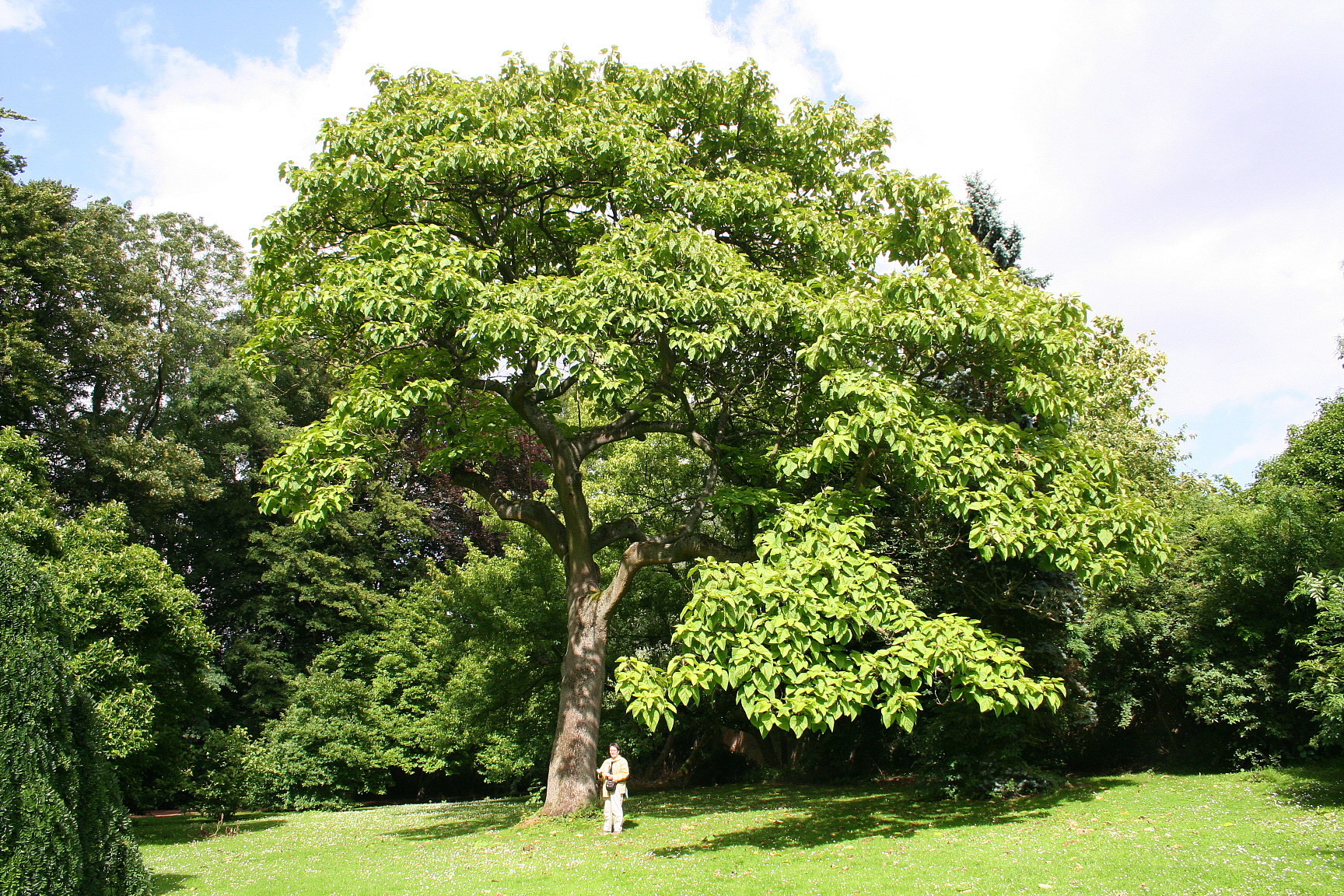
Paulownia tomentosa, common names princess tree, empress tree, or foxglove-tree, is a deciduous hardwood tree in the family Paulowniaceae, native to central and eastern China and the Korean Peninsula. It is an extremely fast-growing tree with seeds that disperse readily and is considered an invasive exotic species in North America that has undergone naturalisation in large areas of the Eastern US, even though seed viability may be low under harsh conditions. P. tomentosa has also been introduced to Western and Central Europe, and is establishing itself as a naturalised species there as well.
The generic name Paulownia honours Anna Pavlovna of Russia, who was Queen Consort of the Netherlands from 1840 to 1849. The specific epithet tomentosa is a Latin word meaning 'covered in hairs'.
This tree grows 10–25 m (33–82 ft) tall, with large heart-shaped to five-lobed leaves 15–40 cm (6–16 in) across, arranged in opposite pairs on the stem. On young growth, the leaves may be in whorls of three and be much bigger than the leaves on more mature growth. The leaves on stump shoots can achieve remarkable size; leaves 98 centimetres (39 in) wide and almost as long have been reported. The leaves can be mistaken for those of the catalpa.
The very fragrant flowers, large and violet-blue in colour are produced before the leaves in early spring, on panicles 10–30 centimetres (4–12 in) long, with a tubular purple corolla 4–6 centimetres (1+1⁄2–2+1⁄4 in) long resembling a foxglove flower. The fruit is a dry egg-shaped capsule 3–4 centimetres (1+1⁄8–1+5⁄8 in) long, containing numerous tiny seeds. The seeds are winged and disperse by wind and water. Pollarded trees do not produce flowers, as these form only on mature wood.
Paulownia tomentosa requires full sun for proper growth. It is tolerant of pollution and can tolerate many soil types[specify][disputed – discuss]. It can also grow from small cracks in pavements and walls.[original research?] Paulownia can survive wildfires because the roots can regenerate new, very fast-growing stems.[citation needed][disputed – discuss]
P. tomentosa is drought-resistant and thrives in barren soil, particularly suitable for cold and arid regions. Its main trunk is short, and its growth rate is relatively slow after it reaches maturity.
P. tomentosa is native to much of central and eastern China and to the Korean peninsula; the Flora of China considers the latter as non-native. In China, it occurs in the following provinces: Anhui, Gansu, Hebei, Henan, Hubei, Hunan, Jiangsu, Jiangxi, Liaoning, Shaanxi, Shanxi, Sichuan.
In August 2021 the EPPO added P. tomentosa to its Alert List, not due to any particular known problem within Europe, but as a step to begin assessing whether it should be regarded as a problematic invader.
Hub AI
Paulownia tomentosa AI simulator
(@Paulownia tomentosa_simulator)
Paulownia tomentosa
Paulownia tomentosa, common names princess tree, empress tree, or foxglove-tree, is a deciduous hardwood tree in the family Paulowniaceae, native to central and eastern China and the Korean Peninsula. It is an extremely fast-growing tree with seeds that disperse readily and is considered an invasive exotic species in North America that has undergone naturalisation in large areas of the Eastern US, even though seed viability may be low under harsh conditions. P. tomentosa has also been introduced to Western and Central Europe, and is establishing itself as a naturalised species there as well.
The generic name Paulownia honours Anna Pavlovna of Russia, who was Queen Consort of the Netherlands from 1840 to 1849. The specific epithet tomentosa is a Latin word meaning 'covered in hairs'.
This tree grows 10–25 m (33–82 ft) tall, with large heart-shaped to five-lobed leaves 15–40 cm (6–16 in) across, arranged in opposite pairs on the stem. On young growth, the leaves may be in whorls of three and be much bigger than the leaves on more mature growth. The leaves on stump shoots can achieve remarkable size; leaves 98 centimetres (39 in) wide and almost as long have been reported. The leaves can be mistaken for those of the catalpa.
The very fragrant flowers, large and violet-blue in colour are produced before the leaves in early spring, on panicles 10–30 centimetres (4–12 in) long, with a tubular purple corolla 4–6 centimetres (1+1⁄2–2+1⁄4 in) long resembling a foxglove flower. The fruit is a dry egg-shaped capsule 3–4 centimetres (1+1⁄8–1+5⁄8 in) long, containing numerous tiny seeds. The seeds are winged and disperse by wind and water. Pollarded trees do not produce flowers, as these form only on mature wood.
Paulownia tomentosa requires full sun for proper growth. It is tolerant of pollution and can tolerate many soil types[specify][disputed – discuss]. It can also grow from small cracks in pavements and walls.[original research?] Paulownia can survive wildfires because the roots can regenerate new, very fast-growing stems.[citation needed][disputed – discuss]
P. tomentosa is drought-resistant and thrives in barren soil, particularly suitable for cold and arid regions. Its main trunk is short, and its growth rate is relatively slow after it reaches maturity.
P. tomentosa is native to much of central and eastern China and to the Korean peninsula; the Flora of China considers the latter as non-native. In China, it occurs in the following provinces: Anhui, Gansu, Hebei, Henan, Hubei, Hunan, Jiangsu, Jiangxi, Liaoning, Shaanxi, Shanxi, Sichuan.
In August 2021 the EPPO added P. tomentosa to its Alert List, not due to any particular known problem within Europe, but as a step to begin assessing whether it should be regarded as a problematic invader.
Recent media