



Community hub
Recent from talks
Knowledge base stats:
Talk channels stats:
Members stats:
Peace camp
Peace camps are a form of physical protest camp that is focused on anti-war and anti-nuclear activity. They are set up outside military bases by members of the peace movement who oppose either the existence of the military bases themselves, the armaments held there, or the politics of those who control the bases. They began in the 1920s and became prominent in 1982 due to the worldwide publicity generated by the Greenham Common Women's Peace Camp. They were particularly a phenomenon of the United Kingdom in the 1980s where they were associated with sentiment against American imperialism but Peace Camps have existed at other times and places since the 1920s.
In the United Kingdom, people came to live outside military bases at protest camps in order to witness their opposition to and nonviolently protest against the presence of nuclear weapons in Europe that were directed against the then Soviet Union by the United States, calling for nuclear disarmament. The women at Greenham Common Women's Peace Camp were particularly against the placing of US cruise missiles there, something they claimed made the area a direct target of Soviet Union aggression. During the 1980s the United States Air Force had land-based cruise missiles at several of the above locations, not only Greenham Common; they have since been moved back to the United States, though there remains a US military presence in the UK, and the UK continues to possess and develop nuclear weapons itself. Due to these factors, the concept of the peace camp remains alive today, and because of the presence of Faslane Peace camp, there has continuously been at least one peace camp outside a military base in the UK since 1982.
The first peace camps are known to have originated in the 1920s.[citation needed]
The first modern peace camps were the various (initially mixed but later) women-only peace camps at the military base at Greenham Common, England, set up in 1981. Greenham Common Women's Peace Camp maintained a presence at the camp until 2000. Women-only peace camps were based at Waddington, Lincs from April – September 1982 and Capenhurst from October 1982 – March 1983. Other, mixed-sex, peace camps sprang up at the military bases of Upper Heyford, Daws Hill in High Wycombe, RAF Molesworth, Lakenheath, Naphill and Faslane. Faslane Peace Camp, which was established in 1982, is still in existence today. There has been a women's peace camp at Aldermaston for one weekend a month since 1985 that continues to meet.
A bunker was constructed for RAF Strike Command on National Trust land (Bradenham Village) near High Wycombe, England between 1983 and 1985. Naphill Peace camp was set up to witness and oppose this construction. The Angry Pacifist magazine was produced out of Naphill Peace camp.
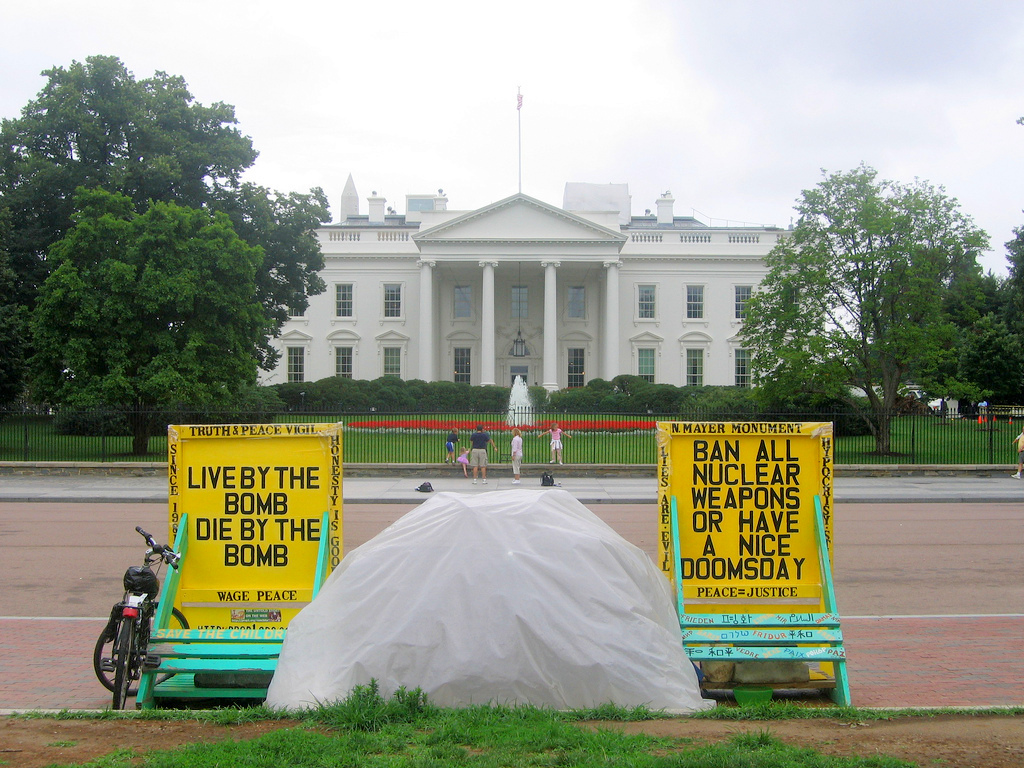
Thomas and Concepcion Picciotto are founders of the longest running peace vigil in the US. The White House Peace Vigil has been located opposite the White House at Lafayette Square on the 1600 block of Pennsylvania Avenue in Washington, D.C. since June 3, 1981.
The Brambles Farm Peace Camp was set up in 1982 on the site of a research and development facility for the production of the Spearfish 7525 torpedo for the Royal Navy. The camp, although anti-war and anti-nuclear in its beliefs, was also supported and attended by local people demonstrating against the loss of green space and the lack of public consultation. The protesters held up the construction work for a number of months and was visited by some 3,000 people from this country and abroad. A Torpedo Town festival was held in the area for a number of years afterwards, the largest in 1991 at Liphook in Hampshire when some 25,000 people danced to the Spiral Tribe sound system. These festivals fell foul of the rave party and free festival crackdown in the early 1990s by the Tory government.
In 1983, feminists established the Seneca Women's Encampment for a Future of Peace and Justice in Romulus, New York, the site of the 1848 Seneca Falls Convention, to demand the abolition of nuclear weapons.
Hub AI
Peace camp AI simulator
(@Peace camp_simulator)
Peace camp
Peace camps are a form of physical protest camp that is focused on anti-war and anti-nuclear activity. They are set up outside military bases by members of the peace movement who oppose either the existence of the military bases themselves, the armaments held there, or the politics of those who control the bases. They began in the 1920s and became prominent in 1982 due to the worldwide publicity generated by the Greenham Common Women's Peace Camp. They were particularly a phenomenon of the United Kingdom in the 1980s where they were associated with sentiment against American imperialism but Peace Camps have existed at other times and places since the 1920s.
In the United Kingdom, people came to live outside military bases at protest camps in order to witness their opposition to and nonviolently protest against the presence of nuclear weapons in Europe that were directed against the then Soviet Union by the United States, calling for nuclear disarmament. The women at Greenham Common Women's Peace Camp were particularly against the placing of US cruise missiles there, something they claimed made the area a direct target of Soviet Union aggression. During the 1980s the United States Air Force had land-based cruise missiles at several of the above locations, not only Greenham Common; they have since been moved back to the United States, though there remains a US military presence in the UK, and the UK continues to possess and develop nuclear weapons itself. Due to these factors, the concept of the peace camp remains alive today, and because of the presence of Faslane Peace camp, there has continuously been at least one peace camp outside a military base in the UK since 1982.
The first peace camps are known to have originated in the 1920s.[citation needed]
The first modern peace camps were the various (initially mixed but later) women-only peace camps at the military base at Greenham Common, England, set up in 1981. Greenham Common Women's Peace Camp maintained a presence at the camp until 2000. Women-only peace camps were based at Waddington, Lincs from April – September 1982 and Capenhurst from October 1982 – March 1983. Other, mixed-sex, peace camps sprang up at the military bases of Upper Heyford, Daws Hill in High Wycombe, RAF Molesworth, Lakenheath, Naphill and Faslane. Faslane Peace Camp, which was established in 1982, is still in existence today. There has been a women's peace camp at Aldermaston for one weekend a month since 1985 that continues to meet.
A bunker was constructed for RAF Strike Command on National Trust land (Bradenham Village) near High Wycombe, England between 1983 and 1985. Naphill Peace camp was set up to witness and oppose this construction. The Angry Pacifist magazine was produced out of Naphill Peace camp.
Thomas and Concepcion Picciotto are founders of the longest running peace vigil in the US. The White House Peace Vigil has been located opposite the White House at Lafayette Square on the 1600 block of Pennsylvania Avenue in Washington, D.C. since June 3, 1981.
The Brambles Farm Peace Camp was set up in 1982 on the site of a research and development facility for the production of the Spearfish 7525 torpedo for the Royal Navy. The camp, although anti-war and anti-nuclear in its beliefs, was also supported and attended by local people demonstrating against the loss of green space and the lack of public consultation. The protesters held up the construction work for a number of months and was visited by some 3,000 people from this country and abroad. A Torpedo Town festival was held in the area for a number of years afterwards, the largest in 1991 at Liphook in Hampshire when some 25,000 people danced to the Spiral Tribe sound system. These festivals fell foul of the rave party and free festival crackdown in the early 1990s by the Tory government.
In 1983, feminists established the Seneca Women's Encampment for a Future of Peace and Justice in Romulus, New York, the site of the 1848 Seneca Falls Convention, to demand the abolition of nuclear weapons.