Hubbry Logo
LiphookLiphookMain
Open search
Liphook
Community hub
Liphook
logo
8 pages, 0 posts
0 subscribers
Be the first to start a discussion here.
Liphook
Liphook
from Wikipedia

Liphook is a village in the East Hampshire district of Hampshire, England. It is 4.1 miles (6.6 km) west of Haslemere, bypassed by the A3 road, and lies on the Hampshire/West Sussex/Surrey borders. It is in the civil parish of Bramshott and Liphook, which includes Bramshott, Griggs Green, Conford, Passfield, Hammer Bottom (also called Hammer Vale), Ludshott Common and Waggoners Wells, and has an area of 6,540 acres (2,650 ha) and a population of 8,491 in 2011.[2]

Key Information

Liphook has a railway station, on the Portsmouth Direct line.

The village grew as a coaching stop between London and Portsmouth during the 17th and 18th centuries. It served as a base during the First World War and the Second World War for Canadian troops stationed in Southern England.

History

[edit]

Pre-coaching times

[edit]

The first record of Liphook is in the Bramshott Manor Court Rolls to one 'Robert of Lupe' in 1281. Then follows Matilda of 'Lhupe' in 1337, William at 'Lupe' in 1365, John at 'Lepe' in 1386, and John Maunser at 'Leope' in 1423. On his death in 1428, John Maunser's tenancy at 'Lepe' between modern London Road and Headley Road is the first identifiable landmark in Liphook. Sir Edmund Pakynham inherited a tenement and land in 'Lepoke' in 1527, and John Hooke bought the manor of 'Chiltle' in 'Lippuck' in 1591. Chiltlee Manor lay to the south of Bramshott Manor and was recorded as being held by the king, William the Conqueror, with four tenants and land for two ploughs, worth fifty three shillings (£2.65).[3] The manor lay on the edge of the royal hunting centre of Woolmer Forest.[4][5]

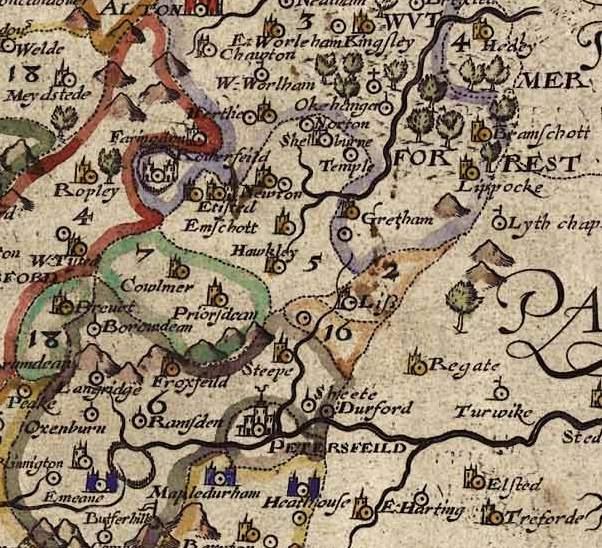
John Speed's map of 1607 shows it as Lippocke.[6]

Some people escaped from the manors of Bramshott, Chiltlee and Ludshott to Liphook, an area above the marshes around the River Wey, to evade taxes of their local Lords.[7]

The coaching age

[edit]

Liphook grew further as a coach stop on the London - Portsmouth route. In Tudor times mail was sent from London to Portsmouth via Southampton and the route through Liphook was only used in emergencies, such as the Armada of 1588. The map of 1675 by John Ogilby shows this road bypassing Bramshott and going through Lippock, however the quality of this road was very poor.

Originally travellers' needs were catered for by stalls, eventually replaced by the half-timbered houses that exist around The Square. Growth accelerated with wagons being replaced by coaches, and coaching in Liphook was firmly established by 1660. The roads were often unmaintained and unsigned - Samuel Pepys records three journeys by this road in May 1661, April 1662 and August 1668, on the last occasion staying in Lippock:

So to coach again, and got to Lippock, late over Hindhead, having an old man, a guide, in the coach with us; but got thither with great fear of being out of our way, it being ten at night. Here good, honest people; and after supper, to bed.[8][5]

refer to caption
The Royal Anchor coaching inn, The Square, Liphook

A coach service from London to Portsmouth started in 1688, which coincided with growth of The Royal Anchor coaching inn, and other 17th century buildings in The Square. The Royal Anchor has a fireback dated 1588 which supports the supposition that there was an earlier building on the site.[5]

In the 17th century the Royal Navy considered the road from Petersfield to Portsmouth impassable for heavy goods in winter. Improvements were made in the 18th century to roads and coaches along with the coming of the turnpike. Turnpiking between Petersfield and Portsmouth began in 1710 and between Kingston and Petersfield via Liphook in 1749. The Old Toll House by Radford Bridge in Liphook dates from the 18th century. Highwaymen were a problem in the 18th century as notices in the Royal Anchor show. By 1784 London-Portsmouth coaches carried mail through Liphook. Turnpiking reduced the journey from London-Portsmouth from two days in the 1660s to 10 hours in 1819. Cary's New Itinerary of 1819 records seven coaches on weekdays left London for Portsmouth via Liphook and three during the night.

Local tradition has it that Nelson spent his last night in England in Liphook before sailing for the Battle of Trafalgar. George III and Queen Charlotte on their stay gave permission for The Blue Anchor to be renamed The Royal Anchor.[9]

In Samuel Lewis's 1831 Topographical Dictionary of England, he referred to Liphook as a hamlet in the parish of Bramshott.[10]

The railway era

[edit]
Liphook Railway Station

The London and South Western Railway came to Liphook in 1859. The Portsmouth Direct line was built after the 1840s 'Railway Mania'. Originally the LSWR route from London to Portsmouth was via a branch from Southampton to Gosport, where passengers then went on the chain ferry across Portsmouth harbour. This lasted until the London, Brighton and South Coast Railway extended their London-Brighton line to Portchester. Initially the LSWR constructed a branch from Woking to Guildford in 1845 then Godalming in 1849, but were reluctant to extend it to Havant. Thomas Brassey, a railway contractor, was granted Act of Parliament to construct a single track in 1853 (doubling was completed on 1 March 1878 [11]). The first train arrived in Liphook on 24 January 1859, but a dispute between the LSWR and the LBSCR meant full service was not initiated until 7 May.[12]

Railways caused the long-distance coaching trade to reduce in the village. The railway station became the hub of short-distance horse-drawn transport, with the blacksmiths shop in The Square flourishing until at least 1918.[13]

refer to caption
Chiltlee Manor House, Liphook

The railway was originally planned to bypass Liphook, but the Liphook Deviation amendment of the Act of Parliament altered it to its present course. In doing so it bisected the estate of Chiltlee Manor, a split that exists to this day. The northern part remained as fields and the village cricket pitch, until its requisition to become the British Army's Ordnance Supply Unit in 1939. After decommissioning it was sold to Sainsbury's to form the site of their shop, the Millennium Centre and several other housing developments. The southern part was sold to Mary Anne Robb in 1869, who built the house of Chiltlee Place and the surrounding arboretum in 1880. In the 1960s the site was sold to the Berg firm of builders for construction of their housing estate.

Liphook's population grew modestly, from 1,367 in 1861 to 1,614 in 1891. The railway did not cause a more substantial increase, since many could not afford to pay the fare for more than an occasional excursion. The Kelly's Directory of 1895 shows far more shopkeepers in Liphook than Bramshott: Liphook had become the predominant centre of the Parish of Bramshott. A few wealthy people however saw the potential of commuter travel, notably Mary Ann Robb and London solicitor William Thomas Longbourn, who bought Foley Manor in 1859. He later sold it to William Barrington Tristram, a former member of the Bombay Council who built the house's Victorian extension.

20th century

[edit]

From 1916 to 1928 author and poet Flora Thompson[14] lived in Liphook where her husband was postmaster. Her first work, Bog-Myrtle and Peat, was published in 1921 when she lived in Liphook. The roads 'Lark Rise' and 'Candleford Gate' are named after two of the works.

During both World War I and II Liphook was the base for Canadian troops, particularly Bramshott Camp. Recent roads in Liphook have been given Canadian place names to commemorate the armed forces of that country which trained in this area during the World Wars. The cemetery of St Mary's church in Bramshott has a section of Canadian graves, including those of both war dead and victims of the influenza outbreak of 1918.[15]

Liphook was one of three sites (with Longmoor and Bordon) occupied by the Royal Engineers' Engineer Stores Depot which, in 1948, employed 700 men. It was established in 1943, originally called Chiltlee Manor Engineer Stores Depot and in 1945 was designated 2 Engineer Stores Depot under the War Office.[16] In 1948 the local MP (for Petersfield), General Sir George Jeffreys, asked the Secretary of State for War, Emanuel Shinwell, whether the men at Liphook were fully occupied as the men themselves stated that they were not. Mr Shinwell promised an investigation.[17] The depot continued its military function until it was closed in 1968.[18]

During the hot summer of 1983, Liphook made the news as the hottest spot (33.7C) in the United Kingdom on three days in July.[19][20]

Governance

[edit]

Liphook is in the parliamentary constituency of Farnham and Bordon, and included in the civil parish of Bramshott and Liphook together with several other settlements nearby.[2]

Amenities

[edit]
Liphook village centre

Transport

[edit]

Liphook was located on both the main road (A3) and rail (Portsmouth Direct line) links between London and Portsmouth, but is now bypassed by the A3. It is served by Liphook railway station.

Education

[edit]

Liphook is the location of the public school Churcher's College Junior school, (the Senior school being located in nearby Petersfield) and Highfield Brookham preparatory school. The site previously housed Littlefield school, which was bought by Churcher's and converted. Liphook is also the home of Bohunt School, a top fifty secondary state school.

Sport

[edit]
cricket match in progress
Liphook and Ripsley CC. Ripsley House beyond.

Liphook and Ripsley Cricket Club play on a ground to the southwest of the village just over the border in West Sussex. The club reached the National Village Cup final in 2018, but were beaten at Lord's by Folkton and Flixton by 72 runs.[21][22]

There are two golf courses near the village: Old Thorns, designed by Peter Alliss, is to the west of the village and Liphook Golf Club is to the south, straddling the Portsmouth Road that was formerly the A3.[citation needed]

Community and culture

[edit]

Liphook Millennium Centre contains a cinema and facilities for community events and occasions.[23] Amateur drama has been a feature of village life since before World War 2. Liphook Amateur Dramatic Society (LADS) existed at least between the 1930s (revived 1955) and 1969.[24] Two companies currently (2014) exist - Liphook Amateur Productions (LAMPS) and The MAD (Methodist Amateur Dramatic) Company.[25]

Local attractions and business

[edit]

Local attractions include the Hollycombe Steam Collection. On the last day of British Summer Time (usually the last Saturday in October) the village holds the Liphook Carnival with a procession of floats through the village followed by a bonfire and fireworks. It has taken place since 1903. "Liphook in Bloom" is an annual floral competition.[2][26] Champneys health spa is west of the village at Forest Mere, a Site of Special Scientific Interest.[27]

Notable people

[edit]

References

[edit]
[edit]
Revisions and contributorsEdit on WikipediaRead on Wikipedia
from Grokipedia
Liphook is a large village in the district of , , situated approximately four miles west of along the , which bypasses the settlement.
The village forms part of the Bramshott and Liphook , which covers 6,540 acres and had a of 9,763 at the 2021 , though the core Liphook area itself is estimated at 7,129 residents.
Nestled in the rolling countryside near the borders of and , Liphook is adjacent to the and is characterized by its historic charm as a designated conservation area since 1977.
The area's origins trace back to the of 1086, which records early settlement at nearby Chiltlee with four households amid the royal hunting grounds of Woolmer Forest, while the name "Liphook" first appears in historical records around 1364.
Liphook gained prominence from the onward as a key coaching stop on the vital London-to-Portsmouth route, with improved roads and regular coach services from 1688 spurring roadside inns like the rebuilt 17th-century Royal Anchor; this era saw visits from figures such as diarist in the 1660s and, reportedly, Admiral Lord Nelson before the .
The arrival of the railway in 1859 brought modest growth, with population rising from 1,367 in 1861 to 1,614 by 1891, though the village retained its rural character; during both World Wars, it served as a base for Canadian troops.
Today, Liphook is renowned for its amenities and community spirit, including the prestigious Liphook Golf Club—opened in 1923 and praised by the Royal and Ancient Golf Club of for its exemplary heathland course—and the Liphook Equine Hospital, one of the UK's largest specialist veterinary practices dedicated to equine care.
The village supports a vibrant local economy with shops, a monthly market, and events like the annual Liphook Carnival, which raises funds for charities, alongside educational facilities, churches, and recreational options such as walks in the surrounding countryside.
Notable attractions nearby include the Hollycombe Steam Collection and the Champneys Forest Mere , enhancing Liphook's appeal as a gateway to the region's natural and historical landscapes.

Geography and Demography

Physical Geography

Liphook is a village situated in the district of , , approximately 4.1 miles (6.6 km) west of . It occupies a position on the borders of , , and , with an grid reference of SU8331 and geographic coordinates of 51.076°N 0.803°W. The village forms part of the Bramshott and Liphook , which encompasses an area of 6,540 acres (26.5 km²) and includes surrounding settlements such as Bramshott, Griggs Green, and Conford. The topography of Liphook is characterized by its location on the western edge of the , a region of undulating countryside featuring a mix of farmland, heathland, and woodland. Elevations in the area range from around 100 to 150 meters above on average, with higher points reaching up to 191 meters in the surrounding chalk hills of the westernmost . The village's landscape is influenced by its proximity to the to the south and the expansive Ludshott Common, a National Trust-managed heathland reserve covering over 100 hectares immediately to the north and east. Environmental features in and around Liphook contribute significantly to local , with ancient woodlands and open supporting diverse and fauna. Sites such as Gillham's Wood, an ancient semi-natural woodland managed by the , harbor species like , , and , alongside habitats for birds and . Commons including Ludshott and Bramshott provide lowland heathland ecosystems, home to reptiles such as adders and sand , as well as ground-nesting birds and rare ; these areas are actively restored through scrub clearance and grazing to maintain their ecological value. The construction of the bypass in the early 1990s has notably shaped the local geography, routing the to the north of the village and creating a significant linear feature that separates parts of the heathland and while reducing through-traffic on older routes. This infrastructure alters drainage patterns and visual connectivity in the Wealden landscape but facilitates access to the surrounding natural areas.

Demography

According to the 2021 Census, the of Bramshott and Liphook, which encompasses Liphook, had a of 9,763, while the corresponding ward recorded 9,771 residents. The Liphook village built-up area had an estimated of 7,129 in 2021, up from 6,457 in 2011, reflecting an annual growth rate of approximately 1.6% over the decade. The grew from 8,491 in 2011 at an annual rate of 1.4%. This steady increase aligns with broader trends in , where the district's rose by 8.7% from 2011 to 2021. Demographic composition in the Bramshott and Liphook ward reveals a higher proportion of residents aged 45 and over, comprising about 53% of the population in 2021, which is characteristic of rural communities. is overwhelmingly at 95%, with Asian residents at 1.9%, Black at 0.5%, and mixed or other ethnic groups making up the remainder. shows as the largest group at 51.3%, though the proportion identifying with no has risen to 40.9%, mirroring national shifts toward . Socio-economic indicators point to low deprivation, with Liphook's lower-layer super output areas ranking in the least deprived quintile nationally under the Index of Multiple Deprivation 2019. The average household size in East Hampshire, including Liphook, stands at 2.39 persons, supporting a stable family-oriented structure. Home ownership is prevalent at 73%, bolstered by the area's position in the London commuter belt, which drives inbound migration from urban centers and enhances quality-of-life rankings.

History

Origins and Pre-Coaching Era

The origins of Liphook are closely intertwined with the broader parish of Bramshott in eastern , where the area formed part of medieval manorial lands on the edge of the ancient of Woolmer. Although Liphook itself is not mentioned in the of 1086, the surrounding manors of Bramshott, Ludshott, and Chiltlee are recorded, reflecting a sparse rural dominated by agricultural and activities. Bramshott manor, held by Edward of Salisbury from the king, supported 13 households with 5 ploughlands, 2 acres of meadow, woodland capable of sustaining 4 swine, and 2 mills valued at 8s 2d annually. Chiltlee, a smaller holding under direct royal ownership, had 4 households, 2 ploughlands, and woodland for 30 swine, indicating an economy reliant on arable farming, pastoral grazing, and woodland resources for pig rearing and other forest products. Ludshott manor, under Hugh of Port, similarly featured 10 households, limited ploughlands, and extensive woodland for 50 swine, underscoring the region's focus on self-sufficient agrarian pursuits amid dense forest cover. Early settlement in the Liphook area remained limited and dispersed during the medieval period, with no major structures or urban development predating the 17th century. The population was small and tied to the feudal manorial system, where tenants worked commons and woodlands for subsistence farming, supplemented by minor ironworking in nearby sites like Waggoners Wells. Growth was constrained by poor road infrastructure, which isolated the area from wider trade networks and reinforced its role as a peripheral extension of Bramshott parish rather than an independent community. The first specific reference to Liphook appears in local records around 1364, evolving from earlier variants like "Lhupe" and marking the gradual emergence of a distinct hamlet within the Chiltlee manor bounds. By the late medieval period, the area supported a modest centered on common lands for and wood collection, with no of substantial buildings or population concentrations until transport improvements later spurred change. The name "Liphook," possibly deriving from elements suggesting a "leaping place" associated with enclosures or deer parks in the , reflects this rustic, woodland-oriented heritage.

Coaching Age

Liphook's emergence as a coaching stop began in the late , owing to its strategic position along the Portsmouth Road, a vital route connecting to the naval port of . The village's location, facilitated by the relatively level of the surrounding Wealden , made it a convenient halting point for travelers navigating the often treacherous roads. By the 1660s, services had become established here, with wagons gradually giving way to faster stagecoaches that required regular changes of horses and provisions. Central to this development were the coaching inns, particularly the Royal Anchor, an early 18th-century establishment that served as a primary hub for rest and resupply. Originally a timber-framed building typical of roadside from the period, the inn catered to passengers, coachmen, and guards, offering ale, meals, and stabling for teams of . Other establishments, such as the Anchor Inn, complemented this role, fostering a local economy centered on and transport-related services. flourished in horses for coach relays, blacksmith repairs for carriages, and the brewing of ale to quench the thirst of weary travelers, drawing merchants and laborers to the area and stimulating ancillary commerce. The introduction of the first service in marked a pivotal advancement, with the Royal Mail running daily from to and stopping at Liphook for changes, typically lasting around 40 minutes. This service, guarded against threats and operating at speeds up to 8 miles per hour, heightened the village's importance, as mail coaches carried not only correspondence but also passengers and valuables. Socially, the influx of traffic brought diverse visitors, including naval personnel and , while the era also saw incidents of highwaymen preying on the routes nearby, such as a notorious theft of a post-boy's just outside Liphook in the late , leading to the robber's capture and transportation. These events underscored the risks of travel but also highlighted the vigilance of local authorities and innkeepers. By the early , around 1830, Liphook had reached the peak of its coaching prominence, with a expanding from a modest handful of families in the mid-17th century to several hundred residents, supported by the steady flow of coaches—up to dozens daily on the busiest routes. The village's timbered buildings and clustered inns reflected this prosperity, embodying a transition from agrarian to dynamic roadside settlement. However, this era's foreshadowed decline, as improvements in road maintenance and the looming advent of railways began to erode the dominance of horse-drawn transport by the 1830s.

Railway Era

The arrival of the railway marked a pivotal shift in Liphook's development during the mid-19th century, transitioning the village from reliance on road-based coaching traffic to a more integrated rail network. The Portsmouth Direct Line, constructed by the London and South Western Railway, reached Liphook with the opening of the full route from to on 1 January 1859, providing a direct link to Waterloo and bypassing longer indirect paths via Bishopstoke. Liphook railway station was established as part of this infrastructure, featuring a modest design suited to the era's engineering standards and serving as a key stop on the 46-mile line to . This connection reduced journey times to to approximately 1.5 hours, facilitating easier access for residents and visitors alike. The railway's introduction spurred gradual economic and demographic changes in Liphook, though growth remained measured compared to other rail-served locales. The population of the encompassing Bramshott parish, centered on Liphook, rose from 1,367 in to 1,614 by 1891, reflecting incremental expansion driven by improved transport rather than explosive urbanization. This shift transformed the local economy from dependence on coaching inns and turnpike roads—evident in the diminished prominence of establishments like the Royal Anchor Hotel, once a bustling stop for travelers—to one oriented around rail services, including goods handling and passenger traffic that supported nearby and trade. Socially, the railway era brought new dynamics to Liphook by the early , attracting an influx of daily commuters to and seasonal tourists drawn to the countryside via the efficient Portsmouth Direct Line. The station's role in this period underscored the end of the coaching age's dominance, as rail travel supplanted horse-drawn routes and integrated Liphook more firmly into the national transport web, though without the dramatic booms seen in larger towns.

Modern Developments

During the First World War, Bramshott Camp near Liphook served as one of the largest training areas for Canadian troops in the , accommodating tens of thousands of soldiers who integrated into the local community. Over 318 Canadian soldiers who died during their training, many from the 1918 influenza pandemic, are buried in the churchyard of in Bramshott. In the Second World War, the camp again hosted Canadian forces, though fatalities were typically interred at Brookwood Military Cemetery rather than locally. Following the Second World War, Liphook experienced suburban expansion, with new housing developments constructed primarily in the northern and eastern areas of the village to accommodate growing populations. This growth reflected broader post-war trends in rural , transforming parts of the settlement from woodland edges into residential zones. The , a key route through Liphook, saw significant upgrades in the late ; proposals for a bypass around Liphook and emerged in the early 1960s, with the dual-carriageway section ultimately opening in 1992, two months ahead of schedule and at a cost of £37 million, which alleviated through-traffic congestion in the village center. In the , the Bramshott and Liphook Neighbourhood Development Plan (2020-2040), adopted by District Council in November 2024, guides by allocating sites for up to approximately 600 new homes, emphasizing , climate adaptation measures, and enhancement through . The parish's population reached 9,763 by the 2021 , reflecting steady growth driven by these housing initiatives. Recent proposals in the 2020s include developments such as up to 200 homes at Penally Farm and around 600 at land south of Longmoor Road, alongside retirement living apartments, all integrated into the neighbourhood plan's framework for managed expansion. Infrastructure improvements have continued to shape Liphook's connectivity; the , opened in 2011 as part of a 4-mile dual-carriageway upgrade on the , bypassed the notorious crossroads, reducing journey times by up to 20 minutes during peak periods and decreasing traffic volumes on local minor roads near Liphook. Flood management efforts intensified after groundwater and events in the early 2000s, including incidents in 2000-2001 and 2002-2003; East Hampshire's Strategic Risk Assessment now incorporates site-specific mitigation, such as land safeguarding for drainage, to address ongoing risks in low-lying areas.

Governance

Local Government

Liphook forms part of the of Bramshott and Liphook, governed at the local level by the Bramshott and Liphook Parish Council, which serves the communities of Bramshott, Liphook, Conford, Griggs Green, Hammer Vale, and Passfield. The council comprises 12 elected members, with elections held every four years, and is responsible for delivering services such as the maintenance of open spaces and commons, including Bramshott Common and Ludshott Common, alongside oversight of community facilities like the Liphook Millennium Centre. The parish council also administers community grants to support local initiatives and engages in local consultations to represent resident interests. Full council meetings and specialized committees—covering , finance and policy, and recreation and open spaces—occur monthly, typically on the first Monday, and are open to the public. At the district level, Liphook lies within the Bramshott and Liphook ward of District Council, established in 1974 under the Local Government Act 1972 to handle responsibilities including housing, planning, waste collection, and leisure services. provides upper-tier services for the area, encompassing education, social care, highways, and libraries. The Bramshott and Liphook leads the implementation of the Bramshott and Liphook Neighbourhood Development Plan (2020-2040), adopted by on 28 November 2024 and by the South Downs National Park Authority on 12 December 2024 following a positive . This plan sets policies for housing growth, directing development to brownfield sites within settlement boundaries and targeting 47 affordable homes by 2040, while emphasizing through measures like 10% net gain and preservation of . initiatives include aims for net-zero carbon emissions by 2050 via energy-efficient building designs and promotion, alongside protections for local commons and corridors to mitigate climate impacts. The monitors progress and collaborates with authorities to ensure alignment with broader policies on housing and the environment.

National Representation

Liphook forms part of the and parliamentary constituency, established following the 2024 boundary review by the Boundary Commission for , which redrew constituencies to reflect changes. Prior to this, the village was within the constituency, represented since 2010 by Conservative MP . The new cross-county seat, encompassing areas of both and including Liphook, , , and , is currently held by Conservative MP Gregory Stafford, who was elected in the July 2024 with 35.7% of the vote (18,951 votes), defeating the Liberal Democrat candidate by a narrow margin of 1,349 votes. Historically, the constituency, which included Liphook, was a Conservative stronghold, with the party securing majorities exceeding 20,000 votes in elections from 2010 to 2019. In the , won with 59.1% of the vote, reflecting strong local support for Conservative policies on rural issues and infrastructure. The 2024 results in and indicate a shift, with the Conservative vote share dropping to 35.7% amid national trends, while Liberal Democrats gained ground at 33.2%, highlighting increasing competition in semi-rural seats like this one. In the 2016 EU referendum, voters narrowly favored remaining in the , with 50.5% (37,346 votes) supporting Remain and 49.5% (36,576 votes) backing Leave, on a turnout of 81.6%. This close result contrasted with the broader Leave vote across (approximately 55%), underscoring Liphook's position in a more balanced electoral district influenced by its proximity to urban centers like . Portions of Liphook lie within the , where the Authority (SDNPA) exercises powers that directly affect local development and land use decisions. The SDNPA, as the local authority for the park area since 2011, collaborates with District Council on initiatives like the Bramshott and Liphook Neighbourhood Development Plan, influencing policies on housing, conservation, and infrastructure to balance objectives with community needs. This governance structure ensures that national environmental priorities, such as protection, shape decisions impacting the village's growth.

Amenities and Economy

Transport

Liphook's road network is dominated by the trunk road, a major route connecting to , which bypasses the village via the 12-mile and Liphook dual carriageway opened on 9 1992. This infrastructure alleviated heavy through-traffic from the village center, with local roads such as Road (now the B2070) serving as primary access points for residents and businesses. The completion of the Hindhead Tunnel in 2011, located approximately 5 miles north of Liphook, further improved regional connectivity by eliminating the single-carriageway bottleneck at and reducing traffic volumes on nearby minor roads, including those approaching Liphook from the north. Post-opening evaluations indicate a notable decrease in local road usage near the scheme, enhancing safety and flow for non-trunk routes in the area. Rail transport centers on Liphook railway station, situated on the Portsmouth Direct Line between London Waterloo and Portsmouth Harbour. Operated by South Western Railway, the station offers direct services to London Waterloo with typical journey times of 60 to 90 minutes and an average of around 1 hour 4 minutes; trains run hourly during peak periods, with the first departure at approximately 05:14 on weekdays. Facilities at the station include a ticket office (open select hours), ticket machines, sheltered waiting areas, 74 car parking spaces, bicycle storage, and step-free access via ramps, though it lacks on-site baby changing or first-class lounges. In the year April 2023 to March 2024, the station recorded 548,000 passenger entries and exits, reflecting its role as a key commuter hub with post-pandemic recovery. Bus services provide additional local and regional links, primarily operated by Stagecoach South. Route 23 connects Liphook to with frequent services throughout the day, while routes 113 and 123 extend to Alton College via and , operating on weekdays and supporting access to and sites. A local circular service, route 250, also serves intra-village travel on weekdays. Cycling infrastructure supports sustainable travel, with a prominent 9-mile circular trail starting and ending in Liphook that traverses Ludshott Common, Woolmer Forest, and nearby villages like Bramshott and Conford, promoting off-road exploration within the . The station offers covered cycle storage to facilitate multimodal journeys. Liphook has no on-site airport, with the nearest facilities being , approximately 26 miles southwest, and London Heathrow Airport, about 40 miles northeast, both accessible via the and rail connections.

Education

Liphook provides a range of educational institutions catering to children from early years through secondary level, with options in both state and independent sectors. The primary provision is served by the Liphook Federation, which encompasses for ages 4-7 and Liphook Church of England Controlled Junior School for ages 7-11, both located on Avenue Close in the village center. enrolls approximately 270 pupils and received an "Outstanding" rating across all inspection categories from in June 2022. Similarly, Liphook Junior School serves around 364 pupils and was rated "Outstanding" overall by in December 2021, with particular praise for its curriculum and pupils' personal development. For independent primary education, Churcher's College Junior School and Nursery, situated on Midhurst Road, offers co-educational provision for ages 3-11 with about 250 pupils. As part of , which has its senior school in nearby , the junior school emphasizes a broad curriculum including academic, creative, and extracurricular activities, and was rated "Excellent" in all areas by the Independent Schools Inspectorate in November 2022. Secondary education in Liphook is primarily provided by Bohunt School, an academy converter on Longmoor Road serving ages 11-18 with over 1,900 pupils, including a sixth form. The school, which draws students from the surrounding area, was inspected by Ofsted in March 2024 and rated "Good" overall, with "Outstanding" judgments for behaviour and attitudes, personal development, and sixth-form provision. Further education opportunities for post-16 students are available through Bohunt School's sixth form, while adult learners in Liphook can access programs offered by Hampshire County Council, including tailored courses in skills development, community education, and lifelong learning initiatives for those aged 19 and over. The proximity to Petersfield, approximately 5 miles away, also allows access to additional post-16 options at institutions such as Churcher's College senior school.

Healthcare and Community Services

Liphook residents have access to primary healthcare through two (GP) surgeries operated by the Swan Medical Group: the Liphook Village Surgery located in the village center at The Square and the Liphook Station Road Surgery near the railway station. These practices offer routine medical consultations, chronic disease management, and minor procedures, with the Village Surgery noted for its accessibility features for disabled patients. Local pharmaceutical services are provided by on Road, which dispenses prescriptions and offers over-the-counter advice. For secondary care, the nearest facilities are Hospital in , approximately 5 miles north, and Petersfield Hospital in , about 7 miles east, both delivering community-based services such as rehabilitation and outpatient treatments. Community health coverage, including district nursing and health visiting, falls under the and Healthcare , which serves . Community services in Liphook emphasize social support and welfare, with the Millennium Centre serving as a key hub for elderly and social care activities. This venue hosts regular events like monthly coffee mornings for social interaction, (U3A) meetings, and art and history groups tailored to seniors, fostering and reducing isolation. The Bramshott and Liphook Parish Council administers welfare grants to local organizations and charities that provide services benefiting parish residents, such as support for vulnerable groups and community facilities. resources are accessible through -wide services from the Healthcare , including community-based talking therapies and crisis support at the Adults' Safe Haven in nearby Leigh Park; options are also available via the Swan Medical Group. Post-COVID provisions have enhanced local healthcare resilience, with Swan Medical Group surgeries hosting joint flu and vaccination clinics from 2021 onward, including dedicated sessions at Liphook sites to boost uptake among eligible residents. The Vaccination Clinic, operational until February 2022, served the broader area including Liphook residents during the peak rollout period of 2021-2023. Addressing the aging population—where 24.5% of residents are over 65, with Liphook identified for higher rates—local strategies prioritize through improved , digital inclusion, and independence-promoting initiatives under the Welfare and Wellbeing Strategy 2024-2029.

Sport and Leisure

Liphook is home to several established sports clubs that foster community engagement through competitive and recreational play. The Liphook & Ripsley Cricket Club, a prominent local institution, fields multiple adult and youth teams in leagues such as the Southern Premier Cricket League and Hampshire Cricket League, with a thriving colts section for ages U9 to U15. The club achieved national recognition as finalists in the 2018 National Village Cup, competing at against Folkton & Flixton. Liphook Golf Club offers an 18-hole heathland course, opened in 1923 and praised for its traditional design and challenging layout within the . Tennis enthusiasts can join the Liphook Lawn Tennis Club, which features three floodlit hard courts and three grass courts at the Memorial Recreation Ground for matches, coaching, and league participation. Football is supported by Liphook United Football Club, an amateur outfit competing in the with teams for seniors, reserves, and youth sections. Recreational facilities in Liphook provide diverse options for fitness and outdoor pursuits. The Liphook Centre serves as a key hub with versatile halls suitable for fitness classes, group exercises, and indoor activities, accommodating events for all ages. Walking trails on Ludshott Common, a National Trust-managed heathland site spanning over 1,000 acres adjacent to Liphook, offer accessible paths for leisurely strolls and nature exploration, including circular routes averaging 2.7 miles. Equestrian activities are available at nearby Hewshott Farm Stables, a British Horse Society-approved center providing riding lessons, hacking routes, and livery services for beginners to advanced riders. Local events emphasize inclusive participation in sports. The Liphook Village Sports Day, held annually, features free sessions from various clubs at Bohunt School, promoting multi-sport experiences for residents of all ages. Community surveys indicate moderate engagement, with organized sports drawing participation from a notable portion of the population through these clubs and events.

Local Economy and Businesses

Liphook's local economy is characterized by low unemployment and a reliance on commuting, with the 2021 Census recording an unemployment rate of 3.2% for residents aged 16 and over; as of the year ending December 2023, the unemployment rate in East Hampshire was 2.8%, influenced by the COVID-19 pandemic, while the East Hampshire claimant count stood at approximately 2% in early 2023. Employment is dominated by professional and service-oriented sectors, with occupations in professional roles accounting for 23% of the workforce, managers and senior officials at 19%, and associate professional and technical positions at 14%, reflecting a skilled commuter base traveling to London and Guildford via the local railway station. Retail and construction also play notable roles district-wide, contributing around 20% and 15% to employment in East Hampshire as of 2021, though Liphook itself lacks large-scale manufacturing or industrial operations. The village supports a range of small businesses and local commerce, centered on Midhurst Road, which hosts essential retail outlets including a Sainsbury's , Argos store, and independent shops offering clothing, interiors, and daily goods. provides a key economic boost through the nearby Hollycombe Steam Collection, a major attraction featuring historic fairground rides and steam engines that draws visitors to the area, supporting related services and seasonal jobs. Small enterprises thrive in , exemplified by local market gardens like Ed's Veg, which grows organic produce on a three-acre site, and gardening firms such as Plums & Roses offering design and maintenance services. firms operate on a modest scale, often home-based or small-scale, contributing to the village's entrepreneurial fabric without dominating the economy. Overall, Liphook maintains a residential focus, with no major industries but a vibrant array of independent shops and service providers. Economic trends in Liphook emphasize and local job retention, as outlined in the Bramshott and Liphook Development Plan (2020-2040, adopted in 2024), which through Policy BL19 safeguards existing sites and promotes new flexible workspaces to reduce out-commuting and foster start-ups. The plan also supports sustainable under Policy BL21, encouraging job creation in visitor accommodations and facilities aligned with the National Park's strategies. Household incomes reflect relative affluence, averaging £57,500 annually in Bramshott and Liphook, surpassing the national median of approximately £35,000. This higher income level underscores the commuter-driven , enabling investment in local sustainable businesses.

Culture and Society

Community and Cultural Life

Liphook's community life is enriched by various groups and volunteer networks that foster social connections and support local initiatives. The Bramshott & Liphook Care Group, a registered charity, provides essential services to hospitals and surgeries for elderly and infirm residents, relying on a dedicated team of volunteers. Annual events such as the Liphook Carnival, held in late , bring the community together through parades, floats, , and fundraising for local charities, with preparations involving widespread volunteer participation. Similarly, the Christmas lights display in the village square, organized by the parish council, creates a festive atmosphere and has been a supported by community efforts despite occasional installation challenges. Cultural heritage in Liphook is preserved through dedicated organizations focused on the village's historical roots, particularly its coaching-era significance as a stop on the London to route. The Liphook Heritage Centre maintains archives, artifacts, and oral histories documenting local buildings from the 18th and 19th centuries, including inns and structures tied to the trade, and offers guided walks and publications to educate residents. The Liphook Conservation Area, centered on these historic elements, is managed under a character appraisal that outlines actions for preservation and enhancement, ensuring the architectural legacy remains integrated into modern village life. Artistic activities thrive at the Liphook Millennium Centre, a multi-purpose venue hosting productions, musical performances, and cinema screenings, providing accessible cultural outlets for residents. Modern community initiatives emphasize inclusivity and digital engagement to strengthen social fabric. The Bramshott and Liphook Neighbourhood Development Plan (2020-2040), adopted in 2024, incorporates policies for affordable housing, accessible transport, and inclusive design in new developments, promoting equitable growth while consulting broadly with residents. The liphook.uk website serves as a central digital hub, offering news, event listings, a talkback forum for discussions, and a quarterly community magazine compiled by volunteers to encourage participation and creativity. Following the COVID-19 pandemic, cultural recovery efforts received support through government grants, such as £100,000 to the nearby Hollycombe Working Steam Museum in 2022, aiding the resumption of heritage events and reinforcing community cultural activities.

Notable People

Flora Thompson (1876–1947), an English author and poet best known for her semi-autobiographical trilogy , resided in Liphook from 1916 to 1928 while her husband served as postmaster at the local post office on London Road. During this period, the rural surroundings of Liphook, including Weavers Down and Holly Hills, profoundly influenced her writing, providing the pastoral inspirations for her depictions of 19th-century English countryside life. Thompson's time in the village also saw her publish nature essays and form the Peverel Society, a local literary group. Pete Wingfield (born 1948), an English musician, record producer, and songwriter renowned for his hit "Eighteen with a Bullet," was born and raised in Liphook. Growing up in the village, Wingfield developed his early interest in American R&B and , learning as a boy before pursuing a career that included session work with artists like and . His roots, including Liphook, shaped his foundational musical influences amid the local post-war cultural scene. Olivia Breen (born 1996), a British Paralympic sprinter specializing in the T38 category, was born and raised in Liphook, where she attended Bohunt School and began her athletic training on local tracks. The supportive community environment in Liphook contributed to her breakthrough at the 2012 London Paralympics, where she was the youngest competitor, and she has since won multiple medals, including bronze in the T38 100m at Tokyo 2020. At 2024, as co-captain of the ParalympicsGB team, she placed fourth in the F38 . Breen's family home in Liphook remains a base for her training, underscoring the village's role in her ongoing career. Liphook's association with Canadian forces spans both World Wars through Bramshott Camp, a major training base that hosted thousands of troops, including members of the who later took part in liberations such as in the during WWII. Over 318 Canadian servicemen, mainly from WWI, are buried in the nearby St. Mary's Churchyard. Beatrice Webb (1858–1943), a pioneering British socialist economist and co-founder of the London School of Economics, retired to Liphook in 1928 with her husband Sidney, living there until her death. The quiet setting provided a reflective space for her later writings on social reform, though her primary contributions predated her residency.

References

Add your contribution
Related Hubs
User Avatar
No comments yet.