
Recent from talks
Treaty of the Pruth
Knowledge base stats:
Talk channels stats:
Members stats:
Treaty of the Pruth
The Treaty of the Pruth was signed on the banks of the river Prut between the Ottoman Empire and the Tsardom of Russia on 23 July 1711 ending the Russo-Turkish War of 1710–1713 with the assistance of Peter Shafirov. The treaty was a political victory for the Ottoman Empire.
The Treaty stipulated the return of Azov Fortress to the Ottomans, Taganrog and several Russian fortresses were to be demolished, and the Tsar pledged to stop interfering in the affairs of the Polish–Lithuanian Commonwealth, which the Russians increasingly saw as under their sphere of influence. The treaty also stipulated the safe return of King Charles XII to Sweden.
The indirect causes of the war can be attributed to the aggressive expansion of the Swedish Empire throughout the 16th and 17th centuries. Sweden’s aggressive expansion in Scandinavia forced a coalition of Eastern European nations to form and contain them, including the Tsardom of Russia. After defeat at the Battle of Narva in 1700, Russia was invaded by King Charles XII as part of the Great Northern War. The invasion of Russia was unsuccessful, and many of Charles’ army died of disease and attrition. In addition, Peter the Great's reign consisted of a period of increasing western influence and orientation, characterised by establishing the capital of Russia as Saint Petersburg in 1703, opening direct naval links to the west.
The Pruth River Campaign erupted as a direct result of the defeat of King Charles XII at the Battle of Poltava in the summer of 1709 and his retreat into the Ottoman Empire. In February 1710, General Stanislaw Poniatowski, father of the last Polish King, was sent to Constantinople by King Charles XII as his envoy after it became clear to the monarch that he would have no safe passage through Poland back to Sweden to continue the Great Northern War. In his role as envoy, the General was to accomplish the following tasks: (i) to work for the deposition of the Grand Vizier Tchorlulu Ali Pasha, who was considered friendly to the Russians, (ii) to prepare the foundations of a Turkish-Swedish alliance (directed against Russia), (iii) to bring Turkey into a war against Russia; (iv) to prevent the recognition of Augustus II as King of Poland by the Sublime Porte; (v) to secure the 'escort' for the Swedish King in conformity with the former promises of Sultan Ahemet III and (vi) to arrange a money loan from the Sublime Porte.
Despite repetitive calls from Russia to extradite King Charles, the Ottoman Court refused. These repetitive calls and aggressive diplomacy on behalf of King Charles XII lead the Ottomans to declare war on Russia on 20 November 1710. Concurrently, Russia and Moldavia (now Romania) signed an agreement which guaranteed Russian military access through Moldavia and promised troops and logistics.
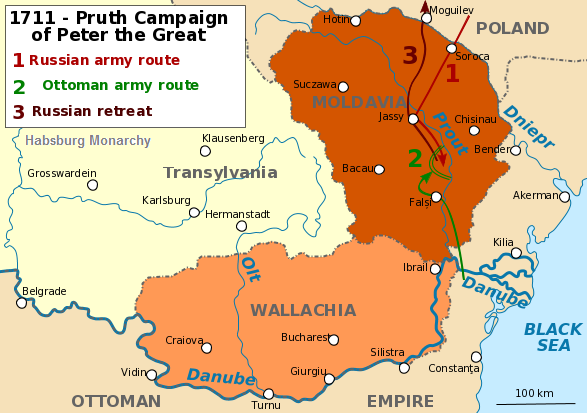
A Russian army of 80,000 men advanced down the Pruth River in the summer of 1711, utilising Moldavian support and military access. The army was led by Peter the Great and Boris Sheremetev and attempted to invade Ottoman occupied Moldavia with the support of exiled ruler (Voivode) of Moldavia Dimitrie Cantemir. The campaign was ill-prepared and lacked proper planning and logistic support, and although the Russian army was large and well equipped, it was outmanoeuvred by a 70,000 strong Ottoman army under the command of Grand Vizier Baltacı Mehmet Pasha.
The decisive moment of the campaign was the four-day Battle of Stănilești, which began on 18 July 1711. The two armies engaged on the floodplains of the Pruth River in an unprepared battle. The battle was so unexpected that General Stanislaw Poniatowski hurriedly wrote to King Charles XII during the engagement on small pieces of paper and dated it 1710 rather than 1711. His letters were delivered to the Swedish monarch by Captain Busquet and the King tried in vain to make it to the negotiations, favouring a renewed Ottoman campaign to capture Kiev and Ukraine. During the engagement, Ottoman forces surrounded and cut off the large Russian army, leading to their eventual surrender on 22 July.
The Russian army was fully surrounded by 22 July, leading Peter to open peace negotiations with Grand Vizier Baltaci Mehmet Pasha. The situation that arose gave the Ottomans a dominant negotiating position, which was further aggravated by the calls for harsher terms by General Stanisław Poniatowski – the emissary of King Charles XII.
Hub AI
Treaty of the Pruth AI simulator
(@Treaty of the Pruth_simulator)
Treaty of the Pruth
The Treaty of the Pruth was signed on the banks of the river Prut between the Ottoman Empire and the Tsardom of Russia on 23 July 1711 ending the Russo-Turkish War of 1710–1713 with the assistance of Peter Shafirov. The treaty was a political victory for the Ottoman Empire.
The Treaty stipulated the return of Azov Fortress to the Ottomans, Taganrog and several Russian fortresses were to be demolished, and the Tsar pledged to stop interfering in the affairs of the Polish–Lithuanian Commonwealth, which the Russians increasingly saw as under their sphere of influence. The treaty also stipulated the safe return of King Charles XII to Sweden.
The indirect causes of the war can be attributed to the aggressive expansion of the Swedish Empire throughout the 16th and 17th centuries. Sweden’s aggressive expansion in Scandinavia forced a coalition of Eastern European nations to form and contain them, including the Tsardom of Russia. After defeat at the Battle of Narva in 1700, Russia was invaded by King Charles XII as part of the Great Northern War. The invasion of Russia was unsuccessful, and many of Charles’ army died of disease and attrition. In addition, Peter the Great's reign consisted of a period of increasing western influence and orientation, characterised by establishing the capital of Russia as Saint Petersburg in 1703, opening direct naval links to the west.
The Pruth River Campaign erupted as a direct result of the defeat of King Charles XII at the Battle of Poltava in the summer of 1709 and his retreat into the Ottoman Empire. In February 1710, General Stanislaw Poniatowski, father of the last Polish King, was sent to Constantinople by King Charles XII as his envoy after it became clear to the monarch that he would have no safe passage through Poland back to Sweden to continue the Great Northern War. In his role as envoy, the General was to accomplish the following tasks: (i) to work for the deposition of the Grand Vizier Tchorlulu Ali Pasha, who was considered friendly to the Russians, (ii) to prepare the foundations of a Turkish-Swedish alliance (directed against Russia), (iii) to bring Turkey into a war against Russia; (iv) to prevent the recognition of Augustus II as King of Poland by the Sublime Porte; (v) to secure the 'escort' for the Swedish King in conformity with the former promises of Sultan Ahemet III and (vi) to arrange a money loan from the Sublime Porte.
Despite repetitive calls from Russia to extradite King Charles, the Ottoman Court refused. These repetitive calls and aggressive diplomacy on behalf of King Charles XII lead the Ottomans to declare war on Russia on 20 November 1710. Concurrently, Russia and Moldavia (now Romania) signed an agreement which guaranteed Russian military access through Moldavia and promised troops and logistics.
A Russian army of 80,000 men advanced down the Pruth River in the summer of 1711, utilising Moldavian support and military access. The army was led by Peter the Great and Boris Sheremetev and attempted to invade Ottoman occupied Moldavia with the support of exiled ruler (Voivode) of Moldavia Dimitrie Cantemir. The campaign was ill-prepared and lacked proper planning and logistic support, and although the Russian army was large and well equipped, it was outmanoeuvred by a 70,000 strong Ottoman army under the command of Grand Vizier Baltacı Mehmet Pasha.
The decisive moment of the campaign was the four-day Battle of Stănilești, which began on 18 July 1711. The two armies engaged on the floodplains of the Pruth River in an unprepared battle. The battle was so unexpected that General Stanislaw Poniatowski hurriedly wrote to King Charles XII during the engagement on small pieces of paper and dated it 1710 rather than 1711. His letters were delivered to the Swedish monarch by Captain Busquet and the King tried in vain to make it to the negotiations, favouring a renewed Ottoman campaign to capture Kiev and Ukraine. During the engagement, Ottoman forces surrounded and cut off the large Russian army, leading to their eventual surrender on 22 July.
The Russian army was fully surrounded by 22 July, leading Peter to open peace negotiations with Grand Vizier Baltaci Mehmet Pasha. The situation that arose gave the Ottomans a dominant negotiating position, which was further aggravated by the calls for harsher terms by General Stanisław Poniatowski – the emissary of King Charles XII.
Recent media