Hubbry Logo
PrutPrutMain
Open search
Prut
Community hub
Prut
logo
8 pages, 0 posts
0 subscribers
Be the first to start a discussion here.
Prut
Prut
from Wikipedia
Prut
Porata, Pyretus
Map of the Prut River
Map
Location
Country
Oblasts/
Counties/
Districts
Ukraine:
Romania:
Moldova:
Cities
Physical characteristics
SourceMt. Hoverla, Carpathian Mountains
 • locationYablunytsia, Nadvirna Raion, Ivano-Frankivsk Oblast, Ukraine
 • coordinates48°9′16.9194″N 24°30′32.2194″E / 48.154699833°N 24.508949833°E / 48.154699833; 24.508949833
MouthDanube
 • location
Galați, Romania Giurgiulești, Moldova
 • coordinates
45°28′8″N 28°12′28″E / 45.46889°N 28.20778°E / 45.46889; 28.20778
Length953 km (592 mi)
Basin size27,540 km2 (10,630 sq mi)
Discharge 
 • locationmouth
 • average110 m3/s (3,900 cu ft/s)
Basin features
ProgressionDanubeBlack Sea
Tributaries 
 • rightCheremosh, Jijia
Official namePrut River Headwaters
Designated20 March 2019
Reference no.2395[1]

The Prut (also spelled in English as Pruth; Romanian pronunciation: [prut], Ukrainian: Прут) is a river in Eastern Europe. It is a left tributary of the Danube,[2][3] and is 953 km (592 mi) long.[4] Part of its course forms Romania's border with Moldova and Ukraine.

Characteristics

[edit]

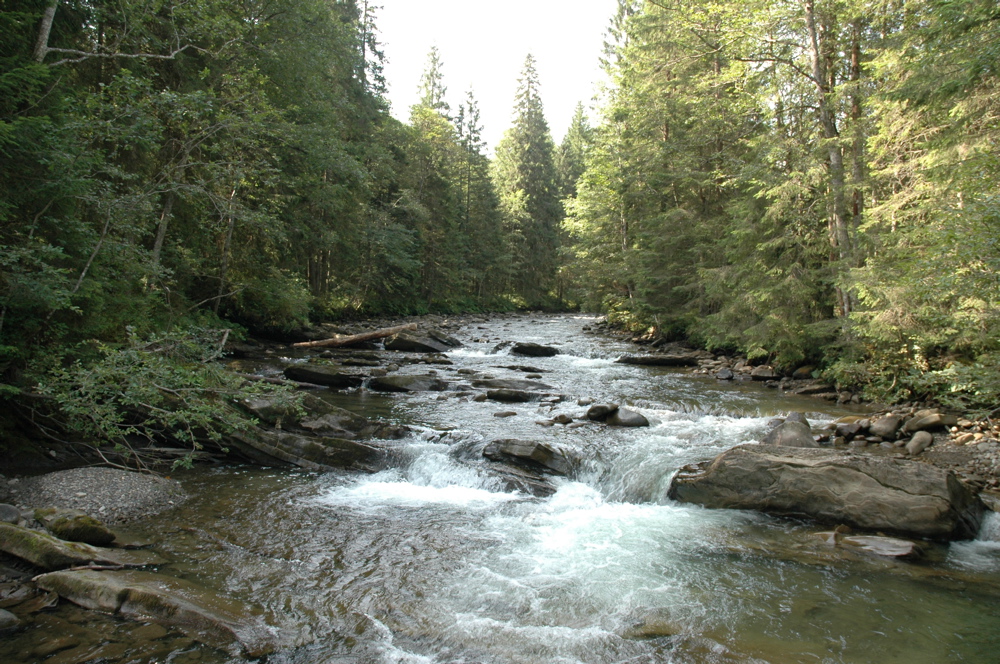
The Prut originates on the eastern slope of Mount Hoverla, in the Carpathian Mountains in Ukraine (Ivano-Frankivsk Oblast). At first, the river flows to the north. Near Yaremche it turns to the northeast, and near Kolomyia to the south-east. Having reached the border between Moldova and Romania, it turns even more to the south-east, and then to the south. It eventually joins the Danube near Giurgiulești, east of Galați and west of Reni.

Between 1918 and 1939, the river was partly in Poland and partly in Greater Romania (Romanian: România Mare). Prior to World War I, it served as a border between Romania and the Russian Empire. After World War II, the river once again denoted a border, this time between Romania and the Soviet Union. Nowadays, for a length of 31 km (19 mi), it forms the border between Romania and Ukraine, and for 711 km (442 mi), it forms the border between Romania and Moldova.[4] It has a hydrographic basin of 27,540 km2,[5] of which 10,990 km2 (4,240 sq mi) are in Romania[3] and 7,790 km2 (3,010 sq mi) in Moldova. The largest city along its banks is Chernivtsi, Ukraine.

The Stânca-Costești Dam, operated jointly by Moldova and Romania, is built on the Prut. There is also a Hydro-Electric Station in Sniatyn (Ukraine). Ships travel from the river's mouth to the port city of Leova (southern Moldova).

The lowermost part of the basin is strongly marshy. The average discharge at its mouth is 110 m3/s (3,900 cu ft/s).[5] The average discharge at the city of Leova is 69.2 m3/s (2,440 cu ft/s). The slope of the river varies from 100 m/km (near the source) to 0.05 m/km (near the mouth). In the upper reaches (to Delyatyn) it has a mountainous character, with a steep right bank, sometimes the cross-sectional profile of the channel has the form of a ridge. Near the city of Yaremche is the waterfall of Probiy.

Name

[edit]

The Prut was known in Antiquity as the Pyretus (Ancient Greek: Πυρετός, romanizedPyretós), or Scythian Porata (possibly),[6] Hierasus (Ἱέρασος, Hiérasos) or Gerasius.[7] Herodotus lists the Prut, under the name of Porata or Pyretus, as being among the five rivers flowing through the Scythian country which swell the Danube.[8] In the second volume of the Ottoman-Bulgarian chronicles of Iman "Jagfar Tarihi" (1680) the Prut River is referred to as Burat. And in the Byzantine treatise of Constantine Porphyrogennetos "On the management of the empire" it is mentioned as the Brut river (Chap. 38) or as Burat (Chapter 42).

Towns

[edit]

The following towns are situated along the river Prut, from source to mouth: Vorokhta, Yaremche, Deliatyn, Lanchyn, Kolomyia, Zabolotiv, Sniatyn, Nepolokivtsi, Luzhany, Chernivtsi, Novoselytsia, Darabani, Lipcani, Ungheni, Leova, Cantemir and CahulPrisacani

Tributaries

[edit]

The following rivers are tributaries to the river Prut (source to mouth):[3]

Left: Turka, Chorniava, Sovytsia, Rokytna, Rynhach, Cherlena, Larga (Briceni), Vilia, Lopatnic, Racovăț, Ciuhur, Camenca, Delia, Nârnova, Lăpușna, Sărata, Larga (Cantemir)

Right: Pistynka, Rybnytsia, Cheremosh, Derelui, Hertsa, Poiana, Cornești, Isnovăț, Rădăuți, Ghireni, Volovăț, Badu, Bașeu, Corogea, Berza Veche, Râioasa, Soloneț, Cerchezoaia, Jijia, Bohotin, Moșna, Pruteț, Gârla Boul Bătrân, Copăceana, Belciug, Elan, Horincea, Oancea, Stoeneșa, Brănești, Chineja

Historical events

[edit]
Alexandros Ypsilantis crosses the Pruth [in 1822] by Peter von Hess, Benaki Museum, Athens.

In 1538, the Ottoman army of Suleiman the Magnificent crossed the Prut during the campaign of Karaboğdan.[9]

During the Russo-Turkish War of 1710–1711, on 19 July 1711 Russian forces initially divided among Peter the Great's army on the west bank and Boris Sheremetev's army on the east bank of the Pruth and allied with Dimitrie Cantemir, the ruler of Moldova, met with the Ottoman army led by Grand Vizier Baltaci Mehmed Pasha. The Turks and Crimean Tatars attacked first against Sheremetev, who then retreated to the other side to join Peter the Great. Afterwards the Russian army set up a defensive camp between Stănilești and the river, which was then completely surrounded by the Ottoman army. Negotiations started on 21 July 1711 and the Treaty of the Prut was signed on 23 July 1711. After this treaty, Dimitrie Cantemir had to go in exile at Moscow. This treaty led to the end of local dynasties of kings and inauguration of Greek rulers from the Fanar Quarter of Istanbul (Phanariotes).

During the Russo-Turkish War of 1768-74, on 1 August 1770, Russian forces led by Field Marshal Pyotr Rumyantsev defeated a larger Ottoman army led by Grand Vizier Ivazzade Halil Pasha in the Battle of Kagul on the Prut.

In 1821, the Greek Nationalist leader Alexander Ypsilantis crossed the Prut river at Sculeni, with the intention of touching off a rebellion in the Danubian Principalities. Though the Wallachian uprising ultimately failed — due especially to irreconcilable differences between Ypsilantis and his Wallachian ally Tudor Vladimirescu — it did touch off the Greek War of Independence, leading to the Kingdom of Greece gaining independence ten years later. In the Principalities it led to the end of Greek Phanariote rule, and indirectly to increasing self-government and eventually to the independence of Romania several decades later. In Greek history, Ypsilantis' crossing of the Prut is an important historical event, commemorated in a famous painting displayed at Athens.

[edit]

Sydir Vorobkevych: Within that Prut Valley (Над Прутом у лузі).[10]

Within that Prut Valley a cabin rests close
In which lives a lassie—a beautiful rose:
Her eyes like the bright stars that lighten the sky;
When you see them, laddie, you'll pause with a sigh.

Within that Prut Valley the moon does not shine,
'Tis only a lover has come to his shrine.
A sweet conversation in murmur now goes
While dreamy old river just quietly flows.

Within that Prut Valley the flowers are plucked
And wreathes for the wedding with myrtle are tucked;
Inside of the cabin play fiddles and bass
While friends sing together: To their Happiness!

Translated by Waldimir Semenyna (13 October 1933, Ukrainian Weekly).

Bridges

[edit]

See also

[edit]
[edit]

References

[edit]
[edit]
Revisions and contributorsEdit on WikipediaRead on Wikipedia
from Grokipedia
The Prut is a transboundary river in , originating on the eastern slopes of in the and flowing 953 kilometers southeast to join the near Giurgiulești, . It serves as a left of the , forming the border between and for most of its lower course after initially traversing and briefly bordering . The river's basin spans 27,500 square kilometers, distributed across (8,300 km² or 30%), (11,000 km² or 40%), and (8,200 km² or 30%), encompassing diverse terrains from mountainous headwaters to lowland floodplains. As the second-longest tributary of the , the Prut plays a critical hydrological role in the region, contributing to flood control, , and toward the biosphere reserve. Ecologically, its corridor supports significant , including habitats for aquatic birds and ecosystems designated for conservation under international frameworks like the EU . Hydropower developments, such as the Stanca-Costești shared by and , have altered its flow regime, influencing downstream discharge averaging 91.6 cubic meters per second at key monitoring points. The river's transboundary character necessitates cooperative management among riparian states to address challenges like and climate-induced variability in .

Geography

Physical characteristics

The Prut River originates on the southwestern slope of Mount Hoverla in the Chernogora massif of the Forested Carpathians, Ukraine, approximately 15 km south-southeast of Vorokhta village. Its source lies at high elevation in the Ukrainian Carpathians, with the river descending a total of 1,577 meters over its course to reach the Danube. The river measures 967 kilometers in length and drains a basin of 27,540 square kilometers, spanning (33%), (39%), and (28%). The basin exhibits an elongated, narrow form with an average width of 51 kilometers, widening to 70 kilometers in places. The average longitudinal slope is approximately 0.2 percent. The Prut joins the as a left south of Giurgiulești, , at an elevation of about 2.6 meters above , approximately 164 kilometers upstream from the Danube's mouth into the . The river's meandering ratio averages 2.1, contributing to its winding path through mountainous, foothill, and lowland terrains.

Course

The Prut River originates on the south-western slopes of Mount Hoverla (also spelled Goverla) in the Chornohora massif of the , at an elevation of approximately 1,500 meters, about 15 kilometers south-southeast of the village of Vorokhta in . From its source, the river flows generally southeastward through rugged mountainous terrain, carving narrow valleys and supporting dense forests in the upper reaches. In its initial 200 kilometers within , it traverses the Carpathian foothills and Subcarpathian region, passing through or near settlements including Yaremche, , and Sniatyn before reaching . Upon exiting the more elevated Ukrainian territory near , the Prut enters the Pokutian-Bessarabian Upland and transitions into the broader Moldavian Plateau, where its course shifts to predominantly form the international boundary between to the west and to the east for roughly 650 kilometers of its total length. Along this border segment, the river meanders through rolling plains and agricultural lowlands, with widths varying from 20 to 100 meters and depths typically under 3 meters outside flood periods; major Romanian settlements on the left bank include , , and , while Moldovan towns such as and lie on the right bank. The river's path in this section is characterized by gentle gradients, supporting riparian ecosystems amid intensive farming, though subject to seasonal variations in flow. In its final stretch, the Prut continues southeastward, briefly skirting the tripoint area involving before definitively delineating the - frontier until its confluence with the River near Giurgiulești in Moldova's District, approximately 5 kilometers upstream from the Ukrainian border town of Reni and east of the Romanian city of . This mouth occurs at an elevation near , where the Prut discharges as the 's last major left-bank , contributing sediments that influence delta formation downstream. The overall course spans about 953 kilometers, reflecting a progression from alpine headwaters to lowland border waterway.

Drainage basin

The drainage basin of the Prut River encompasses approximately 27,500 km² across , , and . accounts for the largest share at 11,000 km² (about 40%), followed by with 8,300 km² (30%) and with 8,200 km² (30%). The basin originates in the and extends through hilly and plain terrains, including the Moldavian Plateau, with elevations ranging from over 2,000 meters at the source to near at the confluence. Land use within the basin is dominated by , covering about 80% of the area, primarily (57.7%) used for crops such as , potatoes, sunflowers, and sugar beets, alongside . Forests occupy roughly 9% of the , concentrated in central upland regions where coverage reaches up to 30%, while urban and industrial areas are limited but contribute to localized pressures. The basin supports a of around 3 million, with significant settlements like in driving economic activity in and . The Prut's catchment includes 41 sub-basins, with 13 first-order tributaries exceeding 15 km in length, drawing from the Eastern Carpathians and Moldavian uplands. Notable tributaries include left-bank rivers such as Jijia () and Racovăț, Larga, Vilia, and Lopatnic (), which contribute to the basin's hydrological network and sediment load. These inflows reflect the basin's transboundary nature, influencing and flood dynamics across borders.

Hydrology

Flow regime

The Prut River displays a nival-pluvial flow regime characteristic of Carpathian-origin rivers, with discharges primarily driven by in spring and convective rainfall in early summer, leading to pronounced seasonal variability. Average annual discharge at the river's near Giurgiulești ranges from 78 to 94 cubic meters per second (m³/s), corresponding to an annual runoff volume of approximately 2.7 cubic kilometers (km³), though this fluctuates between 1.2 km³ in dry years and up to 5 km³ in wet years due to precipitation variability. Flows are minimal during winter months (November to February), often dropping below 40 m³/s basin-wide, reflecting frozen storage and reduced . Discharge rises sharply from March onward with , peaking between May and July when upstream contributions amplify by up to 30-50% relative to winter lows, influenced by mountainous and regional rainfall maxima of 560 mm annually. This period accounts for the majority of annual flow, with monthly maxima exhibiting spatial gradients—higher in upstream reaches due to steeper slopes (up to 16.3‰ overall) and inflows. Downstream, flow occurs through infiltration and in the broader Moldavian plain, resulting in moderated peaks but sustained from . Historical data indicate linear trends of slight annual discharge decline in recent decades (e.g., post-1990), attributed to climatic shifts and upstream abstractions, though interannual oscillations persist with coefficients of variation exceeding 0.3 in gauged sections. Sharp flood hydrographs, with rise times under 24 hours during convective events, underscore the regime's flashiness in headwaters, transitioning to more damped responses near the .

Flood events

The Prut River experiences frequent flash floods due to intense precipitation in its steep, mountainous upper basin in the Carpathians, leading to rapid runoff and high peak discharges. These events are exacerbated by the river's relatively short length and tributaries like the , with historical floods often occurring in summer from prolonged heavy rains or . The most severe flood on record struck in July–August 2008, triggered by extreme rainfall in the upper basin shared by , , and . Peak discharge reached 7,140 cubic meters per second (m³/s) at the Prut's entry into , the highest ever recorded for any Romanian and surpassing prior maxima by over 50%. The Stanca-Costesti reservoir on the - stored significant volumes but faced overflow risks, contributing to downstream inundation despite mitigation efforts. Impacts included 34 deaths in along the Prut and Dnister rivers, with over 25,000 evacuations; in , riverbanks burst at multiple points, causing widespread agricultural losses estimated in hundreds of millions of USD across affected regions. Another major event occurred in summer 2010, driven by and heavy rains from June 21 to July 1, causing floods on the Prut and adjacent River. A breach on the night of July 5–6 along the Prut valley in led to rapid inundation, evacuating more than 3,100 people (including 2,300 from rural areas) and damaging in low-lying border zones with . Peak flows exceeded critical thresholds on multiple tributaries, highlighting vulnerabilities in hydrotechnical works despite partial retention by upstream reservoirs. Earlier significant floods include those in May 1965, July 1969, June 1985, June 1988, and August 1991, which inundated rural areas in the Prut-Bârlad watershed, often with short-duration but high-intensity waves affecting Romania's northeastern plains. The 1991 event on the Jijia tributary (a Prut affluent) began and persisted for 10 days, disrupting communities without recorded fatalities but causing localized and deposition. These recurrent floods underscore the river's nival-pluvial , where spring combines with summer storms to amplify risks, though post-2008 investments in dikes and monitoring have reduced some downstream vulnerabilities.

Ecology and Environment

Biodiversity

The Prut River basin encompasses diverse aquatic and terrestrial ecosystems, supporting significant biodiversity across multiple taxa. The ichthyofauna remains relatively rich despite anthropogenic pressures, with surveys identifying over 40 fish species, including rheophilic and lithophilic guilds predominant in upstream sections. Key species include Aspius aspius, Pelecus cultratus, Rhodeus sericeus, Barbus barbus, Misgurnus fossilis, Cobitis taenia, Gymnocephalus schraetser, and Zingel streber, many of which are indicators of good water quality but vulnerable to habitat fragmentation and overfishing. Recent records note the presence of introduced species like Gymnocephalus baloni (first detected in 2010) and Benthophilus sp. (2015), alongside invasive aliens such as silver carp (Hypophthalmichthys molitrix), which compete with natives in the lower reaches. Terrestrial and riparian features prominently, with the basin hosting approximately 61 species, over 270 species, and diverse and communities. In the lower Prut , nine and seven species form critical ecological links in habitats, though many face risks from drying trends and . Avifauna is particularly notable, with over 225 species recorded in protected areas, including migratory concentrations exceeding thousands during seasonal peaks; endangered taxa such as the small (Phalacrocorax pygmaeus), yellow heron (Ardea intermedia), and white egret (Egretta garzetta) nest in intact lakes like Cioroiu. The Prut headwaters support 35 nationally , of which 23 are globally threatened per IUCN criteria, alongside three Bern Convention Appendix II-listed taxa. Flora and invertebrate diversity further enriches the , with key species and serving as indicators in terrestrial zones, while rare —over 80 protected or vulnerable forms—occur along the Romania-Moldova stretch. Threatened in the basin, some listed in the European Red List and international conventions, inhabit meadows and marshes, vulnerable to degradation. Protected areas, including the Prut River Headwaters and Lower Prut Biosphere Reserve, harbor six IUCN Red List and 17 animal species, aiding conservation amid broader basin threats like and hydrological alterations.

Pollution and degradation

The Prut River experiences pollution primarily from agricultural runoff, including excessive fertilizers and pesticides, which contribute significant nutrient loads such as nitrogen and phosphorus, exacerbating across its basin spanning , , and . Urban and industrial point sources, including untreated discharges and outdated facilities, introduce , organic compounds, and xenobiotics, particularly affecting tributaries and middle sections. Ammonium nitrogen pollution remains a persistent issue despite monitoring, with statistical analyses of data from monitoring stations indicating elevated concentrations that violate regulatory thresholds in multiple segments, driven by sewage and agricultural inputs. Cross-border dynamics amplify degradation, as pollutants from upstream Ukrainian and Romanian activities, including animal farming and solid waste dumping, accumulate downstream in , where total wastewater loads have been quantified as exerting substantial pressure on the . Water quality assessments reveal variability: a 2022 survey reported a pollution index of 0.52, classifying much of the basin as clean, though localized hotspots from unauthorized discharges of petroleum products and toxic chemicals degrade recreational and aesthetic values. In the southern reaches, heavy metals like copper and selenium show major negative impacts, correlating with industrial and mining legacies, while nutrient excesses from spring agricultural peaks further impair downstream biodiversity and ecosystem health. Degradation extends beyond chemical to physical loss from unsustainable and , compounded by historical overapplication of inputs that have led to degradation and increased loads, reducing the river's self-purification capacity. Efforts to mitigate include basin-wide reduction initiatives under frameworks like the River Protection Convention, though transboundary coordination challenges persist due to differing national enforcement standards.

Climate change impacts and conservation

Climate change projections for the Prut River basin indicate variable impacts on , with modeled changes in mean annual river discharge ranging from -30% to +6% across representative concentration pathways (RCPs), driven by alterations in and patterns. Seasonal shifts are pronounced, featuring decreased summer flows due to higher and reduced winter/spring snowmelt contributions, exacerbating vulnerability in the transboundary basin shared by , , and . Observed trends from 1961–2010 show a modest 1.8% decline in annual flow post-1990, alongside insignificant negative trends (-0.6 mm/year), compounded by abstractions that amplify low-flow conditions. These alterations heighten risks of both floods and droughts, with increasing frequency reported in the basin, potentially stressing aquatic ecosystems and for and municipalities. Conservation efforts emphasize wetland restoration and transboundary cooperation to mitigate degradation. The UNDP-GEF project, launched in 2020, targets ecological integrity in key Prut floodplain wetlands, focusing on high-nature-value areas through sustainable management practices to preserve biodiversity amid hydrological pressures. The Lower Prut Biosphere Reserve in Moldova, part of the DANUBEPARKS network, implements habitat restoration and monitoring to safeguard floodplain ecosystems vulnerable to flow regime changes. In 2023, Moldova, Romania, and Ukraine signed the Trilateral Prut Declaration, committing to harmonized basin management plans, enhanced monitoring of shared waters, and integrated flood-drought strategies, including climate adaptation measures. Additional initiatives address nutrient pollution reduction via basin-wide approaches, fostering multi-stakeholder collaboration to counter anthropogenic stressors intersecting with climate effects. These programs draw on empirical monitoring data, prioritizing evidence-based interventions over unsubstantiated projections.

Infrastructure and Human Modification

Dams and reservoirs

The Stânca-Costești Dam, the primary reservoir-forming structure on the Prut River's main stem, is situated at river kilometer 421 (approximately 80 km upstream from the confluence) and demarcates the - border near the localities of Stânca () and Costești (). Completed in through a bilateral agreement between and the , the incorporates concrete elements and stands 47 meters high with a crest length of 740 meters. It primarily functions for flood attenuation, hydroelectric generation, low-flow augmentation, and support across the downstream basin, retaining flood volumes that would otherwise exacerbate inundations in and . The impounded Stânca-Costești Reservoir covers 59 square kilometers at normal retention level, with a gross storage of 1.285 billion cubic meters and an active (usable) enabling retention of up to 40% of the Prut's mean annual flow for regulatory purposes. The reservoir's design prioritizes seasonal filling during high-spring flows and controlled releases to mitigate summer droughts and winter floods, though has reduced capacity by an estimated 1-2% annually due to upstream . A downstream hydroelectric facility, operational since commissioning, generates power from releases, contributing to regional energy needs amid the Prut's variable . Joint management by Romanian and Moldovan authorities includes bilateral protocols for allocation and , with recent adjustments to operating rules aimed at enhancing resilience to reduced inflows from variability. Beyond this major installation, the Prut's main channel lacks additional large-scale dams or reservoirs, though over 1,000 smaller impoundments—primarily for local , , and minor —exist on tributaries within the Ukrainian, Romanian, and Moldovan portions of the basin. These tributary structures, often under 10 in height, do not significantly alter the Prut's overall flow regime but contribute to localized sediment trapping and . No major new projects on the have been implemented since 1976, reflecting geopolitical constraints and environmental concerns over transboundary impacts.

Bridges and navigation

The Prut River features several bridges, many of which serve as critical border crossings between Romania and Moldova along its lower course. The Eiffel Bridge at Ungheni, a railway structure completed in 1877 and designed by Gustave Eiffel, links Ungheni in Moldova with Pantelimon, Romania, and remains a key rail connection despite its age. Upstream in Ukraine, the bridge at Yaremche, documented in 1893 drawings, exemplifies early infrastructure in the Carpathian region. Recent infrastructure initiatives aim to enhance road connectivity across the - border. In 2025, and approved construction of a new road bridge between Bumbata, , and Leova, , to boost and regional links. As of February 2025, contracted designs for four additional Prut bridges, including upgrades at locations like Stânca-Costești, to replace aging structures and integrate further into European transport networks. Navigation on the Prut is restricted primarily to its lower sections near the confluence, where depths permit small vessels. Commercial trade navigation resumed in on July 1, 2013, after a 25-year suspension, enabling limited from the Prut- link at Giurgiulești. Historical records indicate extended upstream to near since 1870, though geopolitical shifts, including Soviet border closures in 1940, curtailed operations until recent revivals. The river's 180.7 km of inland waterway in and supports potential expansion, but shallow upper reaches and flood risks limit broader use to log rafting and seasonal boating.

Settlements and Economy

Major towns and cities

The Prut River flows through or alongside several urban centers, primarily in its upper reaches in and along the Romania-Moldova border. In , Yaremche serves as a key resort settlement in , situated amid the Carpathian foothills where the river features rapids and the Probiy waterfall, attracting tourists for its natural scenery. Downstream, functions as an administrative and cultural hub in the same , with historical ties to salt and Hutsul traditions along the riverbanks. , the most populous city directly on the Prut with around 240,000 residents as of recent estimates, lies further southwest in , spanning both banks and serving as a regional economic and educational center. Along the lower course, where the Prut demarcates the Romania-Moldova frontier for approximately 650 kilometers, major settlements include in Moldova's Ungheni District, a border hub linked to Romania via rail and forthcoming highway bridges that facilitate cross-border trade and transport. , in Moldova's Cahul District near the river's confluence with the , supports local agriculture and serves as an administrative center with access to resources. On the Romanian side, smaller towns such as Darabani in border the river, contributing to regional connectivity but lacking large-scale urban development directly on its course. These settlements rely on the Prut for , , and historical , though limited by its seasonal flow and transboundary status.

Economic utilization

The Prut River serves as a vital resource for generation, primarily through the Stânca-Costești Dam, a joint Romanian-Moldovan structure completed in 1978 that forms a for a hydroelectric power plant with an installed capacity of approximately 16 MW, contributing to flood control and electricity production for local grids. The dam's operations have been adjusted for climate adaptation, including modified release regimes to mitigate downstream flow reductions exacerbated by upstream abstractions and conditions. These facilities underscore the river's role in regional , though development has fragmented habitats and altered natural flow regimes, impacting overall basin . Agriculture dominates economic utilization, with irrigation drawing about 70% of abstracted in the Moldovan Prut basin, of which roughly 25% supports crop cultivation on fertile floodplains, enabling production of grains, , and fruits that form the backbone of rural economies. In the Lower Prut region, farming accounts for over 90% of household income, bolstered by restored pumping stations along the river that supply micro- systems and enhance resilience to irregular rainfall patterns. Recent investments, including U.S.-funded rehabilitations of 10 irrigation systems in the Prut and basins, have expanded high-value crop areas by improving delivery efficiency and reducing losses from outdated infrastructure. Navigation remains limited but functional on select stretches, with commercial river transport resuming in 2013 after a 25-year hiatus, facilitating movements such as the inaugural 550-ton shipment from Giurgiulești port upstream to , primarily for construction materials amid efforts to dredge silted channels. Shallow depths and seasonal fluctuations restrict year-round viability, confining operations to lower sections where depths permit small vessels, though bilateral Moldova-Romania agreements aim to enhance connectivity via new bridges and canal maintenance. Fishing contributes modestly, targeting like , pike, and in riverine and habitats, but yields are constrained by , barriers, and regulatory bans on certain overexploited zones, with enforcement focusing on rather than scaled commercial output.

Etymology and Cultural Significance

Name origins

The name Prut traces to ancient attestations from the 5th century BCE, when the Greek historian described the river—among five waterways swelling the —as Pyretus (Πυρετός in Greek) or Porata. These terms likely reflect or pre-Indo-European nomenclature for the river's path through the Carpathian region. Linguistic analysis links Poratus—a Latinized variant—to roots connoting "rapid" or "fiery," possibly alluding to the river's turbulent upper course originating on Mount Hoverla's slopes at elevations exceeding 1,800 meters. The modern Romanian and Ukrainian form Prut preserves this core, with no evidence of later medieval coinage; instead, it aligns with Thracian-Dacian hydronymic patterns common to regional rivers like the and Jiu, predating Slavic or Romance influences. Romantic legends positing a eponymous lover named Prut remain unverified without textual or archaeological support.

Role in regional identity

The Prut River constitutes a foundational element in the regional identity of historical , serving as the axis of the province that encompasses territories now divided between and . Its basin historically unified Romanian-speaking populations under the Principality of , fostering shared linguistic, cultural, and national ties that persist despite subsequent geopolitical partitions. Even as the river delineates the modern border between and , it symbolizes an artificial divide between regions with a common heritage, where cultural continuity across its banks reinforces notions of a singular Romanian nation spanning both states. In the upper reaches within Ukraine's Carpathian highlands, the Prut defines the core territory of the Hutsul ethnic subgroup, whose distinct highlander identity is inextricably linked to the river's valleys. The Hutsuls, inhabiting the northern slopes over the Prut, have preserved a rich folklore, folkways, and dialect shaped by the riverine landscape, which features prominently in their oral traditions, music, and place names such as those in the Prut basin. This association underscores the Prut's role in anchoring Hutsul cultural autonomy amid broader Ukrainian and regional influences, with the river's environs evoking a sense of mystical isolation and resilience in ethnographic narratives.

History

Early history

Archaeological evidence indicates human presence along the Prut River basin from the period, with open-air sites such as Teţcani X and cave sites like Buzdujeni I in the middle Prut region of present-day yielding stone tools and faunal remains consistent with industries associated with occupation. Subsequent and Eneolithic settlements (circa 6000–3500 BCE) appear densely distributed in the Romanian Moldavia area, exploiting riverine resources for early agricultural communities, as evidenced by settlement pattern studies incorporating geophysical and archaeobotanical data. Chalcolithic cultures, including Gumelnița (circa 4800–4600 BCE), established tell settlements between the and rivers, featuring fortified enclosures, with intricate incised designs, and evidence of ; excavations at sites like Taraclia I reveal multi-layered occupations with and crop cultivation adapted to soils. Middle and Late Age sites in the Brînzeni microzone further document semi-sedentary communities with pit dwellings and lithic industries, investigated since pre- surveys. In , the Prut was identified as the Pyretus (Greek: Πυρετός) or Scythian Porata, one of five major rivers originating in Scythian territories and to the , as described by in the 5th century BCE; its name likely derives from Indo-European roots connoting rapidity or fire, reflecting its swift Carpathian headwaters. The surrounding lower valley hosted populations, a Thracian-speaking group known for fortified hilltop settlements and interactions with and , though direct Roman expansion under (106 CE) did not encompass the Prut, leaving it peripheral to the province of .

Imperial conflicts and border formations

The Pruth River Campaign of 1711, part of the Russo-Ottoman War of 1710–1713, saw Tsar Peter I lead approximately 38,000 Russian troops across the into Ottoman-vassal in early July, advancing along the Prut toward the . Ottoman forces under , numbering around 170,000 including , encircled the Russians near Stănilești on the Prut from July 18–22. Facing supply shortages and numerical inferiority, Peter negotiated surrender, resulting in the signed on July 21, 1711, which required to return to the Ottomans, demolish and other fortresses, and abstain from interfering in Polish-Lithuanian affairs. This outcome, allegedly influenced by Swedish king Charles XII's presence with the Ottomans, halted Russian southern expansion temporarily. During the Russo-Turkish War of 1806–1812, Russian forces occupied and , crossing the Prut to besiege Ottoman positions. The Treaty of , concluded on May 28, 1812, awarded —the eastern Moldavian territory between the Prut and rivers, spanning 45,630 square kilometers—annexing it as a . Article 4 explicitly designated the Prut as the boundary between the and remaining Ottoman-suzerain , formalizing the river's role as an imperial frontier. This cession reflected Russia's strategic push to the , displacing local populations and integrating the region into imperial administration. The Prut retained border status amid ongoing tensions. In June 1853, Russian commander General Mikhail Gorchakov directed 80,000 troops across the Prut into the neutral of and , citing protection of Orthodox interests against Ottoman reforms. This occupation, viewed as a violation of international agreements, prompted Ottoman Sultan Abdülmecid I to declare war on October 4, 1853, drawing British, French, and Sardinian intervention in the . Heavy Russian losses—fewer than half survived due to disease—underscored logistical challenges of Prut crossings. Following the 1856 Treaty of Paris, southern Bessarabia reverted to , but the Prut continued demarcating most of the Russian frontier with the principalities, which united as in 1859. Until 1918, the river defined the boundary between the and , embodying imperial rivalries over access and Orthodox influence.

Modern geopolitical role

The Prut River delineates the border between Romania and Moldova for approximately 711 kilometers and between Romania and Ukraine for 31 kilometers, positioning it as a key demarcation in Eastern European geopolitics. This boundary underscores Moldova's precarious position between EU/NATO-aligned Romania and Russian-influenced spheres, including the breakaway Transnistria region east of the Dniester. In the context of Russia's invasion of Ukraine, the Prut has heightened regional tensions, with fears of spillover hybrid threats and information warfare targeting Moldova's pro-Western government under President Maia Sandu. Cross-border cooperation has intensified to address shared challenges, exemplified by the Trilateral Prut Declaration signed on October 20, 2023, by , , and , committing to joint management of the river basin amid and security concerns. Infrastructure developments, such as the planned road bridge across the Prut between Bumbăta () and Leova, approved by the government in 2025, aim to enhance connectivity and symbolize 's EU integration aspirations, countering Russian leverage through energy dependence and . The Giurgiulești port near the Prut's confluence with the has emerged as a vital export route for grain during the Black Sea blockade, facilitating overland shipments and bolstering 's economy while exposing the river's strategic value in wartime logistics. The river also serves as a conduit for irregular migration and , with Romanian-Moldovan border forces intercepting groups attempting illegal crossings, as in a July 17, 2025, incident involving six migrants of Afro-Asian origin. Persistent unification sentiments between and , rooted in shared and language, view the Prut less as a divider and more as a historical link, though policies prioritize alignment over merger to avoid provoking . Overall, the Prut embodies the frontline dynamics of post-Soviet realignment, where ecological collaboration masks deeper contests over and influence.

References

Add your contribution
Related Hubs
User Avatar
No comments yet.