
Recent from talks
Pegomastax
Knowledge base stats:
Talk channels stats:
Members stats:
Pegomastax
Pegomastax is a genus of heterodontosaurid dinosaur that lived during the Early Jurassic of South Africa. The only known specimen was discovered in a 1966–1967 expedition in Transkei District of Cape Province, but was not described until 2012 when Paul Sereno named it as the new taxon Pegomastax africana. The genus name is derived from the Greek for "strong jaw", and the species name describes the provenance of Africa; it was originally spelled africanus, was corrected to africana to align with the gender of the genus name.
The only known material of Pegomastax included a partial skull with well-preserved lower jaw and teeth, showing affinities for Heterodontosaurus and the group with a deep jaw, mobile predentary, and a large canine tooth at the front of the snout. The front of the jaws would have supported a keratinous bill, and wear on the teeth suggests that Pegomastax had a herbivorous diet, possibly of tougher plant matter than relatives that lacked the canine. The morphology of the teeth and jaw shows that Pegomastax may have been most closely related to South American taxon Manidens, instead of the other South African or Lesothan genera Heterodontosaurus or Lycorhinus.
Along with many other heterodontosaurids, Pegomastax is known from the upper Elliot Formation. Though of uncertain provenance, it was probably from the middle of the section, making it from the mid Sinemurian and older than all the other heterodontosaurids in the formation. It would have lived alongside an abundance of sauropodomorph taxa like Massospondylus, the ornithischian Lesothosaurus, and crocodylomorphs like Protosuchus, as well as the theropod Megapnosaurus and synapsids like Diarthrognathus and Pachygenelus. The fauna of the upper Elliot is more gracile than that of the lower Elliot, which probably reflects the drier climate at the time.
A partial disarticulated skull of a new taxon of Heterodontosauridae was discovered in the 1966-1967 expedition to the Transkei District of Cape Province, South Africa, found in the upper Elliot Formation at the Voyizane (alternatively Voisana) locality. The specimen, given the accession number SAM-PK-K10488 was found alongside other heterodontosaurid material in Voisana, including the heterodontosaurid postcrania SAM-PK-K1328, the maxillae SAM-PK-K1326 and SAM-PK-K1334, the Heterodontosaurus juvenile skull SAM-PK-K10487, and the complete Heterodontosaurus skull and postcrania SAM-PK-K1332. The specimen SAM-PK-K10488 was identified as a new taxon by American paleontologist Paul Sereno in the 1980s, but remained undescribed until 2012, where designated it as the holotype specimen of the new taxon Pegomastax africanus. The genus name is derived from the Greek words pegos and mastax, meaning "strong jaw", while the species name is from the Latin for "pertaining to Africa". The species name was amended by Sereno later in 2012 to the feminine P. africana, following the feminine gender of the Greek word μάσταξ (mastax).
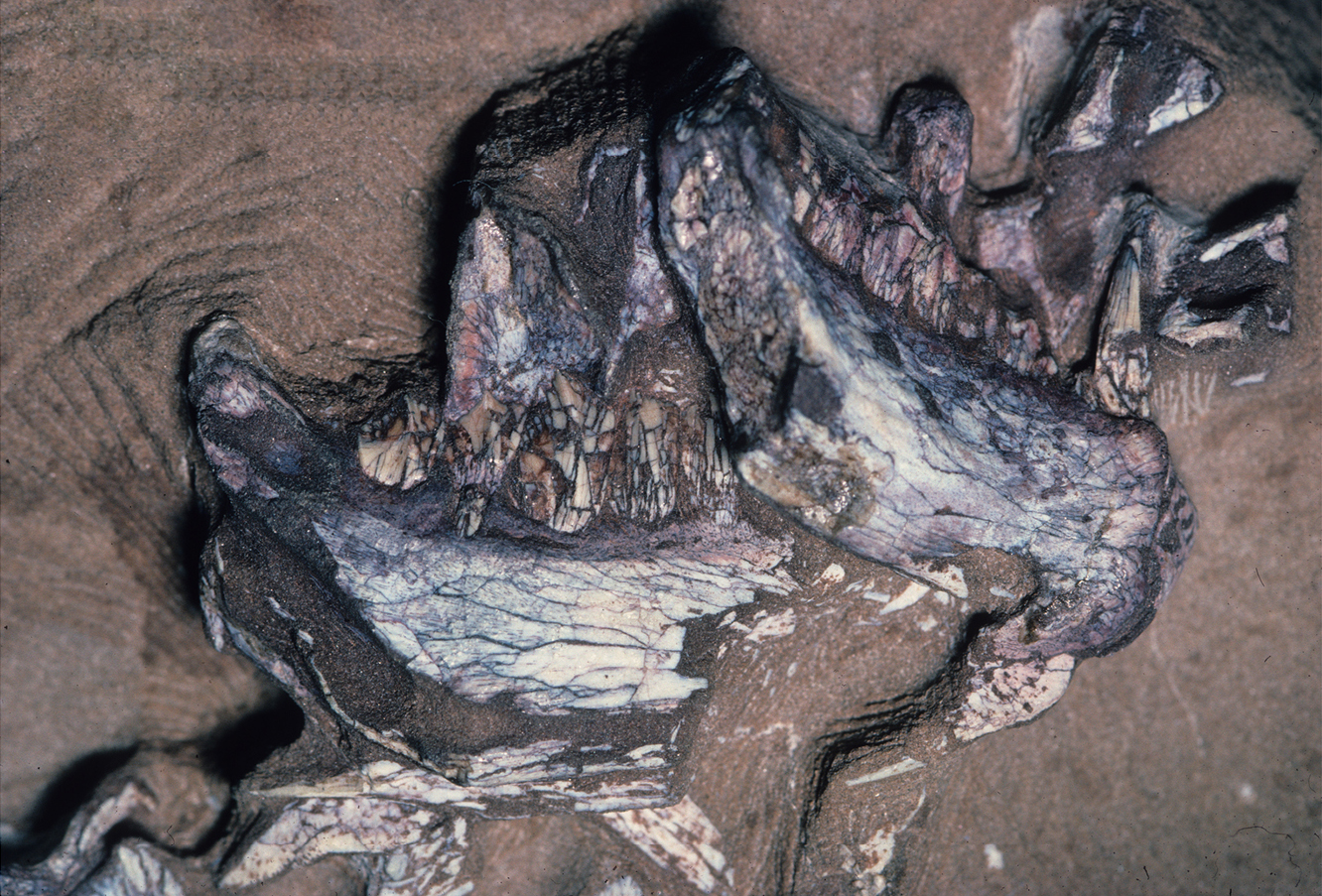
Pegomastax comes from the Red Beds, or upper Elliot Formation, of South Africa and Lesotho. This part of the formation is considered to be from the earliest Jurassic, the Hettangian and Sinemurian epochs from around 200 to 190 million years ago. The provenance of Pegomastax and the Voisana locality within the upper Elliot Formation is uncertain, but it is likely from the middle deposits of the formation, which places it in the mid-Sinemurian. Pegomastax is known from a single partial skull, which includes a postorbital, both dentaries, a predentary and teeth; prepared from the matrix at Harvard University. The specimen is preserved in a small sandstone block of matrix, and further preparation of CT scanning may allow for the identification of more intermediate bone fragments. The lower jaws are preserved close to their position in life, but bones on the inside are shifted or displaced if they are preserved.
Pegomastax is estimated to have a skull length of 73 mm (2.9 in), compared to Heterodontosaurus at 115 mm (4.5 in) and Tianyulong at 65 mm (2.6 in). It can be distinguished from other heterodontosaurids by having a very deep predentary that projects forwards and down, a curved primary ridge on the dentary teeth, and a concave margin to the crown on either side of the middle denticle. Though there are many similarities to Heterodontosaurus, the unusually deep, parrot-like shape of the predentary was suggested by Sereno to indicate different feeding specializations among different heterodontosaurids.
A postorbital is known for Pegomastax, with a deep rear process more similar to Manidens than Heterodontosaurus. The predentary of Pegomastax is a simple wedge-shaped bone. Like Heterodontosaurus there are no prominent processes, and the predentary sits on a loose and possibly mobile saddle-like articulation at the front of the dentary. Several foramina perforate the dental edge of the predentary, which is angled about 45 degrees below horizontal, and would have supported a keratinous bill. Unlike all other heterodontosaurs the predentary is much taller than long, with the length of the dental margin only 70% of the total height of the bone. Pegomastax has a robust dentary, with the tooth row being 27 mm (1.1 in) and a depth at mid-length of 9 mm (0.35 in). For comparison, the dentary of Heterodontosaurus has an equivalent depth of 10 mm (0.39 in) and a length of 42 mm (1.7 in), though the dentary of Manidens is slightly deeper than Pegomastax. The teeth in the dentary are inset from the cheek by a buccal emargination, and a foramina at the front end of this emargination near the predentary exists, but does not contain a tract as in Echinodon and Fruitadens. The anterior end of the dentary is deeper than the middle, as in Heterodontosaurus and Abrictosaurus.
There were probably 11 teeth in the lower jaw of Pegomastax, the first eight preserved in the right dentary and the last five in the left. A large caniniform tooth is present at the front of the jaw as in most other heterodontosaurids, but unlike in Heterodontosaurus, Abrictosaurus and Lycorhinus the caniniform is straight. Serrations are present on the front edge of the tooth, but absent on the rear. Following the caniniform, there is a toothless diastema in the jaw, following which the teeth rapidly increase in size up to the sixth. All dentary crowns are asymmetrical, with the front edge higher and the crown slightly curving to the rear along its length. The inner face of the rear crowns is worn nearly flat by jaw action. The apical margins of the crowns bear denticles, which are present on both sides and at the end of the prominent primary ridge.
Hub AI
Pegomastax AI simulator
(@Pegomastax_simulator)
Pegomastax
Pegomastax is a genus of heterodontosaurid dinosaur that lived during the Early Jurassic of South Africa. The only known specimen was discovered in a 1966–1967 expedition in Transkei District of Cape Province, but was not described until 2012 when Paul Sereno named it as the new taxon Pegomastax africana. The genus name is derived from the Greek for "strong jaw", and the species name describes the provenance of Africa; it was originally spelled africanus, was corrected to africana to align with the gender of the genus name.
The only known material of Pegomastax included a partial skull with well-preserved lower jaw and teeth, showing affinities for Heterodontosaurus and the group with a deep jaw, mobile predentary, and a large canine tooth at the front of the snout. The front of the jaws would have supported a keratinous bill, and wear on the teeth suggests that Pegomastax had a herbivorous diet, possibly of tougher plant matter than relatives that lacked the canine. The morphology of the teeth and jaw shows that Pegomastax may have been most closely related to South American taxon Manidens, instead of the other South African or Lesothan genera Heterodontosaurus or Lycorhinus.
Along with many other heterodontosaurids, Pegomastax is known from the upper Elliot Formation. Though of uncertain provenance, it was probably from the middle of the section, making it from the mid Sinemurian and older than all the other heterodontosaurids in the formation. It would have lived alongside an abundance of sauropodomorph taxa like Massospondylus, the ornithischian Lesothosaurus, and crocodylomorphs like Protosuchus, as well as the theropod Megapnosaurus and synapsids like Diarthrognathus and Pachygenelus. The fauna of the upper Elliot is more gracile than that of the lower Elliot, which probably reflects the drier climate at the time.
A partial disarticulated skull of a new taxon of Heterodontosauridae was discovered in the 1966-1967 expedition to the Transkei District of Cape Province, South Africa, found in the upper Elliot Formation at the Voyizane (alternatively Voisana) locality. The specimen, given the accession number SAM-PK-K10488 was found alongside other heterodontosaurid material in Voisana, including the heterodontosaurid postcrania SAM-PK-K1328, the maxillae SAM-PK-K1326 and SAM-PK-K1334, the Heterodontosaurus juvenile skull SAM-PK-K10487, and the complete Heterodontosaurus skull and postcrania SAM-PK-K1332. The specimen SAM-PK-K10488 was identified as a new taxon by American paleontologist Paul Sereno in the 1980s, but remained undescribed until 2012, where designated it as the holotype specimen of the new taxon Pegomastax africanus. The genus name is derived from the Greek words pegos and mastax, meaning "strong jaw", while the species name is from the Latin for "pertaining to Africa". The species name was amended by Sereno later in 2012 to the feminine P. africana, following the feminine gender of the Greek word μάσταξ (mastax).
Pegomastax comes from the Red Beds, or upper Elliot Formation, of South Africa and Lesotho. This part of the formation is considered to be from the earliest Jurassic, the Hettangian and Sinemurian epochs from around 200 to 190 million years ago. The provenance of Pegomastax and the Voisana locality within the upper Elliot Formation is uncertain, but it is likely from the middle deposits of the formation, which places it in the mid-Sinemurian. Pegomastax is known from a single partial skull, which includes a postorbital, both dentaries, a predentary and teeth; prepared from the matrix at Harvard University. The specimen is preserved in a small sandstone block of matrix, and further preparation of CT scanning may allow for the identification of more intermediate bone fragments. The lower jaws are preserved close to their position in life, but bones on the inside are shifted or displaced if they are preserved.
Pegomastax is estimated to have a skull length of 73 mm (2.9 in), compared to Heterodontosaurus at 115 mm (4.5 in) and Tianyulong at 65 mm (2.6 in). It can be distinguished from other heterodontosaurids by having a very deep predentary that projects forwards and down, a curved primary ridge on the dentary teeth, and a concave margin to the crown on either side of the middle denticle. Though there are many similarities to Heterodontosaurus, the unusually deep, parrot-like shape of the predentary was suggested by Sereno to indicate different feeding specializations among different heterodontosaurids.
A postorbital is known for Pegomastax, with a deep rear process more similar to Manidens than Heterodontosaurus. The predentary of Pegomastax is a simple wedge-shaped bone. Like Heterodontosaurus there are no prominent processes, and the predentary sits on a loose and possibly mobile saddle-like articulation at the front of the dentary. Several foramina perforate the dental edge of the predentary, which is angled about 45 degrees below horizontal, and would have supported a keratinous bill. Unlike all other heterodontosaurs the predentary is much taller than long, with the length of the dental margin only 70% of the total height of the bone. Pegomastax has a robust dentary, with the tooth row being 27 mm (1.1 in) and a depth at mid-length of 9 mm (0.35 in). For comparison, the dentary of Heterodontosaurus has an equivalent depth of 10 mm (0.39 in) and a length of 42 mm (1.7 in), though the dentary of Manidens is slightly deeper than Pegomastax. The teeth in the dentary are inset from the cheek by a buccal emargination, and a foramina at the front end of this emargination near the predentary exists, but does not contain a tract as in Echinodon and Fruitadens. The anterior end of the dentary is deeper than the middle, as in Heterodontosaurus and Abrictosaurus.
There were probably 11 teeth in the lower jaw of Pegomastax, the first eight preserved in the right dentary and the last five in the left. A large caniniform tooth is present at the front of the jaw as in most other heterodontosaurids, but unlike in Heterodontosaurus, Abrictosaurus and Lycorhinus the caniniform is straight. Serrations are present on the front edge of the tooth, but absent on the rear. Following the caniniform, there is a toothless diastema in the jaw, following which the teeth rapidly increase in size up to the sixth. All dentary crowns are asymmetrical, with the front edge higher and the crown slightly curving to the rear along its length. The inner face of the rear crowns is worn nearly flat by jaw action. The apical margins of the crowns bear denticles, which are present on both sides and at the end of the prominent primary ridge.
Recent media