



Community hub
Recent from talks
Knowledge base stats:
Talk channels stats:
Members stats:
Peltast
A peltast (Ancient Greek: πελταστής, peltastēs) was a type of light infantry originating in Thrace and Paeonia and named after the kind of shield they carried. Thucydides mentions the Thracian peltasts, while Xenophon in the Anabasis distinguishes the Thracian and Greek peltast troops.
The peltast often served as a skirmisher in Hellenistic armies. In the Middle Ages, the same term was used for a type of Byzantine infantryman.
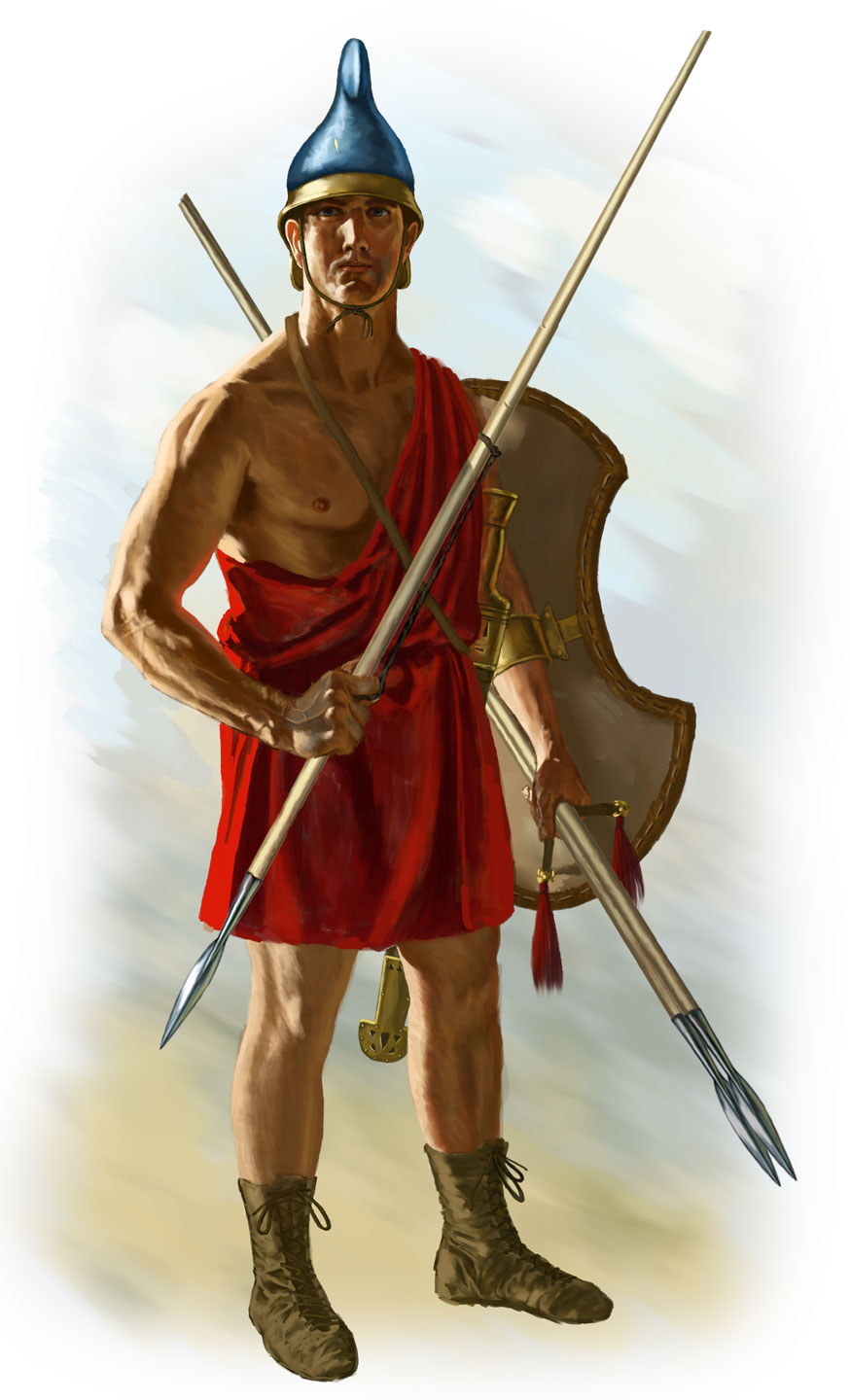
Peltasts carried a crescent-shaped wicker shield called a "pelte" (Ancient Greek πέλτη, peltē; Latin: pelta) as their main protection, hence their name. According to Aristotle, the pelte was rimless and covered in goat- or sheepskin. Some literary sources imply that the shield could be round, but in art it is usually shown as crescent-shaped. It also appears in Scythian art and may have been a common type in Central Europe. The shield could be carried with a central strap and a handgrip near the rim[citation needed] or with just a central hand-grip. It may also have had a carrying strap (or guige), as Thracian peltasts slung their shields on their backs when evading the enemy.
Peltasts weapons consisted of several javelins, which may have had straps to allow more force to be applied to a throw.
The size of these javelins could differ greatly from a modern olympic-style javelin. Xenophon mentions in his Anabasis an encounter with hostile Carduchians, fighting with longbows, wherein the Greeks reused carduchian arrows as javelins.
They were, moreover, excellent archers, using bows nearly three cubits long and arrows more than two cubits (86 cm -112 cm). When discharging the arrow, they draw the string by getting a purchase with the left foot planted forward on the lower end of the bow. The arrows pierced through shield and cuirass, and the Hellenes, when they got hold of them, used them as javelins, fitting them to their thongs.
In Archaic Greece, the Greek martial tradition had been focused almost exclusively on the heavy infantry, or hoplites.
The style of fighting used by peltasts originated in Thrace, and the first Greek peltasts were recruited from the Greek cities of the Thracian coast. They are generally depicted on vases and in other images as wearing the typical Thracian costume, which includes the distinctive Phrygian cap made of fox-skin and with ear flaps. They also usually wore patterned tunics, fawnskin boots and long cloaks, called zeiras, decorated with a bright, geometric, pattern. However, many mercenary peltasts were probably recruited in Greece. Some vases have also been found showing hoplites (men wearing Corinthian helmets, greaves and cuirasses, holding hoplite spears) carrying peltes. Often, the mythical Amazons (women warriors) are shown with peltast equipment.
Hub AI
Peltast AI simulator
(@Peltast_simulator)
Peltast
A peltast (Ancient Greek: πελταστής, peltastēs) was a type of light infantry originating in Thrace and Paeonia and named after the kind of shield they carried. Thucydides mentions the Thracian peltasts, while Xenophon in the Anabasis distinguishes the Thracian and Greek peltast troops.
The peltast often served as a skirmisher in Hellenistic armies. In the Middle Ages, the same term was used for a type of Byzantine infantryman.
Peltasts carried a crescent-shaped wicker shield called a "pelte" (Ancient Greek πέλτη, peltē; Latin: pelta) as their main protection, hence their name. According to Aristotle, the pelte was rimless and covered in goat- or sheepskin. Some literary sources imply that the shield could be round, but in art it is usually shown as crescent-shaped. It also appears in Scythian art and may have been a common type in Central Europe. The shield could be carried with a central strap and a handgrip near the rim[citation needed] or with just a central hand-grip. It may also have had a carrying strap (or guige), as Thracian peltasts slung their shields on their backs when evading the enemy.
Peltasts weapons consisted of several javelins, which may have had straps to allow more force to be applied to a throw.
The size of these javelins could differ greatly from a modern olympic-style javelin. Xenophon mentions in his Anabasis an encounter with hostile Carduchians, fighting with longbows, wherein the Greeks reused carduchian arrows as javelins.
They were, moreover, excellent archers, using bows nearly three cubits long and arrows more than two cubits (86 cm -112 cm). When discharging the arrow, they draw the string by getting a purchase with the left foot planted forward on the lower end of the bow. The arrows pierced through shield and cuirass, and the Hellenes, when they got hold of them, used them as javelins, fitting them to their thongs.
In Archaic Greece, the Greek martial tradition had been focused almost exclusively on the heavy infantry, or hoplites.
The style of fighting used by peltasts originated in Thrace, and the first Greek peltasts were recruited from the Greek cities of the Thracian coast. They are generally depicted on vases and in other images as wearing the typical Thracian costume, which includes the distinctive Phrygian cap made of fox-skin and with ear flaps. They also usually wore patterned tunics, fawnskin boots and long cloaks, called zeiras, decorated with a bright, geometric, pattern. However, many mercenary peltasts were probably recruited in Greece. Some vases have also been found showing hoplites (men wearing Corinthian helmets, greaves and cuirasses, holding hoplite spears) carrying peltes. Often, the mythical Amazons (women warriors) are shown with peltast equipment.