



Community hub
Recent from talks
Knowledge base stats:
Talk channels stats:
Members stats:
Penhale Sands
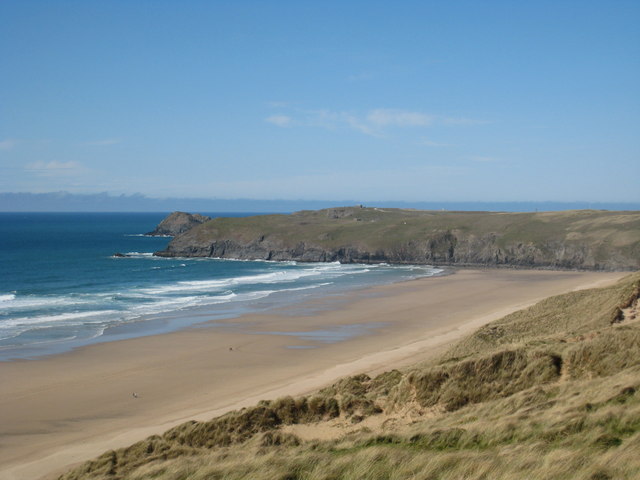
Penhale Sands (Cornish: Peran Treth, meaning St Piran's sands), or Penhale Dunes, is a complex of sand dunes and a protected area for its wildlife, on the north Cornwall coast in England, UK. It is the most extensive system of sand dunes in Cornwall and is believed to be the landing site of Saint Piran. Dating from the 6th century, St Piran's Oratory is thought to be one of the oldest Christian sites in Britain. The remains were discovered in the late 18th century, and in 2014 the covering sand was removed to reveal a building more than a thousand years old, in a reasonable state of preservation. A restricted military area dating from 1939, Penhale Camp, is found on the northern part of the dunes.
The area has been designated as a Site of Special Scientific Interest (SSSI) since 1953 and became a Special Area of Conservation (SAC) in 2004. The South West Coast Path runs through the dunes.
The sands are located 5 miles (8.0 km) south-west of the town of Newquay, in the civil parish of Perranzabuloe, stretching for over 2.5 miles (4.0 km) between Perranporth in the south and Holywell to the north, with the Atlantic Ocean and Perran Beach to the west. The Cornish sand dunes are thought to have formed over 5,000 years ago as sea levels rose to approximately their present levels. Penhale Sands are the largest dune system within Cornwall and has a maximum depth of 48 metres (157 ft) of sand. The system, of over 650 hectares (1,600 acres), extends for more than 1 mile (1.6 km) inland and includes Reen Sands, Gear Sands and Perransands.
The South West Coast Path runs through the dunes.
Penhale Sands and Perran Beach are believed to be the 6th century landing site of Saint Piran from Ireland, regarded the bringer of Christianity to, and the patron saint of Cornwall. On this site, situated in a hollow, St Piran's Oratory was built around this time. It is thought to be the oldest Christian site in Cornwall and one of the oldest in Britain. The church was abandoned in the tenth century due to the encroachment of sand. A replacement church was built further inland and abandoned in 1795. The oratory site was excavated in 1835 and 1843 before the remains were encased in a large concrete structure in 1910. The concrete structure was removed in 1980 and the delicate site buried in sand for its protection. In 2014 the sand was removed to reveal the remains of the church.
Penhale Camp was established in 1939, to the north of the dunes, as a World War II emergency measure to train anti-aircraft gunners. There still remains evidence of the gun sites, searchlight batteries and defensive positions such as pillboxes and trenches. On 7 June 1940 the camp was bombed by a single German bomber, probably looking for the nearby St Eval airfield; twenty-two British soldiers were killed in the raid, most were subsequently buried in nearby St Piran Church Perranzabuloe. In 1943 the camp was occupied by the United States Army Corps of Engineers as part of the buildup to Operation Overlord, the D-Day landings. The engineers built the fourteen Nissen huts on the Camp; still used today as accommodation for training units. In 1955, three Royal Artillery men drowned while swimming in the sea at Perran Corner. These dangerous waters, with treacherous rip tides, have also claimed the lives of at least two civilians.
The sand dunes have for many years been used by naturists, as an unofficial naturist beach. Over the years, the Ministry of Defence have complained about nude sunbathers, but a compromise was reached with the land owner in 2007
In April 2010, the camp was closed by the Ministry of Defence and was sold in September that year for £1.5million. However, the area is still governed by Ministry of Defence Byelaws Today, Penhale Camp and the associated training area are available to all Arms and Services wishing to carry out low level infantry skills training, cadre courses, communications and CPX training. The surrounding area provides opportunities for all recognised adventurous training activities and the newer extreme sports such as power kiting and coasteering. Now established in Penhale Camp is EBO Adventure Centre which provides a diverse range of training activities including Military Resettlement.
Hub AI
Penhale Sands AI simulator
(@Penhale Sands_simulator)
Penhale Sands
Penhale Sands (Cornish: Peran Treth, meaning St Piran's sands), or Penhale Dunes, is a complex of sand dunes and a protected area for its wildlife, on the north Cornwall coast in England, UK. It is the most extensive system of sand dunes in Cornwall and is believed to be the landing site of Saint Piran. Dating from the 6th century, St Piran's Oratory is thought to be one of the oldest Christian sites in Britain. The remains were discovered in the late 18th century, and in 2014 the covering sand was removed to reveal a building more than a thousand years old, in a reasonable state of preservation. A restricted military area dating from 1939, Penhale Camp, is found on the northern part of the dunes.
The area has been designated as a Site of Special Scientific Interest (SSSI) since 1953 and became a Special Area of Conservation (SAC) in 2004. The South West Coast Path runs through the dunes.
The sands are located 5 miles (8.0 km) south-west of the town of Newquay, in the civil parish of Perranzabuloe, stretching for over 2.5 miles (4.0 km) between Perranporth in the south and Holywell to the north, with the Atlantic Ocean and Perran Beach to the west. The Cornish sand dunes are thought to have formed over 5,000 years ago as sea levels rose to approximately their present levels. Penhale Sands are the largest dune system within Cornwall and has a maximum depth of 48 metres (157 ft) of sand. The system, of over 650 hectares (1,600 acres), extends for more than 1 mile (1.6 km) inland and includes Reen Sands, Gear Sands and Perransands.
The South West Coast Path runs through the dunes.
Penhale Sands and Perran Beach are believed to be the 6th century landing site of Saint Piran from Ireland, regarded the bringer of Christianity to, and the patron saint of Cornwall. On this site, situated in a hollow, St Piran's Oratory was built around this time. It is thought to be the oldest Christian site in Cornwall and one of the oldest in Britain. The church was abandoned in the tenth century due to the encroachment of sand. A replacement church was built further inland and abandoned in 1795. The oratory site was excavated in 1835 and 1843 before the remains were encased in a large concrete structure in 1910. The concrete structure was removed in 1980 and the delicate site buried in sand for its protection. In 2014 the sand was removed to reveal the remains of the church.
Penhale Camp was established in 1939, to the north of the dunes, as a World War II emergency measure to train anti-aircraft gunners. There still remains evidence of the gun sites, searchlight batteries and defensive positions such as pillboxes and trenches. On 7 June 1940 the camp was bombed by a single German bomber, probably looking for the nearby St Eval airfield; twenty-two British soldiers were killed in the raid, most were subsequently buried in nearby St Piran Church Perranzabuloe. In 1943 the camp was occupied by the United States Army Corps of Engineers as part of the buildup to Operation Overlord, the D-Day landings. The engineers built the fourteen Nissen huts on the Camp; still used today as accommodation for training units. In 1955, three Royal Artillery men drowned while swimming in the sea at Perran Corner. These dangerous waters, with treacherous rip tides, have also claimed the lives of at least two civilians.
The sand dunes have for many years been used by naturists, as an unofficial naturist beach. Over the years, the Ministry of Defence have complained about nude sunbathers, but a compromise was reached with the land owner in 2007
In April 2010, the camp was closed by the Ministry of Defence and was sold in September that year for £1.5million. However, the area is still governed by Ministry of Defence Byelaws Today, Penhale Camp and the associated training area are available to all Arms and Services wishing to carry out low level infantry skills training, cadre courses, communications and CPX training. The surrounding area provides opportunities for all recognised adventurous training activities and the newer extreme sports such as power kiting and coasteering. Now established in Penhale Camp is EBO Adventure Centre which provides a diverse range of training activities including Military Resettlement.