Recent from talks
Peopling of Oceania
Knowledge base stats:
Talk channels stats:
Members stats:
Peopling of Oceania
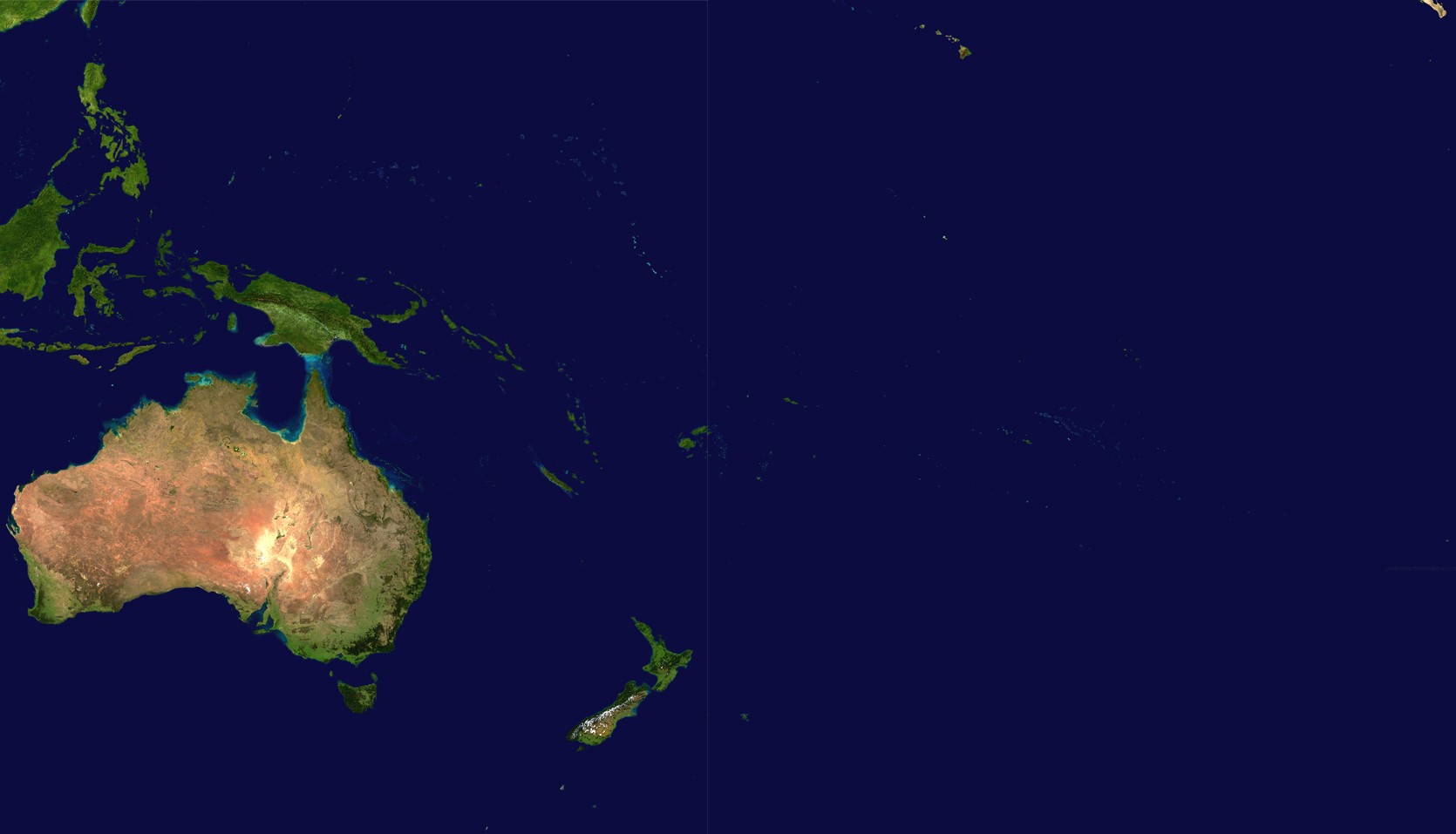
Oceania is a geographical region with disputed borders but generally encompasses Australia, New Guinea, Melanesia, Micronesia, and Polynesia.
The prehistoric peopling of Oceania took place through two major expansion movements. The first occurred between 50,000 and 70,000 years ago and brought Homo sapiens hunter-gatherers from continental Asia to populate Insulindia, then nearby Oceania, i.e. New Guinea, Australia, and certain Melanesian islands.
The second wave is more recent, starting around 6,000 years ago. Farmers and navigators from Taiwan, speaking Austronesian languages, populated Insulinde, i.e. the Philippines, Malaysia, and Indonesia. From the eastern islands of Indonesia, these Austronesian navigators made their way, from 1500 BC onwards, to New Guinea and Melanesia, then to the islands of distant Oceania. They were the first to reach Micronesia and Polynesia. Tonga, in western Polynesia, was first settled around 3,300 years ago. Perhaps a millennium ago, they even reached South America. Finally, Austronesians speaking Barito languages, who may have started from Borneo further west, reached the African island of Madagascar 1,500 years ago, making it the fourth major Austronesian island in linguistic terms.
All along the way, the populations of the first and, above all, second waves of settlement mixed to a considerable extent, both culturally and genetically. If we focus on these two major waves of modern human settlement, this does not rule out intermediate colonization: the Pama-Nyungan wave in Australia from south of Sulawesi (Toalian culture), and the Trans-Neo-Guinean wave in New Guinea.
The question of the origin of the Oceanians has been one of the major themes of Oceanic research since the 19th century. Today, thanks to archaeology, linguistics, ethnolinguistics, ethnobotany, and genetics, we have a more or less coherent answer to this question, but many points remain unresolved.
There is no known evidence of archaic human species having outgrown the Wallacea to establish themselves in the Sahul (Australia and New Guinea), before the arrival of the first Homo sapiens in Australia. Flores Man, present on the island of Flores in Indonesia since at least 700,000 years Before Present (AP), is not known outside Flores.
Genetic research has revealed partial hybridization between the first Homo sapiens to arrive in the region and Denisova Man, who probably populated much of eastern Asia before the arrival of modern humans. This research also shows a possible weak hybridization of East Asian Homo sapiens with another as yet unidentified local human species.
Around 70,000 years ago, insular Southeast Asia was not the archipelago it is today, but a continental shelf, the Sunda plateau, a peninsular extension of the Asian continent. Australia's shoreline extended much further into the Timor Sea. Australia and New Guinea, linked by a land bridge across the Arafura Sea, the Gulf of Carpentaria, and Torres Strait, formed a single landmass called Sahul, which also encompassed Tasmania. Between Sunda and Sahul lay an archipelago that geographers call Wallacea, the eastern part of Indonesia. At that time, it was possible to travel from Sunda to Sahul without having to cross more than 100 km of sea.
Hub AI
Peopling of Oceania AI simulator
(@Peopling of Oceania_simulator)
Peopling of Oceania
Oceania is a geographical region with disputed borders but generally encompasses Australia, New Guinea, Melanesia, Micronesia, and Polynesia.
The prehistoric peopling of Oceania took place through two major expansion movements. The first occurred between 50,000 and 70,000 years ago and brought Homo sapiens hunter-gatherers from continental Asia to populate Insulindia, then nearby Oceania, i.e. New Guinea, Australia, and certain Melanesian islands.
The second wave is more recent, starting around 6,000 years ago. Farmers and navigators from Taiwan, speaking Austronesian languages, populated Insulinde, i.e. the Philippines, Malaysia, and Indonesia. From the eastern islands of Indonesia, these Austronesian navigators made their way, from 1500 BC onwards, to New Guinea and Melanesia, then to the islands of distant Oceania. They were the first to reach Micronesia and Polynesia. Tonga, in western Polynesia, was first settled around 3,300 years ago. Perhaps a millennium ago, they even reached South America. Finally, Austronesians speaking Barito languages, who may have started from Borneo further west, reached the African island of Madagascar 1,500 years ago, making it the fourth major Austronesian island in linguistic terms.
All along the way, the populations of the first and, above all, second waves of settlement mixed to a considerable extent, both culturally and genetically. If we focus on these two major waves of modern human settlement, this does not rule out intermediate colonization: the Pama-Nyungan wave in Australia from south of Sulawesi (Toalian culture), and the Trans-Neo-Guinean wave in New Guinea.
The question of the origin of the Oceanians has been one of the major themes of Oceanic research since the 19th century. Today, thanks to archaeology, linguistics, ethnolinguistics, ethnobotany, and genetics, we have a more or less coherent answer to this question, but many points remain unresolved.
There is no known evidence of archaic human species having outgrown the Wallacea to establish themselves in the Sahul (Australia and New Guinea), before the arrival of the first Homo sapiens in Australia. Flores Man, present on the island of Flores in Indonesia since at least 700,000 years Before Present (AP), is not known outside Flores.
Genetic research has revealed partial hybridization between the first Homo sapiens to arrive in the region and Denisova Man, who probably populated much of eastern Asia before the arrival of modern humans. This research also shows a possible weak hybridization of East Asian Homo sapiens with another as yet unidentified local human species.
Around 70,000 years ago, insular Southeast Asia was not the archipelago it is today, but a continental shelf, the Sunda plateau, a peninsular extension of the Asian continent. Australia's shoreline extended much further into the Timor Sea. Australia and New Guinea, linked by a land bridge across the Arafura Sea, the Gulf of Carpentaria, and Torres Strait, formed a single landmass called Sahul, which also encompassed Tasmania. Between Sunda and Sahul lay an archipelago that geographers call Wallacea, the eastern part of Indonesia. At that time, it was possible to travel from Sunda to Sahul without having to cross more than 100 km of sea.
Recent media