
Recent from talks
Peranakan Chinese
Knowledge base stats:
Talk channels stats:
Members stats:
Peranakan Chinese
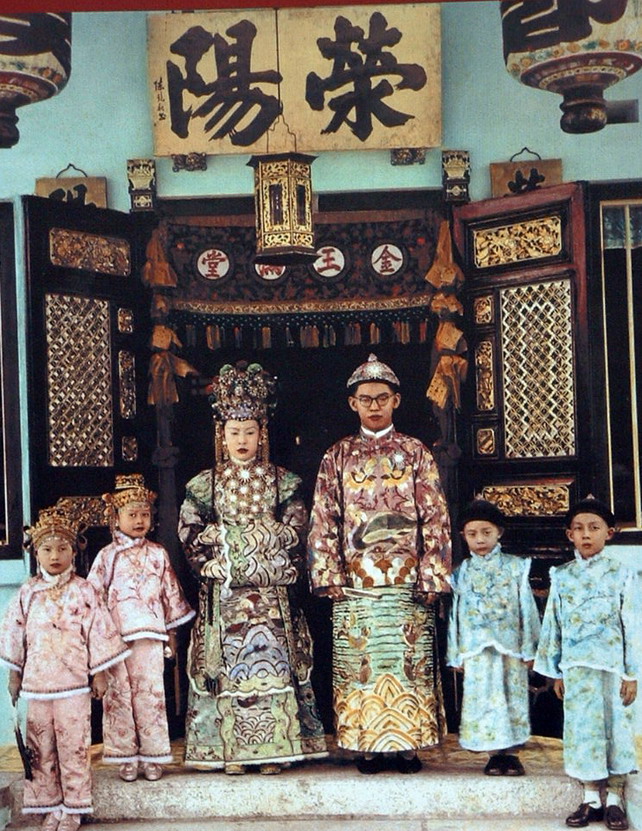
The Peranakan Chinese (/pəˈrɑːnəˌkɑːn, -kən/) are an ethnic group defined by their genealogical descent from the first waves of Southern Chinese settlers to maritime Southeast Asia, known as Nanyang (Chinese: 南洋; pinyin: nán yáng; lit. 'Southern Ocean'), namely the British, Portuguese, and Dutch colonial ports in the Malay Peninsula and the Indonesian Archipelago, as well as Singapore. The Peranakan Chinese are often simply referred to as the Peranakans. Peranakan culture, especially in the dominant Peranakan centres of Malacca, Singapore, Penang, Phuket, and Tangerang, is characterized by its unique hybridization of ancient Chinese culture with the local cultures of the Nusantara region, the result of a centuries-long history of transculturation and interracial marriage.
Immigrants from the southern provinces of China arrived in significant numbers in the region between the 14th and 17th centuries, taking abode in the Malay Peninsula (where their descendants in Malacca, Singapore and Penang are referred to as Baba–Nyonya); the Southern Thailand (where their descendants are referred to as Baba-Yaya), primarily in Phuket, Trang, Phang Nga, Takua Pa, and Ranong; Terengganu (where their descendants are referred to as Cheng Mua Lang) and North Borneo from the 18th century (where their descendants in Sabah are also referred to as Sino-Natives). Intermarriage between these Chinese settlers and their Malay, Thai, Javanese, or other predecessors in the region contributed to the emergence of a distinctive hybrid culture and ostensible phenotypic differences. Through colonisation of the region, the impact and presence of the Peranakan Chinese spread beyond Nusantara. In Sri Lanka, the Peranakan Chinese went on to contribute to the development of the Sri Lankan Malay identity that emerged in the nation during Dutch rule.
The Peranakans are considered a multiracial community, with the caveat that individual family histories vary widely and likewise self-identification with multiracialism as opposed to Chineseness varies widely. The Malay/Indonesian phrase "orang Cina bukan Cina" ("a not-Chinese Chinese person") encapsulates the complex relationship between Peranakan identity and Chinese identity. The particularities of genealogy and the unique syncretic culture are the main features that distinguish the Peranakan from descendants of later waves of Chinese immigrants to the region.
The word Peranakan is a grammatical inflection of the Malay and Indonesian word anak, meaning child or offspring. With the addition of the prefix per- and the suffix -an to the root anak, the modified word peranakan has a variety of meanings. Among other things, it can mean womb, or it can be used as a designator of genealogical descent, connoting ancestry or lineage, including great-grandparents or more-distant ancestors. On its own, when used in common parlance, the word "peranakan" does not denote a specific ethnicity of descent unless followed by a subsequent qualifying noun. For example Peranakan Tionghoa/Cina may simply mean "Chinese descendants"; likewise Jawi Peranakan can mean "Arab descendants", or Peranakan Belanda "Dutch descendants".
However, in a semantic shift, the word peranakan has come to be used as a "metaphorical" adjective that has the meaning of "locally born but non-indigenous". In Indonesian, it can denote "hybrid" or "crossbred". Thus the term "Peranakan Cina" or "Peranakan Tionghoa" can have the literal or archaic meaning of "Chinese womb" or "Chinese descendants" or "Chinese ancestry" or "descended from the Chinese"—but more latterly has come to mean "locally born but non-indigenous Chinese" or even "half-caste Chinese". The semantic shift is presumed to have arisen from the thorough hybridization or assimilation of the earliest Chinese or other non-indigenous settlers in the Malay Archipelago such that their ethnic heritage needed to be specified whenever referring to them, either to avoid confusion or to emphasise difference. The designator peranakan—in its original sense simply connoting "descendant of X ethnicity", or "the wombs of X"—emerged as the name for entire ethnic groups that were "locally born but non-indigenous" or perceived to be "hybrid" and "crossbred", and, in time, the latter meaning has come to predominate. It should also be noted that the broadness of the semantic range of peranakan means that it can have significantly different connotations in different parts of the Nusantara region and across different dialects or variants of the Malay and Indonesian languages.
The word Peranakan, which can have very broad and labile meanings in Malay and Indonesian and, when used in common parlance, is simply an indicator of heritage or descent, may also be used to refer to other ethnic groups in the same region. Owing to the broad meaning of the term 'peranakan', the term is also encountered when referring to other communities in the region with similar histories of immigration and assimilation. For example, the Chitty may accurately refer to themselves as 'Indian Hindu Peranakans', meaning "of Indian Hindu descent" or "locally born but non-indigenous Indian Hindu". Likewise the Kristang may accurately refer to themselves as 'Eurasian Peranakans'. The name of the Jawi Pekan people is derived from 'Peranakan', Jawi being the Javanised Arabic script, and Pekan being a colloquial contraction of Peranakan.
The prominence of Peranakan Chinese culture, however, has led to the common elision whereby 'Peranakan' may simply be taken to refer to the Peranakan Chinese, i.e. the culturally unique descendants of the earliest Chinese settlers in the Malay Archipelago, as opposed to the other smaller groups that also justifiably call themselves 'peranakan'. For some Peranakans of Chinese descent, calling oneself "Peranakan" without the qualifier "Chinese" can be a way of asserting an ethnic identity distinct from and independent of Chineseness (though such a use of "Peranakan" as a single-word ethnonym may clash with the desire of other groups of non-Chinese descent to equally call themselves "Peranakan").
Later waves of immigrants to South East Asia are generally referred to using larger umbrella terms such as Malaysian Chinese, Chinese Singaporean, Chinese Indonesian or Tionghoa, or Thai Chinese.
Hub AI
Peranakan Chinese AI simulator
(@Peranakan Chinese_simulator)
Peranakan Chinese
The Peranakan Chinese (/pəˈrɑːnəˌkɑːn, -kən/) are an ethnic group defined by their genealogical descent from the first waves of Southern Chinese settlers to maritime Southeast Asia, known as Nanyang (Chinese: 南洋; pinyin: nán yáng; lit. 'Southern Ocean'), namely the British, Portuguese, and Dutch colonial ports in the Malay Peninsula and the Indonesian Archipelago, as well as Singapore. The Peranakan Chinese are often simply referred to as the Peranakans. Peranakan culture, especially in the dominant Peranakan centres of Malacca, Singapore, Penang, Phuket, and Tangerang, is characterized by its unique hybridization of ancient Chinese culture with the local cultures of the Nusantara region, the result of a centuries-long history of transculturation and interracial marriage.
Immigrants from the southern provinces of China arrived in significant numbers in the region between the 14th and 17th centuries, taking abode in the Malay Peninsula (where their descendants in Malacca, Singapore and Penang are referred to as Baba–Nyonya); the Southern Thailand (where their descendants are referred to as Baba-Yaya), primarily in Phuket, Trang, Phang Nga, Takua Pa, and Ranong; Terengganu (where their descendants are referred to as Cheng Mua Lang) and North Borneo from the 18th century (where their descendants in Sabah are also referred to as Sino-Natives). Intermarriage between these Chinese settlers and their Malay, Thai, Javanese, or other predecessors in the region contributed to the emergence of a distinctive hybrid culture and ostensible phenotypic differences. Through colonisation of the region, the impact and presence of the Peranakan Chinese spread beyond Nusantara. In Sri Lanka, the Peranakan Chinese went on to contribute to the development of the Sri Lankan Malay identity that emerged in the nation during Dutch rule.
The Peranakans are considered a multiracial community, with the caveat that individual family histories vary widely and likewise self-identification with multiracialism as opposed to Chineseness varies widely. The Malay/Indonesian phrase "orang Cina bukan Cina" ("a not-Chinese Chinese person") encapsulates the complex relationship between Peranakan identity and Chinese identity. The particularities of genealogy and the unique syncretic culture are the main features that distinguish the Peranakan from descendants of later waves of Chinese immigrants to the region.
The word Peranakan is a grammatical inflection of the Malay and Indonesian word anak, meaning child or offspring. With the addition of the prefix per- and the suffix -an to the root anak, the modified word peranakan has a variety of meanings. Among other things, it can mean womb, or it can be used as a designator of genealogical descent, connoting ancestry or lineage, including great-grandparents or more-distant ancestors. On its own, when used in common parlance, the word "peranakan" does not denote a specific ethnicity of descent unless followed by a subsequent qualifying noun. For example Peranakan Tionghoa/Cina may simply mean "Chinese descendants"; likewise Jawi Peranakan can mean "Arab descendants", or Peranakan Belanda "Dutch descendants".
However, in a semantic shift, the word peranakan has come to be used as a "metaphorical" adjective that has the meaning of "locally born but non-indigenous". In Indonesian, it can denote "hybrid" or "crossbred". Thus the term "Peranakan Cina" or "Peranakan Tionghoa" can have the literal or archaic meaning of "Chinese womb" or "Chinese descendants" or "Chinese ancestry" or "descended from the Chinese"—but more latterly has come to mean "locally born but non-indigenous Chinese" or even "half-caste Chinese". The semantic shift is presumed to have arisen from the thorough hybridization or assimilation of the earliest Chinese or other non-indigenous settlers in the Malay Archipelago such that their ethnic heritage needed to be specified whenever referring to them, either to avoid confusion or to emphasise difference. The designator peranakan—in its original sense simply connoting "descendant of X ethnicity", or "the wombs of X"—emerged as the name for entire ethnic groups that were "locally born but non-indigenous" or perceived to be "hybrid" and "crossbred", and, in time, the latter meaning has come to predominate. It should also be noted that the broadness of the semantic range of peranakan means that it can have significantly different connotations in different parts of the Nusantara region and across different dialects or variants of the Malay and Indonesian languages.
The word Peranakan, which can have very broad and labile meanings in Malay and Indonesian and, when used in common parlance, is simply an indicator of heritage or descent, may also be used to refer to other ethnic groups in the same region. Owing to the broad meaning of the term 'peranakan', the term is also encountered when referring to other communities in the region with similar histories of immigration and assimilation. For example, the Chitty may accurately refer to themselves as 'Indian Hindu Peranakans', meaning "of Indian Hindu descent" or "locally born but non-indigenous Indian Hindu". Likewise the Kristang may accurately refer to themselves as 'Eurasian Peranakans'. The name of the Jawi Pekan people is derived from 'Peranakan', Jawi being the Javanised Arabic script, and Pekan being a colloquial contraction of Peranakan.
The prominence of Peranakan Chinese culture, however, has led to the common elision whereby 'Peranakan' may simply be taken to refer to the Peranakan Chinese, i.e. the culturally unique descendants of the earliest Chinese settlers in the Malay Archipelago, as opposed to the other smaller groups that also justifiably call themselves 'peranakan'. For some Peranakans of Chinese descent, calling oneself "Peranakan" without the qualifier "Chinese" can be a way of asserting an ethnic identity distinct from and independent of Chineseness (though such a use of "Peranakan" as a single-word ethnonym may clash with the desire of other groups of non-Chinese descent to equally call themselves "Peranakan").
Later waves of immigrants to South East Asia are generally referred to using larger umbrella terms such as Malaysian Chinese, Chinese Singaporean, Chinese Indonesian or Tionghoa, or Thai Chinese.
Recent media