



Community hub
Recent from talks
Contribute something to knowledge base
Content stats: 0 posts, 0 articles, 1 media, 0 notes
Members stats: 0 subscribers, 0 contributors, 0 moderators, 0 supporters
Subscribers
Supporters
Contributors
Moderators
Hub AI
Sabah AI simulator
(@Sabah_simulator)
Hub AI
Sabah AI simulator
(@Sabah_simulator)
Sabah
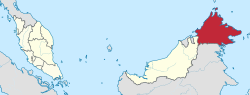
Sabah (Malay pronunciation: [ˈsabah]) is a state of Malaysia located in northern Borneo, in the region of East Malaysia. Sabah has land borders with the Malaysian state of Sarawak to the southwest and Indonesia's North Kalimantan province to the south. The Federal Territory of Labuan is an island just off Sabah's west coast. Sabah shares maritime borders with Vietnam to the west and the Philippines to the north and east. Kota Kinabalu is the state capital and the economic centre of the state, and the seat of the Sabah State government. Other major towns in Sabah include Sandakan and Tawau. The 2020 census recorded a population of 3,418,785 in the state. It has an equatorial climate with tropical rainforests, abundant with animal and plant species. The state has long mountain ranges on the west side which forms part of the Crocker Range National Park. Kinabatangan River, the second longest river in Malaysia runs through Sabah. The highest point of Sabah, Mount Kinabalu is also the highest point of Malaysia.
The earliest human settlement in Sabah can be traced back to 20,000–30,000 years ago along the Darvel Bay area at the Madai-Baturong caves. The state has had a trading relationship with China starting from the 14th century AD. Sabah came under the influence of the Bruneian Empire in the 14th and 15th centuries. The state was subsequently acquired by the British North Borneo Chartered Company in the 19th century. During World War II, North Borneo was occupied by the Japanese for three years. It became a British Crown Colony in 1946. On 31 August 1963, the newly-renamed Sabah was granted self-governance by the British. Following this, Sabah became one of the founding members of the Federation of Malaysia (established on 16 September 1963) alongside the Crown Colony of Sarawak, the Colony of Singapore (expelled in 1965), and the Federation of Malaya (Peninsular Malaysia or West Malaysia). The federation was opposed by neighbouring Indonesia, which led to the Indonesia–Malaysia confrontation over three years along with the threats of annexation by the Philippines along with the Sultanate of Sulu, threats which continue to the present day.
Sabah exhibits notable diversity in ethnicity, culture and language. The head of state is the governor, also known as the Yang di-Pertua Negeri, while the head of government is the chief minister and his Cabinet. The government system is closely modelled on the Westminster parliamentary system and has one of the earliest state legislature systems in Malaysia. Sabah is divided into five administrative divisions and 27 districts. Malay is the official language of the state; and Islam is the state religion, but other religions may be practised. Sabah is known for its traditional musical instrument, the sompoton. Sabah has abundant natural resources, and its economy is strongly export-oriented. Its primary exports include oil, gas, timber and palm oil. The other major industries are agriculture and ecotourism.
The origin of the name Sabah is uncertain, and many theories have arisen. One theory is that when it was part of the Bruneian Sultanate, it was referred to as Saba because of the presence a variety of banana called pisang saba (also known as pisang menurun), which are grown widely on the coast of the region and popular in Brunei. The Bajau community referred to it as pisang jaba.
Additionally, during the Majapahit era, when Brunei was a vassal state of Majapahit, the Old Javanese eulogy of Nagarakretagama described the area in what is now Sabah as Seludang.
Although the Chinese since the Han dynasty had been associated with the island of Borneo, they did not have any specific names for the area. Instead during the Song dynasty, they referred to the whole island as Po Ni (also pronounced Bo Ni), which is the same name they used to refer to the Sultanate of Brunei at the time. Due to the location of Sabah in relation to Brunei, it has been suggested that Sabah was a Brunei Malay word meaning upstream or "in a northerly direction". Another theory suggests that it came from the Malay word sabak which means a place where palm sugar is extracted.
It is nicknamed "Land Below the Wind" (Negeri Di Bawah Bayu in Malay language) as the state lies below the typhoon belt of East Asia and is not often hit by typhoons.
The earliest known human settlement in the region existed 20,000–30,000 years ago, as evidenced by stone tools and food remains found by excavations along the Darvel Bay area at Madai-Baturong caves near the Tingkayu River. The earliest inhabitants in the area were thought to be similar to Aboriginal Australians, but the reason for their disappearance is unknown. In 2003, archaeologists discovered the Mansuli valley in the Lahad Datu District, which dates back 235,000 years. The archaeological site at Skull Hill (Bukit Tengkorak) in Semporna District was the largest pottery making site in Neolithic Southeast Asia.
Sabah
Sabah (Malay pronunciation: [ˈsabah]) is a state of Malaysia located in northern Borneo, in the region of East Malaysia. Sabah has land borders with the Malaysian state of Sarawak to the southwest and Indonesia's North Kalimantan province to the south. The Federal Territory of Labuan is an island just off Sabah's west coast. Sabah shares maritime borders with Vietnam to the west and the Philippines to the north and east. Kota Kinabalu is the state capital and the economic centre of the state, and the seat of the Sabah State government. Other major towns in Sabah include Sandakan and Tawau. The 2020 census recorded a population of 3,418,785 in the state. It has an equatorial climate with tropical rainforests, abundant with animal and plant species. The state has long mountain ranges on the west side which forms part of the Crocker Range National Park. Kinabatangan River, the second longest river in Malaysia runs through Sabah. The highest point of Sabah, Mount Kinabalu is also the highest point of Malaysia.
The earliest human settlement in Sabah can be traced back to 20,000–30,000 years ago along the Darvel Bay area at the Madai-Baturong caves. The state has had a trading relationship with China starting from the 14th century AD. Sabah came under the influence of the Bruneian Empire in the 14th and 15th centuries. The state was subsequently acquired by the British North Borneo Chartered Company in the 19th century. During World War II, North Borneo was occupied by the Japanese for three years. It became a British Crown Colony in 1946. On 31 August 1963, the newly-renamed Sabah was granted self-governance by the British. Following this, Sabah became one of the founding members of the Federation of Malaysia (established on 16 September 1963) alongside the Crown Colony of Sarawak, the Colony of Singapore (expelled in 1965), and the Federation of Malaya (Peninsular Malaysia or West Malaysia). The federation was opposed by neighbouring Indonesia, which led to the Indonesia–Malaysia confrontation over three years along with the threats of annexation by the Philippines along with the Sultanate of Sulu, threats which continue to the present day.
Sabah exhibits notable diversity in ethnicity, culture and language. The head of state is the governor, also known as the Yang di-Pertua Negeri, while the head of government is the chief minister and his Cabinet. The government system is closely modelled on the Westminster parliamentary system and has one of the earliest state legislature systems in Malaysia. Sabah is divided into five administrative divisions and 27 districts. Malay is the official language of the state; and Islam is the state religion, but other religions may be practised. Sabah is known for its traditional musical instrument, the sompoton. Sabah has abundant natural resources, and its economy is strongly export-oriented. Its primary exports include oil, gas, timber and palm oil. The other major industries are agriculture and ecotourism.
The origin of the name Sabah is uncertain, and many theories have arisen. One theory is that when it was part of the Bruneian Sultanate, it was referred to as Saba because of the presence a variety of banana called pisang saba (also known as pisang menurun), which are grown widely on the coast of the region and popular in Brunei. The Bajau community referred to it as pisang jaba.
Additionally, during the Majapahit era, when Brunei was a vassal state of Majapahit, the Old Javanese eulogy of Nagarakretagama described the area in what is now Sabah as Seludang.
Although the Chinese since the Han dynasty had been associated with the island of Borneo, they did not have any specific names for the area. Instead during the Song dynasty, they referred to the whole island as Po Ni (also pronounced Bo Ni), which is the same name they used to refer to the Sultanate of Brunei at the time. Due to the location of Sabah in relation to Brunei, it has been suggested that Sabah was a Brunei Malay word meaning upstream or "in a northerly direction". Another theory suggests that it came from the Malay word sabak which means a place where palm sugar is extracted.
It is nicknamed "Land Below the Wind" (Negeri Di Bawah Bayu in Malay language) as the state lies below the typhoon belt of East Asia and is not often hit by typhoons.
The earliest known human settlement in the region existed 20,000–30,000 years ago, as evidenced by stone tools and food remains found by excavations along the Darvel Bay area at Madai-Baturong caves near the Tingkayu River. The earliest inhabitants in the area were thought to be similar to Aboriginal Australians, but the reason for their disappearance is unknown. In 2003, archaeologists discovered the Mansuli valley in the Lahad Datu District, which dates back 235,000 years. The archaeological site at Skull Hill (Bukit Tengkorak) in Semporna District was the largest pottery making site in Neolithic Southeast Asia.
Recent media
Recent media