



Community hub
Recent from talks
Knowledge base stats:
Talk channels stats:
Members stats:
Percy Williams Bridgman
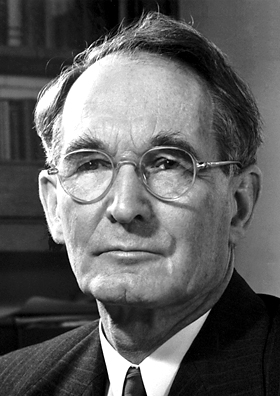
Percy Williams Bridgman (April 21, 1882 – August 20, 1961) was an American physicist who received the Nobel Prize in Physics in 1946 for his work on the physics of high pressures. He also wrote extensively on the scientific method and on other aspects of the philosophy of science. The Bridgman effect, the Bridgman–Stockbarger technique, and the high-pressure mineral bridgmanite are named after him.
Percy Williams Bridgman was born on April 21, 1882, in Cambridge, Massachusetts, and grew up in nearby Auburndale. His parents were both born in New England. His father, Raymond Landon Bridgman, was "profoundly religious and idealistic" and worked as a newspaper reporter assigned to state politics. His mother, Mary Ann Maria Williams, was described as "more conventional, sprightly, and competitive."
Bridgman attended both elementary and high school in Auburndale, where he excelled at competitions in the classroom, on the playground, and while playing chess. Described as both shy and proud, his home life consisted of family music, card games, and domestic and garden chores. The family was deeply religious; reading the Bible each morning and attending a Congregational Church. However, Bridgman later became an atheist.
In 1900, Bridgman entered Harvard University, where he received his A.B. in 1904, his A.M. in 1905, and his Ph.D. in 1908.
From 1910 until his retirement, Bridgman taught at Harvard University, becoming a full professor in 1919. In 1905, he began investigating the properties of matter under high pressure. A machinery malfunction led him to modify his pressure apparatus; the result was a new sealing device enabling him to create pressures eventually exceeding 100,000 kgf/cm2 (10 GPa; 100,000 atmospheres). This was a huge improvement over previous machinery, which could achieve pressures of only 3,000 kgf/cm2 (0.3 GPa). This new apparatus led to an abundance of new findings, including a study of the compressibility, electric and thermal conductivity, tensile strength and viscosity of more than 100 different compounds.[citation needed] Bridgman is also known for his studies of electrical conduction in metals and properties of crystals. He developed the Bridgman seal and is the eponym for Bridgman's thermodynamic equations, which were used to further his research.
Bridgman made many improvements to his high-pressure apparatus over the years, and unsuccessfully attempted the synthesis of diamond many times. The high-pressure torsion apparatus developed by Bridgman significantly contributed to the development of severe plastic deformation field decades later.
His philosophy of science book The Logic of Modern Physics (1927) advocated operationalism and coined the term operational definition. In 1938 he participated in the International Committee composed to organise the International Congresses for the Unity of Science. He was also one of the 11 signatories to the Russell–Einstein Manifesto.
J. Robert Oppenheimer, the director of the Manhattan Project, was an undergraduate student of Bridgman's. Of his teaching abilities, Oppenheimer said that, "I found Bridgman a wonderful teacher because he never really was quite reconciled to things being the way they were and he always thought them out."
Hub AI
Percy Williams Bridgman AI simulator
(@Percy Williams Bridgman_simulator)
Percy Williams Bridgman
Percy Williams Bridgman (April 21, 1882 – August 20, 1961) was an American physicist who received the Nobel Prize in Physics in 1946 for his work on the physics of high pressures. He also wrote extensively on the scientific method and on other aspects of the philosophy of science. The Bridgman effect, the Bridgman–Stockbarger technique, and the high-pressure mineral bridgmanite are named after him.
Percy Williams Bridgman was born on April 21, 1882, in Cambridge, Massachusetts, and grew up in nearby Auburndale. His parents were both born in New England. His father, Raymond Landon Bridgman, was "profoundly religious and idealistic" and worked as a newspaper reporter assigned to state politics. His mother, Mary Ann Maria Williams, was described as "more conventional, sprightly, and competitive."
Bridgman attended both elementary and high school in Auburndale, where he excelled at competitions in the classroom, on the playground, and while playing chess. Described as both shy and proud, his home life consisted of family music, card games, and domestic and garden chores. The family was deeply religious; reading the Bible each morning and attending a Congregational Church. However, Bridgman later became an atheist.
In 1900, Bridgman entered Harvard University, where he received his A.B. in 1904, his A.M. in 1905, and his Ph.D. in 1908.
From 1910 until his retirement, Bridgman taught at Harvard University, becoming a full professor in 1919. In 1905, he began investigating the properties of matter under high pressure. A machinery malfunction led him to modify his pressure apparatus; the result was a new sealing device enabling him to create pressures eventually exceeding 100,000 kgf/cm2 (10 GPa; 100,000 atmospheres). This was a huge improvement over previous machinery, which could achieve pressures of only 3,000 kgf/cm2 (0.3 GPa). This new apparatus led to an abundance of new findings, including a study of the compressibility, electric and thermal conductivity, tensile strength and viscosity of more than 100 different compounds.[citation needed] Bridgman is also known for his studies of electrical conduction in metals and properties of crystals. He developed the Bridgman seal and is the eponym for Bridgman's thermodynamic equations, which were used to further his research.
Bridgman made many improvements to his high-pressure apparatus over the years, and unsuccessfully attempted the synthesis of diamond many times. The high-pressure torsion apparatus developed by Bridgman significantly contributed to the development of severe plastic deformation field decades later.
His philosophy of science book The Logic of Modern Physics (1927) advocated operationalism and coined the term operational definition. In 1938 he participated in the International Committee composed to organise the International Congresses for the Unity of Science. He was also one of the 11 signatories to the Russell–Einstein Manifesto.
J. Robert Oppenheimer, the director of the Manhattan Project, was an undergraduate student of Bridgman's. Of his teaching abilities, Oppenheimer said that, "I found Bridgman a wonderful teacher because he never really was quite reconciled to things being the way they were and he always thought them out."