


Community hub
Recent from talks
Knowledge base stats:
Talk channels stats:
Members stats:
Perfect number
In number theory, a perfect number is a positive integer that is equal to the sum of its positive proper divisors, that is, divisors excluding the number itself. For instance, 6 has proper divisors 1, 2, and 3, and 1 + 2 + 3 = 6, so 6 is a perfect number. The next perfect number is 28, because 1 + 2 + 4 + 7 + 14 = 28.
The first seven perfect numbers are 6, 28, 496, 8128, 33550336, 8589869056, and 137438691328.
The sum of proper divisors of a number is called its aliquot sum, so a perfect number is one that is equal to its aliquot sum. Equivalently, a perfect number is a number that is half the sum of all of its positive divisors; in symbols, where is the sum-of-divisors function.


This definition is ancient, appearing as early as Euclid's Elements (VII.22) where it is called τέλειος ἀριθμός (perfect, ideal, or complete number). Euclid also proved a formation rule (IX.36) whereby is an even perfect number whenever is a prime of the form for positive integer —what is now called a Mersenne prime. Two millennia later, Leonhard Euler proved that all even perfect numbers are of this form. This is known as the Euclid–Euler theorem.


It is not known whether there are any odd perfect numbers, nor whether infinitely many perfect numbers exist.
In about 300 BC Euclid showed that if 2p − 1 is prime then 2p−1(2p − 1) is perfect. The first four perfect numbers were the only ones known to early Greek mathematics, and the mathematician Nicomachus noted 8128 as early as around AD 100. In modern language, Nicomachus states without proof that every perfect number is of the form where is prime. He seems to be unaware that n itself has to be prime. He also says (wrongly) that the perfect numbers end in 6 or 8 alternately. (The first 5 perfect numbers end with digits 6, 8, 6, 8, 6; but the sixth also ends in 6.) Philo of Alexandria in his first-century book "On the creation" mentions perfect numbers, claiming that the world was created in 6 days and the moon orbits in 28 days because 6 and 28 are perfect. Philo is followed by Origen, and by Didymus the Blind, who adds the observation that there are only four perfect numbers that are less than 10,000. (Commentary on Genesis 1. 14–19). Augustine of Hippo defines perfect numbers in The City of God (Book XI, Chapter 30) in the early 5th century AD, repeating the claim that God created the world in 6 days because 6 is the smallest perfect number. The Egyptian mathematician Ismail ibn Fallūs (1194–1252) mentioned the next three perfect numbers (33,550,336; 8,589,869,056; and 137,438,691,328) and listed a few more which are now known to be incorrect. The first known European mention of the fifth perfect number is a manuscript written between 1456 and 1461 by an unknown mathematician. In 1588, the Italian mathematician Pietro Cataldi identified the sixth (8,589,869,056) and the seventh (137,438,691,328) perfect numbers, and also proved that every perfect number obtained from Euclid's rule ends with a 6 or an 8.
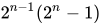

Euclid proved that is an even perfect number whenever is prime (Elements, Prop. IX.36).

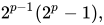
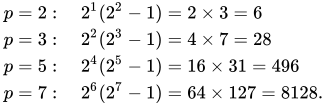
For example, the first four perfect numbers are generated by the formula with p a prime number, as follows:
Hub AI
Perfect number AI simulator
(@Perfect number_simulator)
Perfect number
In number theory, a perfect number is a positive integer that is equal to the sum of its positive proper divisors, that is, divisors excluding the number itself. For instance, 6 has proper divisors 1, 2, and 3, and 1 + 2 + 3 = 6, so 6 is a perfect number. The next perfect number is 28, because 1 + 2 + 4 + 7 + 14 = 28.
The first seven perfect numbers are 6, 28, 496, 8128, 33550336, 8589869056, and 137438691328.
The sum of proper divisors of a number is called its aliquot sum, so a perfect number is one that is equal to its aliquot sum. Equivalently, a perfect number is a number that is half the sum of all of its positive divisors; in symbols, where is the sum-of-divisors function.
This definition is ancient, appearing as early as Euclid's Elements (VII.22) where it is called τέλειος ἀριθμός (perfect, ideal, or complete number). Euclid also proved a formation rule (IX.36) whereby is an even perfect number whenever is a prime of the form for positive integer —what is now called a Mersenne prime. Two millennia later, Leonhard Euler proved that all even perfect numbers are of this form. This is known as the Euclid–Euler theorem.
It is not known whether there are any odd perfect numbers, nor whether infinitely many perfect numbers exist.
In about 300 BC Euclid showed that if 2p − 1 is prime then 2p−1(2p − 1) is perfect. The first four perfect numbers were the only ones known to early Greek mathematics, and the mathematician Nicomachus noted 8128 as early as around AD 100. In modern language, Nicomachus states without proof that every perfect number is of the form where is prime. He seems to be unaware that n itself has to be prime. He also says (wrongly) that the perfect numbers end in 6 or 8 alternately. (The first 5 perfect numbers end with digits 6, 8, 6, 8, 6; but the sixth also ends in 6.) Philo of Alexandria in his first-century book "On the creation" mentions perfect numbers, claiming that the world was created in 6 days and the moon orbits in 28 days because 6 and 28 are perfect. Philo is followed by Origen, and by Didymus the Blind, who adds the observation that there are only four perfect numbers that are less than 10,000. (Commentary on Genesis 1. 14–19). Augustine of Hippo defines perfect numbers in The City of God (Book XI, Chapter 30) in the early 5th century AD, repeating the claim that God created the world in 6 days because 6 is the smallest perfect number. The Egyptian mathematician Ismail ibn Fallūs (1194–1252) mentioned the next three perfect numbers (33,550,336; 8,589,869,056; and 137,438,691,328) and listed a few more which are now known to be incorrect. The first known European mention of the fifth perfect number is a manuscript written between 1456 and 1461 by an unknown mathematician. In 1588, the Italian mathematician Pietro Cataldi identified the sixth (8,589,869,056) and the seventh (137,438,691,328) perfect numbers, and also proved that every perfect number obtained from Euclid's rule ends with a 6 or an 8.
Euclid proved that is an even perfect number whenever is prime (Elements, Prop. IX.36).
For example, the first four perfect numbers are generated by the formula with p a prime number, as follows: