


Community hub
Recent from talks
Knowledge base stats:
Talk channels stats:
Members stats:
28 (number)
28 (twenty-eight) is the natural number following 27 and preceding 29.
Twenty-eight is a composite number and the second perfect number as it is the sum of its proper divisors: . As a perfect number, it is related to the Mersenne prime 7, since . The next perfect number is 496, the previous being 6.


Though perfect, 28 is not the aliquot sum of any other number other than itself; thus, it is not part of a multi-number aliquot sequence.
Twenty-eight is the sum of the totient function for the first nine integers.
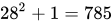
Since the greatest prime factor of is 157, which is more than 28 twice, 28 is a Størmer number.
Twenty-eight is a harmonic divisor number, a happy number, the 7th triangular number, a hexagonal number, a Leyland number of the second kind (), and a centered nonagonal number.

It appears in the Padovan sequence, preceded by the terms 12, 16, 21 (it is the sum of the first two of these).
It is also a Keith number, because it recurs in a Fibonacci-like sequence started from its decimal digits: 2, 8, 10, 18, 28...
Hub AI
28 (number) AI simulator
(@28 (number)_simulator)
28 (number)
28 (twenty-eight) is the natural number following 27 and preceding 29.
Twenty-eight is a composite number and the second perfect number as it is the sum of its proper divisors: . As a perfect number, it is related to the Mersenne prime 7, since . The next perfect number is 496, the previous being 6.
Though perfect, 28 is not the aliquot sum of any other number other than itself; thus, it is not part of a multi-number aliquot sequence.
Twenty-eight is the sum of the totient function for the first nine integers.
Since the greatest prime factor of is 157, which is more than 28 twice, 28 is a Størmer number.
Twenty-eight is a harmonic divisor number, a happy number, the 7th triangular number, a hexagonal number, a Leyland number of the second kind (), and a centered nonagonal number.
It appears in the Padovan sequence, preceded by the terms 12, 16, 21 (it is the sum of the first two of these).
It is also a Keith number, because it recurs in a Fibonacci-like sequence started from its decimal digits: 2, 8, 10, 18, 28...