


Community hub
Recent from talks
Contribute something
Nothing was collected or created yet.
Perino Model 1908
View on Wikipedia | This article includes a list of general references, but it lacks sufficient corresponding inline citations. (November 2014) |
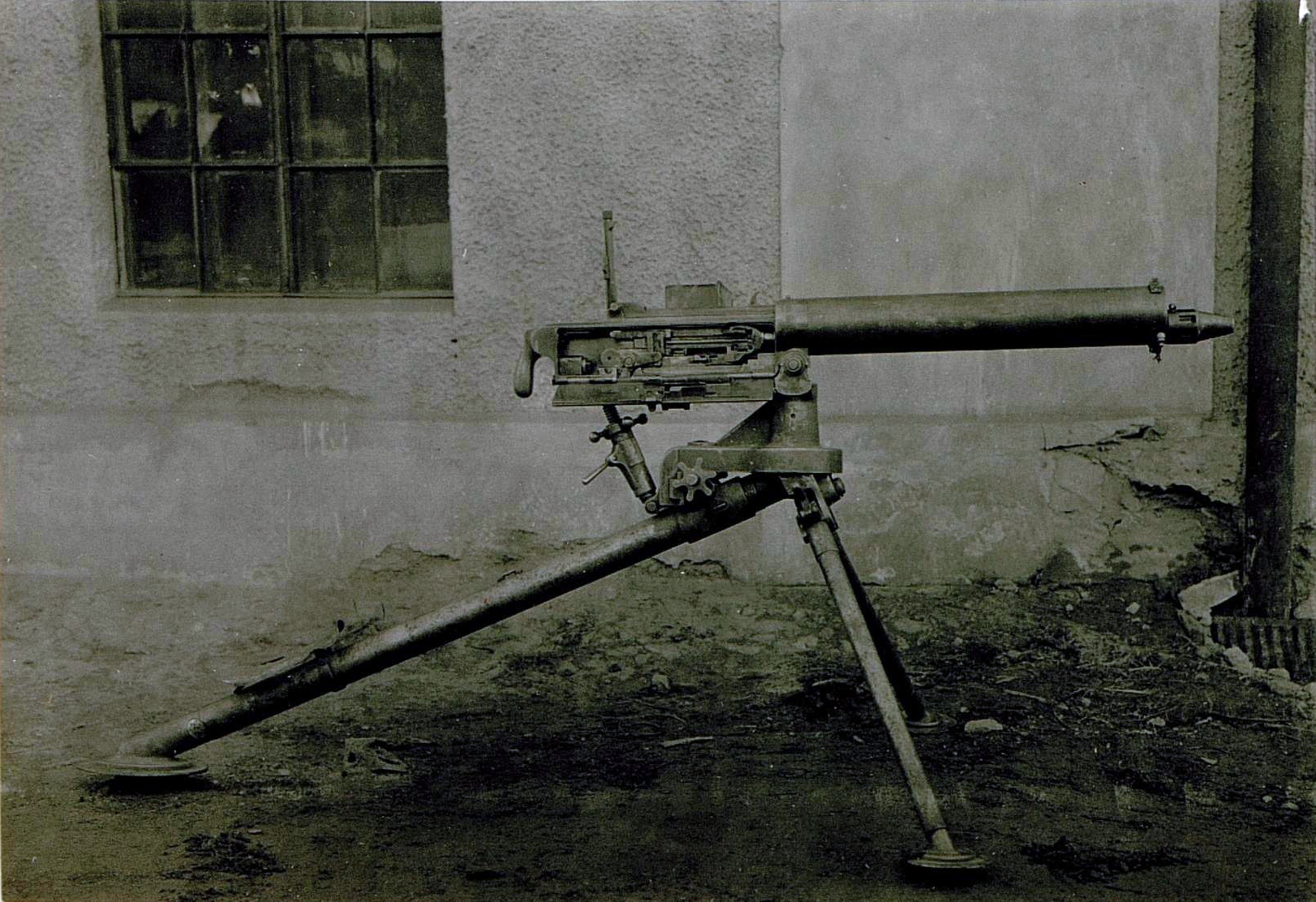
The Perino Model 1908 was an early machine gun of Italian origin designed earlier in 1901 by Giuseppe Perino, an engineer (Tecnico dell'Artiglieria). Perino's design apparently was the first Italian-designed machine gun, and in its original configuration weighed in at a heavy 27 kilograms (60 lb), which made it largely unsuitable to field utilization and apt only for fortifications; a lightened 1910 version brought the weight down to 15 kilograms (33 lb). The gun was nonetheless adopted by the Regio Esercito and saw some use alongside the Fiat-Revelli Modello 14 and the Maxim guns. It had a unique feed mechanism, with a hopper on the side of the gun filled with up to five twenty-round clips rather than being belt fed. This allowed the loader to constantly keep the gun at maximum capacity, meaning the gun crew never had to stop to reload.
Key Information


References
[edit]- ^ Esposito, Gabriele, Armies of the Italian-Turkish War: Conquest of Libya, 1911–1912 Osprey Publishing (2020)
- McNab, Chris: Twentieth-century Small Arms, Grange Books, 2004; ISBN 1-84013-381-3
- Nevio Mantoan, Weapons and Equipment of the Italian Army in the Great War 1915-1918, Gino Rossato Editore, First Edition. July 1996.
External links
[edit]- thedonovan.com: A picture of a World War I Alpino, with the assault version of the Perino
- Max Difilippo: Machine guns used by Italy during WW1 (in Italian)
- Italian Perino Machine Gun - Forgotten Weapons
- YouTube animation showing mechanism of Perino machine gun
| Sidearms |
|  | ||||
|---|---|---|---|---|---|---|
| Rifles |
| |||||
| Hand grenades | ||||||
| Machine guns |
| |||||
| Helmets | ||||||
| Other equipment | ||||||
 | This article relating to machine guns is a stub. You can help Wikipedia by expanding it. |
Perino Model 1908
View on GrokipediaHistory
Development
Giuseppe Perino, an Italian Army officer and artillery engineer known as Tecnico dell'Artiglieria, initiated the design of what would become Italy's first indigenous machine gun in 1901, motivated by the Regio Esercito's reliance on imported designs like the Maxim gun and a desire for a domestically produced alternative.[1] Perino patented his recoil-operated concept that year at the Italian artillery factory in Rome, aiming to address vulnerabilities in existing foreign weapons through innovative engineering.[4] By 1903, Perino had developed initial prototypes, which were demonstrated to the Regio Esercito, highlighting the gun's recoil operation and a novel strip-feeding system using 20-round metal trays loaded from the left side.[1] These early models featured a water-cooled barrel and a mechanism that retained spent casings within the strips to minimize battlefield clutter, distinguishing it from belt-fed competitors.[4] A key innovation was enclosing all moving parts within a sealed metal casing, which Perino overcame as a major design challenge to shield the internals from dust, dirt, and fouling—issues that plagued open mechanisms in dusty environments.[1] Early trials in 1903 pitted the prototypes against the Maxim gun and a Bergmann design, where the Perino achieved a practical rate of fire of around 100-120 rounds per minute, demonstrating reliable operation despite its heavier initial weight of approximately 27 kilograms.[1] Observers noted its advantages in reduced sensitivity to environmental contaminants compared to the Maxim, though the imported gun was temporarily favored for its established performance.[4] Further refinements led to official adoption in 1908 following secret comparative tests that confirmed the Perino's superior sustained fire capabilities.[4]Adoption and production
The Perino Model 1908 underwent extensive government trials in 1907 and 1908, during which it demonstrated notable reliability in dusty conditions compared to the Maxim gun, though early tests revealed overheating issues that required refinements to the water cooling system.[4] In a secret 1908 comparison trial against the Maxim, the Perino achieved a higher rate of fire and proved more dependable in adverse environments, leading to its formal evaluation by Italian authorities.[1][4] Following these successful trials, the Regio Esercito officially adopted the Perino Model 1908 in 1908 as Italy's first domestically produced machine gun, marking a shift toward national manufacturing independence in automatic weapons.[1] Production was ordered from the Regia Fabbrica d'Armi di Terni, with approximately 200 units manufactured between 1908 and 1914 for evaluation and limited deployment.[1] The design's complex machining requirements contributed to high production costs and logistical challenges, restricting output despite the gun's innovative features.[1] Adoption remained limited due to the weapon's substantial total weight, exceeding 50 kg when including the tripod, water jacket, and ammunition, which made it less mobile than emerging lighter alternatives.[1] It faced competition from foreign designs such as the Danish Madsen machine gun, which offered greater portability, ultimately leading the Italian military to favor the Fiat-Revelli Modello 1914 for broader service owing to its scalability in mass production.[1] The Perino fired the standard 6.5×52mm Carcano cartridge, aligning with Italian infantry needs.[1]Combat service
The Perino Model 1908 entered limited service with the Italian Royal Army prior to World War I but saw its primary combat deployment during the conflict from 1915 to 1918. By May 1915, the Italian army had only about 600 machine guns of all types available in total, including a limited number of Perino Model 1908s, though this overall number proved insufficient to fully equip all infantry regiments, which were intended to receive two sections of two guns each. These Perino weapons were issued mainly to fortifications and select infantry units along the Alpine front, serving in a secondary role compared to imported models like the Maxim and the domestically produced Fiat-Revelli Modello 1914, which benefited from greater production capacity.[5][1][6] In the early phases of Italy's involvement, the Perino was employed by units such as the Reggimento Carabinieri Reali during the Second Battle of the Isonzo in July 1915, where it provided suppressive fire in assaults on positions like Podgora amid challenging mountainous terrain. Its water-cooled design supported sustained fire in defensive roles, but the gun's heavy weight and limited availability restricted its mobility and widespread tactical use. By 1916, additional antiquated Perino guns were drawn from storage to supplement frontline needs, alongside other obsolete models like the Gardner and Nordenfelt, highlighting ongoing shortages in automatic weapons.[6][5] Austro-Hungarian forces captured several Perino guns during the intense fighting of the Isonzo battles, leading to limited use by the enemy on the Italian front. Overall production remained low at around 200 units initially for evaluation, with the design overshadowed by the Fiat-Revelli's scalability for mass wartime output. Following the war, the Perino was phased out by the early 1920s as the Italian army standardized on more mobile and reliable machine guns, with no recorded significant service in the interwar period or World War II.[1][7]Design
Operating mechanism
The Perino Model 1908 features a long-recoil operating mechanism, in which the barrel and bolt remain locked together during the initial phase of recoil, traveling rearward before a cam in the receiver unlocks the bolt for extraction of the spent cartridge.[1] This design, patented by Giuseppe Perino in 1901, relies on the recoil energy to cycle the action without additional gas assistance, distinguishing it from contemporary short-recoil or gas-operated systems.[1] A key innovation is the sealed receiver, which fully encloses all moving components—including the bolt, recoil spring, and firing pin—within a robust steel casing to prevent dirt and debris ingress, enhancing reliability in field conditions compared to open-bolt designs common in early 1900s machine guns.[1] The receiver's hinged right side allows access for maintenance while maintaining overall protection during operation.[1] In the firing sequence, a cartridge from the strip feed is chambered under gravity assistance from the side hopper as the bolt moves forward under spring tension after trigger release. The gun employs a striker mechanism to ignite the primer upon bolt closure, initiating firing on a closed bolt for improved accuracy.[1] Following discharge, recoil drives the barrel and bolt rearward; the bolt then unlocks, extracts the empty case, and returns it to the feed strip rather than ejecting it separately, with the loaded strip advancing automatically for the next cycle.[1] Safety features include a manual safety lever on the receiver to secure the bolt and prevent unintended firing.[1]Feeding and cooling systems
The Perino Model 1908 employed an innovative hopper feed system that set it apart from belt-fed machine guns of the era. A vertical hopper mounted on the left side of the receiver held up to five metal strips, each loaded with 20 rounds of 6.5×52mm Mannlicher–Carcano ammunition, providing a total capacity of 100 rounds without relying on belts or drums.[1] [8] The strips were inserted laterally into the hopper, with gravity feeding the bottom strip into the receiver; recoil operation pulled the strip forward, advancing rounds via a pawl mechanism to chamber each cartridge sequentially.[1] Spent casings were automatically returned to the empty spaces in the strip, which then ejected from the right side of the gun after firing, allowing an assistant gunner to top off the hopper by adding new strips to the top during sustained operation.[1] This gravity-assisted design enabled rapid reloads and continuous feeding, though improper strip alignment could lead to malfunctions.[1] An integrated oil pump automatically lubricated rounds during feeding, enhancing reliability in the hopper mechanism.[1] The cooling system featured a water jacket encasing the barrel to dissipate heat during prolonged firing, with a capacity of approximately 1.8 L and an auxiliary 10 L tank, supporting sustained fire.[8] The jacket incorporated valves to vent steam and prevent pressure buildup from boiling water, while the reciprocating barrel acted as a pump to circulate coolant effectively.[1] An air-cooled variant was also developed for alternative heat management, but the water-cooled configuration was standard for the Model 1908.[1] Maintenance of these systems emphasized accessibility, with the right side of the receiver hinging downward to expose moving parts for cleaning and repairs without full disassembly. Barrel removal was straightforward for routine servicing of the cooling jacket, though the specialized metal strips required precise fabrication, contributing to logistical challenges in production and supply.[1]Specifications
The Perino Model 1908 was a water-cooled heavy machine gun designed for sustained fire in defensive positions, featuring a tripod mount for stability. Its key technical parameters are summarized below.[1]| Specification | Detail |
|---|---|
| Caliber | 6.5×52mm Carcano[2] |
| Action | Long recoil, fully automatic only[2] |
| Rate of fire | 450 rounds per minute (cyclic)[2] |
| Muzzle velocity | Approximately 700 m/s |
| Effective range | 800 meters with iron sights[8] |
| Dimensions | Overall length: 1,130 mm; barrel length: 620 mm[8] |
| Weight | 30 kg (gun body, unloaded); total approximately 55-60 kg including water and tripod[1] |
| Feed | 20-round strips in hopper (capacity 100 rounds)[2] [1] |
| Crew | Typically 3-4 operators[1] |