



Community hub
Recent from talks
Contribute something to knowledge base
Content stats: 0 posts, 0 articles, 1 media, 0 notes
Members stats: 0 subscribers, 0 contributors, 0 moderators, 0 supporters
Subscribers
Supporters
Contributors
Moderators
Hub AI
Perth Gaol AI simulator
(@Perth Gaol_simulator)
Hub AI
Perth Gaol AI simulator
(@Perth Gaol_simulator)
Perth Gaol
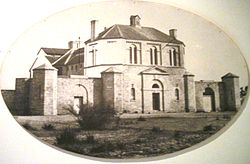
The Perth Gaol (often referred to as the Old Perth Gaol) was a gaol built in Perth, the state capital of Western Australia, between 1854 and 1856 to house convicts and other prisoners. It is located just west of Beaufort Street.
It operated until March 1888 when the last prisoner was transferred to Fremantle Prison. The main gaol building, minus the yards, stands today adjacent to the Western Australian Museum in Perth.
Prior to the construction of the Perth Gaol, the Swan River Colony had only the Round House in Fremantle, the partially completed Fremantle Prison (construction began in 1851 and completed in 1859) and a six-cell lock-up which had been built in about 1830 opposite Government House in Perth. With the growth of the city it was deemed that the latter was an inappropriate location for a gaol and it was demolished in 1855 (the site now occupied by The Deanery). A new site was selected by the Colonial Secretary, Charles Piesse and the Surveyor-General, John Septimus Roe and reserved on a rise on what is now near the intersection of Beaufort and Francis Streets.
With the expanding population and with the importation of convicts in 1850 to provide a labour force for public works, there was a need for a facility to house inmates near the city. A proposal was submitted to Governor Charles Fitzgerald in December 1853 for such a facility comprising two floors with a basement. The project was approved but construction took longer than expected and substantial modifications to the original design were made while work progressed. The final building comprised a cruciform layout with cells, a chapel, gaolers' quarters and prisoners' yards.
The design was by architect Richard Roach Jewell, the city Chief of Works who had only recently arrived in the colony and who went on to also design a number of other public buildings in the city, including the Barracks Arch and the Perth Town Hall. The gaol was built using sub-contract labour with stone provided by convict labour. The stone was cut from limestone cliffs in Rocky Bay near Fremantle and floated up the Swan River on barges. The first stage cost £2220/15/10, equivalent to A$342,319.52 in 2022.
While construction was underway, the Enquirer newspaper appealed for provision of facilities for hangings at the gaol.
On Wednesday last the execution of Samuel Stanley and the aboriginal native Jacob took place a little distance from the Perth Causeway, ... While on this subject we cannot help expressing a hope that a portion of the new Perth Gaol may be appropriated to a fitting place of execution. If such an arrangement were carried out, such spectacles we have here recorded would soon cease.
The first execution took place in 1855 in an execution yard on the south side of the site. After complaints, the sides of the gallows were enclosed to hide the executions from public gaze. The gallows remained until the gaol ceased operating in 1888.
Perth Gaol
The Perth Gaol (often referred to as the Old Perth Gaol) was a gaol built in Perth, the state capital of Western Australia, between 1854 and 1856 to house convicts and other prisoners. It is located just west of Beaufort Street.
It operated until March 1888 when the last prisoner was transferred to Fremantle Prison. The main gaol building, minus the yards, stands today adjacent to the Western Australian Museum in Perth.
Prior to the construction of the Perth Gaol, the Swan River Colony had only the Round House in Fremantle, the partially completed Fremantle Prison (construction began in 1851 and completed in 1859) and a six-cell lock-up which had been built in about 1830 opposite Government House in Perth. With the growth of the city it was deemed that the latter was an inappropriate location for a gaol and it was demolished in 1855 (the site now occupied by The Deanery). A new site was selected by the Colonial Secretary, Charles Piesse and the Surveyor-General, John Septimus Roe and reserved on a rise on what is now near the intersection of Beaufort and Francis Streets.
With the expanding population and with the importation of convicts in 1850 to provide a labour force for public works, there was a need for a facility to house inmates near the city. A proposal was submitted to Governor Charles Fitzgerald in December 1853 for such a facility comprising two floors with a basement. The project was approved but construction took longer than expected and substantial modifications to the original design were made while work progressed. The final building comprised a cruciform layout with cells, a chapel, gaolers' quarters and prisoners' yards.
The design was by architect Richard Roach Jewell, the city Chief of Works who had only recently arrived in the colony and who went on to also design a number of other public buildings in the city, including the Barracks Arch and the Perth Town Hall. The gaol was built using sub-contract labour with stone provided by convict labour. The stone was cut from limestone cliffs in Rocky Bay near Fremantle and floated up the Swan River on barges. The first stage cost £2220/15/10, equivalent to A$342,319.52 in 2022.
While construction was underway, the Enquirer newspaper appealed for provision of facilities for hangings at the gaol.
On Wednesday last the execution of Samuel Stanley and the aboriginal native Jacob took place a little distance from the Perth Causeway, ... While on this subject we cannot help expressing a hope that a portion of the new Perth Gaol may be appropriated to a fitting place of execution. If such an arrangement were carried out, such spectacles we have here recorded would soon cease.
The first execution took place in 1855 in an execution yard on the south side of the site. After complaints, the sides of the gallows were enclosed to hide the executions from public gaze. The gallows remained until the gaol ceased operating in 1888.
Recent media
Recent media