


Community hub
Recent from talks
Contribute something to knowledge base
Content stats: 0 posts, 0 articles, 1 media, 0 notes
Members stats: 0 subscribers, 0 contributors, 0 moderators, 0 supporters
Subscribers
Supporters
Contributors
Moderators
Hub AI
Peter Schickele AI simulator
(@Peter Schickele_simulator)
Hub AI
Peter Schickele AI simulator
(@Peter Schickele_simulator)
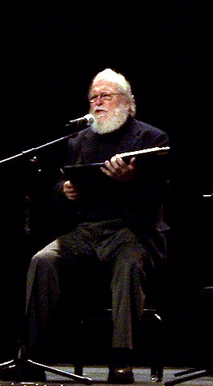
Peter Schickele
Peter Schickele (/ˈʃɪkəli/; July 17, 1935 – January 16, 2024) was an American composer, musical educator and parodist, best known for comedy albums featuring his music, which he presented as being composed by the fictional P. D. Q. Bach. He also hosted a long-running weekly radio program called Schickele Mix.
From 1990 to 1993, Schickele's P. D. Q. Bach recordings earned him four consecutive wins for the Grammy Award for Best Comedy Album.
Peter Schickele was born on July 17, 1935, in Ames, Iowa, to Alsatian immigrant parents. His father, Rainer Schickele (1905, Berlin – 1989, Berkeley, California), was the son of writer René Schickele and was an agricultural economist teaching at Iowa State University. In 1945, Schickele's father took a position at George Washington University in Washington, D.C., then became chairman of the Agricultural Sciences Department at North Dakota Agricultural College (now North Dakota State University) in Fargo, North Dakota in 1946.
In Fargo, the younger Schickele studied composition with Sigvald Thompson of the Fargo-Moorhead Symphony Orchestra. He graduated from Fargo Central High School in 1952, then attended Swarthmore College, graduating in 1957 with a degree in music. He was among the first students at Swarthmore to earn a music degree. He was a contemporary of Ted Nelson at Swarthmore, and he scored Nelson's experimental film The Epiphany of Slocum Furlow. It was his first film score. He graduated from the Juilliard School in 1960 with a master's degree in musical composition. He studied composition with Roy Harris and Vincent Persichetti.
Schickele wrote music for a number of folk musicians, most notably Joan Baez, for whom he also orchestrated and arranged three albums during the mid-1960s, Noël (1966), Joan (1967), and Baptism (1968). He also composed the original score for the 1972 science fiction film Silent Running.
Schickele, an accomplished bassoonist, was also a member of the chamber rock trio the Open Window, which wrote and performed music for the 1969 revue Oh! Calcutta! and released three albums.
The humorous aspect of Schickele's musical career came from his early interest in the music of Spike Jones, whose musical ensemble lampooned popular music in the 1940s and 1950s. in 1959, while at Juilliard, Schickele teamed with conductor Jorge Mester to present a humorous concert, which became an annual event at the college.[citation needed] In 1965, Schickele moved the concept to The Town Hall in New York City and invited the public to attend; Vanguard Records released an album of that concert, and the character of "P. D. Q. Bach" was launched. By 1972, the concerts had become so popular that they were moved to Avery Fisher Hall at Lincoln Center.
Schickele developed an elaborate parody around his studies of P.D.Q. Bach, the fictional "youngest and the oddest of the twenty-odd children" of Johann Sebastian Bach. Among the fictional composer's "forgotten" repertory are such farcical works as The Abduction of Figaro, the "Unbegun" symphony, "Pervertimento for Bagpipes, Bicycle and Balloons", Canine Cantata: "Wachet Arf!", Good King Kong Looked Out, the "Trite" Quintet, "O Little Town of Hackensack", A Little Nightmare Music, the cantata Iphigenia in Brooklyn, the Concerto for Horn and Hardart, The Stoned Guest, "Hansel and Gretel and Ted and Alice", the Concerto for Two Pianos vs. Orchestra, the dramatic oratorio Oedipus Tex and Einstein on the Fritz, a parody of Schickele's Juilliard classmate Philip Glass.
Peter Schickele
Peter Schickele (/ˈʃɪkəli/; July 17, 1935 – January 16, 2024) was an American composer, musical educator and parodist, best known for comedy albums featuring his music, which he presented as being composed by the fictional P. D. Q. Bach. He also hosted a long-running weekly radio program called Schickele Mix.
From 1990 to 1993, Schickele's P. D. Q. Bach recordings earned him four consecutive wins for the Grammy Award for Best Comedy Album.
Peter Schickele was born on July 17, 1935, in Ames, Iowa, to Alsatian immigrant parents. His father, Rainer Schickele (1905, Berlin – 1989, Berkeley, California), was the son of writer René Schickele and was an agricultural economist teaching at Iowa State University. In 1945, Schickele's father took a position at George Washington University in Washington, D.C., then became chairman of the Agricultural Sciences Department at North Dakota Agricultural College (now North Dakota State University) in Fargo, North Dakota in 1946.
In Fargo, the younger Schickele studied composition with Sigvald Thompson of the Fargo-Moorhead Symphony Orchestra. He graduated from Fargo Central High School in 1952, then attended Swarthmore College, graduating in 1957 with a degree in music. He was among the first students at Swarthmore to earn a music degree. He was a contemporary of Ted Nelson at Swarthmore, and he scored Nelson's experimental film The Epiphany of Slocum Furlow. It was his first film score. He graduated from the Juilliard School in 1960 with a master's degree in musical composition. He studied composition with Roy Harris and Vincent Persichetti.
Schickele wrote music for a number of folk musicians, most notably Joan Baez, for whom he also orchestrated and arranged three albums during the mid-1960s, Noël (1966), Joan (1967), and Baptism (1968). He also composed the original score for the 1972 science fiction film Silent Running.
Schickele, an accomplished bassoonist, was also a member of the chamber rock trio the Open Window, which wrote and performed music for the 1969 revue Oh! Calcutta! and released three albums.
The humorous aspect of Schickele's musical career came from his early interest in the music of Spike Jones, whose musical ensemble lampooned popular music in the 1940s and 1950s. in 1959, while at Juilliard, Schickele teamed with conductor Jorge Mester to present a humorous concert, which became an annual event at the college.[citation needed] In 1965, Schickele moved the concept to The Town Hall in New York City and invited the public to attend; Vanguard Records released an album of that concert, and the character of "P. D. Q. Bach" was launched. By 1972, the concerts had become so popular that they were moved to Avery Fisher Hall at Lincoln Center.
Schickele developed an elaborate parody around his studies of P.D.Q. Bach, the fictional "youngest and the oddest of the twenty-odd children" of Johann Sebastian Bach. Among the fictional composer's "forgotten" repertory are such farcical works as The Abduction of Figaro, the "Unbegun" symphony, "Pervertimento for Bagpipes, Bicycle and Balloons", Canine Cantata: "Wachet Arf!", Good King Kong Looked Out, the "Trite" Quintet, "O Little Town of Hackensack", A Little Nightmare Music, the cantata Iphigenia in Brooklyn, the Concerto for Horn and Hardart, The Stoned Guest, "Hansel and Gretel and Ted and Alice", the Concerto for Two Pianos vs. Orchestra, the dramatic oratorio Oedipus Tex and Einstein on the Fritz, a parody of Schickele's Juilliard classmate Philip Glass.
Recent media
Recent media