


Community hub
Recent from talks
Contribute something to knowledge base
Content stats: 0 posts, 0 articles, 1 media, 0 notes
Members stats: 0 subscribers, 0 contributors, 0 moderators, 0 supporters
Subscribers
Supporters
Contributors
Moderators
Hub AI
Peterhof (Novgorod) AI simulator
(@Peterhof (Novgorod)_simulator)
Hub AI
Peterhof (Novgorod) AI simulator
(@Peterhof (Novgorod)_simulator)
Peterhof (Novgorod)
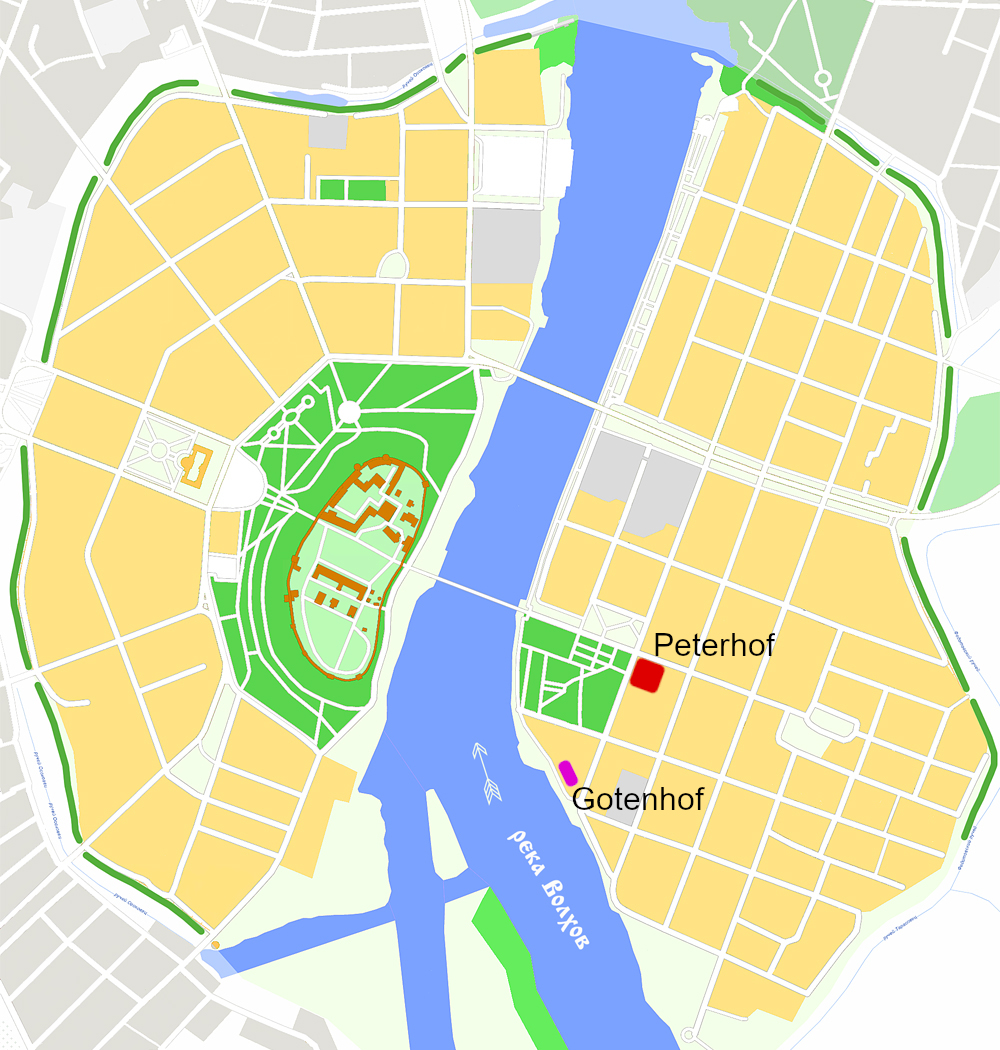
The Peterhof or Petershof (Middle Low German and modern German for "Peter's courtyard"; Russian: немецкий двор; Latin: curia sancti Petri) was a Hanseatic kontor, one of the four major trading posts of the Hanseatic League, on the right bank of the Volkhov at Novgorod, Russia, then forming the Novgorod Republic. It was named after St. Peter's Church, a Catholic church that was used by the Hanseatic merchants. It eventually consisted of two parts, the palisaded enclave, called the Peterhof proper, further uphill from the river Volkhov, and a beachyard, the Gotenhof, on the river that was eventually included in the Peterhof. Baltic trade, including Novgorod's trade, was dominated by the Hanseatic League from the 13th to 15th centuries. It was first shut down in 1494 by Ivan III of Russia, but later reopened in 1514, although a terminal decline could not be halted.
A kontor was a corporation (universitas) with a level of legal autonomy, the code of the Peterhof was called the schra. It was established around 1200 by traders from the Holy Roman Empire who earlier had used the Gotenhof. The Peterhof maintained special ties with Visby, although Lübeck tried to take over control only with partial success. Visby and Lübeck were in the 15th century sidelined by the Livonian towns. Ships from the Baltic accessed Novgorod over the Neva, Lake Ladoga and the Volkhov. Transport over land was in winter by sleighs, moving to Dorpat via Pskov.
The most important export good was fur, but beeswax, timber, honey and resin were also exported. Imports to Novgorod included herring, Flemish broadcloth, metals such as silver, salt and wine. Novgorod had an elaborate system to supply squirrel furs.
Although the Hanseatic residents did not live in complete isolation from the natives of Novgorod, the Peterhof was the most spatially segregated kontor. It and the Gotenhof were surrounded by a wooden palissade with one gate, the enclave bordered the market of Novgorod. There were strict regulations on contact with outsiders: Russian men were not allowed into the courtyard at night; however, Russian women were allowed into the kontor's bathhouse and German apprentices learnt Russian as servants for boyars. German boys also lived with farmers to learn the Russian language.
Novgorod had grown into an important merchant city over the 11th century. Scandinavian merchants dominated the Baltic trade for most of the 12th century and the Gutnic or Gotlanders had a big role. Their most important city was Visby on Gotland. The Scandinavian-Gotlandic traders had a trading post in Novgorod called the Gutagard or Gotenhof, also called St. Olav's Hof. From the middle of the 12th century traders of the northern Holy Roman Empire began to trade in Visby and formed the Gotlandic Association or the association of merchants from the Holy Roman Empire visiting Gotland. The Gotlandic Association could use this through an agreement with Visby.
The German merchants of the Gotlandic Association managed to overtake competitors (other Scandinavians) before 1200. German traders were organised in merchant guilds (universitates mercatorum) called hansas. Around that time they also got their own trading post, the Peterhof, on a lease. The St. Peter's Church was located there, it was also used as a storage place for the post's archive, coffers and valuable trading goods. This was something that also happened at other kontors. The church could be so crammed with storage that it became eventually necessary to forbid stacking goods on the altar. The Peterhof had a considerable degree of legal autonomy, although its court of appeal was located in Visby, and created its own code of regulations, the schra. It was stricter than other kontors' regulations on contact with outsiders and its head, the alderman, had greater and more absolute authority than the aldermen of other kontors. This may owe to the Peterhof's remoteness and isolation.
The German hansas gradually coalesced into the Hanseatic League over the 13th century.
Procopius of Ustyug was a Hanseatic trader before he converted to the Russian Orthodox church and became a holy fool or fool for Christ.
Peterhof (Novgorod)
The Peterhof or Petershof (Middle Low German and modern German for "Peter's courtyard"; Russian: немецкий двор; Latin: curia sancti Petri) was a Hanseatic kontor, one of the four major trading posts of the Hanseatic League, on the right bank of the Volkhov at Novgorod, Russia, then forming the Novgorod Republic. It was named after St. Peter's Church, a Catholic church that was used by the Hanseatic merchants. It eventually consisted of two parts, the palisaded enclave, called the Peterhof proper, further uphill from the river Volkhov, and a beachyard, the Gotenhof, on the river that was eventually included in the Peterhof. Baltic trade, including Novgorod's trade, was dominated by the Hanseatic League from the 13th to 15th centuries. It was first shut down in 1494 by Ivan III of Russia, but later reopened in 1514, although a terminal decline could not be halted.
A kontor was a corporation (universitas) with a level of legal autonomy, the code of the Peterhof was called the schra. It was established around 1200 by traders from the Holy Roman Empire who earlier had used the Gotenhof. The Peterhof maintained special ties with Visby, although Lübeck tried to take over control only with partial success. Visby and Lübeck were in the 15th century sidelined by the Livonian towns. Ships from the Baltic accessed Novgorod over the Neva, Lake Ladoga and the Volkhov. Transport over land was in winter by sleighs, moving to Dorpat via Pskov.
The most important export good was fur, but beeswax, timber, honey and resin were also exported. Imports to Novgorod included herring, Flemish broadcloth, metals such as silver, salt and wine. Novgorod had an elaborate system to supply squirrel furs.
Although the Hanseatic residents did not live in complete isolation from the natives of Novgorod, the Peterhof was the most spatially segregated kontor. It and the Gotenhof were surrounded by a wooden palissade with one gate, the enclave bordered the market of Novgorod. There were strict regulations on contact with outsiders: Russian men were not allowed into the courtyard at night; however, Russian women were allowed into the kontor's bathhouse and German apprentices learnt Russian as servants for boyars. German boys also lived with farmers to learn the Russian language.
Novgorod had grown into an important merchant city over the 11th century. Scandinavian merchants dominated the Baltic trade for most of the 12th century and the Gutnic or Gotlanders had a big role. Their most important city was Visby on Gotland. The Scandinavian-Gotlandic traders had a trading post in Novgorod called the Gutagard or Gotenhof, also called St. Olav's Hof. From the middle of the 12th century traders of the northern Holy Roman Empire began to trade in Visby and formed the Gotlandic Association or the association of merchants from the Holy Roman Empire visiting Gotland. The Gotlandic Association could use this through an agreement with Visby.
The German merchants of the Gotlandic Association managed to overtake competitors (other Scandinavians) before 1200. German traders were organised in merchant guilds (universitates mercatorum) called hansas. Around that time they also got their own trading post, the Peterhof, on a lease. The St. Peter's Church was located there, it was also used as a storage place for the post's archive, coffers and valuable trading goods. This was something that also happened at other kontors. The church could be so crammed with storage that it became eventually necessary to forbid stacking goods on the altar. The Peterhof had a considerable degree of legal autonomy, although its court of appeal was located in Visby, and created its own code of regulations, the schra. It was stricter than other kontors' regulations on contact with outsiders and its head, the alderman, had greater and more absolute authority than the aldermen of other kontors. This may owe to the Peterhof's remoteness and isolation.
The German hansas gradually coalesced into the Hanseatic League over the 13th century.
Procopius of Ustyug was a Hanseatic trader before he converted to the Russian Orthodox church and became a holy fool or fool for Christ.
Recent media
Recent media