



Community hub
Recent from talks
Knowledge base stats:
Talk channels stats:
Members stats:
Pez
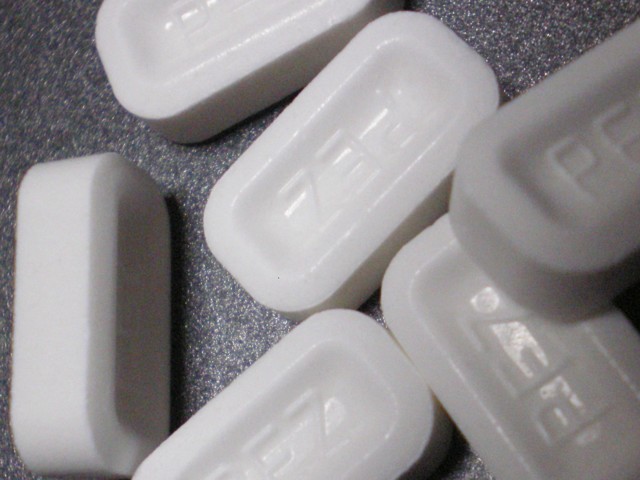
Pez (English: /pɛz/, German: [peːts]; stylised as PEZ, officially Pfefferminz, German for peppermint) is the brand name of an Austrian candy and associated manual candy dispensers. The candy is a pressed, dry, straight-edged, curved-corner block 15 mm (5⁄8 inch) long, 8 mm (5⁄16 inch) wide and 5 mm (3⁄16 inch) high, with each Pez dispenser holding 12 candy pieces.
Pez was invented in Austria and later exported worldwide. The all-uppercase spelling of the logo echoes the trademark's style on the packaging and the dispensers, with the logo drawn in perspective and giving the appearance that the letters are built out of 44 brick-like Pez mints (14 bricks in the P and 15 in each of the E and Z).
Despite the widespread recognition and popularity of the Pez dispenser, the company considers itself to be primarily a candy company, stating that "[t]oday, billions of PEZ candies are consumed annually in the U.S.A. alone". Pez dispensers are a part of popular culture in many nations, an example being "Soul Candy" in the Japanese manga series Bleach. Because of the large number of dispenser designs over the years, they are collected by many.
PEZ was first marketed as a compressed peppermint sweet in Vienna, Austria, in 1927 by Eduard Haas III. The name PEZ is an abbreviation of PfeffErminZ (German for peppermint). The original product was a round peppermint lozenge called PEZ drops. Over time, a new manufacturing process evolved and the hard pressed brick shape known today was created. The product packaging evolved from wrapped rolls to a small tin to hold the mints, similar to the modern Altoids tins. The first PEZ mint dispensers, known as "regulars", were similar in shape to a cigarette lighter and dispensed an adult breath mint marketed as an alternative to tobacco. They were invented by Oscar Uxa. Haas Food Manufacturing Corporation of Vienna was the first to sell PEZ products.
World War II slowed marketing and production. In 1945, manufacturers devised and promoted the Pez Box Regular. In 1949 the first dispenser was officially introduced at the Vienna Trade Fair. In 1952 Eduard Haas introduced his product to the United States, and Curtis Allina headed Pez's US business. In 1955, the Pez company placed heads on the dispensers and marketed them for children. Santa Claus, Popeye, Mickey Mouse and Donald Duck were among the first character dispensers. Since 1950, over 1500 Pez dispensers, including the original character dispensers, have been created.
Pez vending machines were used in Germany, Switzerland and Austria. The first German machines were introduced around 1954 and were produced by DWM (Deutsche Waggon- und Maschinenfabrik) and GWS (Georg Wiegandt und Söhne), both of Berlin, Germany. Machines were later introduced in Switzerland and then in Austria, in October 1956; these were produced by Glerios / R.Seipel & Co. and Theodor Braun (Vienna).
In 1973, Pez built a factory in Orange, Connecticut, US. In 1983, Scott McWhinnie became the president of the Pez company. He retired in 2003. Joe Vittoria became president of the company in 2004. Around 2005 the size of the original factory was doubled and the Pez dispenser line was expanded. In the mid-1990s the peppermint flavor was reintroduced with remakes of the "regulars".
In early 2002 the family of the original founder of the company bought back 32.5% of the stock from investment company PGH for €18M. They now own 67.5% of the company. The headquarters are in Traun, Austria. The Pez mints are produced in Jánossomorja, Hungary and Orange, Connecticut, while the dispensers are produced in Hungary and China. In 2011, a PEZ Visitor Center was opened in Orange, with over 4,000 square feet dedicated to all things PEZ.
Hub AI
Pez AI simulator
(@Pez_simulator)
Pez
Pez (English: /pɛz/, German: [peːts]; stylised as PEZ, officially Pfefferminz, German for peppermint) is the brand name of an Austrian candy and associated manual candy dispensers. The candy is a pressed, dry, straight-edged, curved-corner block 15 mm (5⁄8 inch) long, 8 mm (5⁄16 inch) wide and 5 mm (3⁄16 inch) high, with each Pez dispenser holding 12 candy pieces.
Pez was invented in Austria and later exported worldwide. The all-uppercase spelling of the logo echoes the trademark's style on the packaging and the dispensers, with the logo drawn in perspective and giving the appearance that the letters are built out of 44 brick-like Pez mints (14 bricks in the P and 15 in each of the E and Z).
Despite the widespread recognition and popularity of the Pez dispenser, the company considers itself to be primarily a candy company, stating that "[t]oday, billions of PEZ candies are consumed annually in the U.S.A. alone". Pez dispensers are a part of popular culture in many nations, an example being "Soul Candy" in the Japanese manga series Bleach. Because of the large number of dispenser designs over the years, they are collected by many.
PEZ was first marketed as a compressed peppermint sweet in Vienna, Austria, in 1927 by Eduard Haas III. The name PEZ is an abbreviation of PfeffErminZ (German for peppermint). The original product was a round peppermint lozenge called PEZ drops. Over time, a new manufacturing process evolved and the hard pressed brick shape known today was created. The product packaging evolved from wrapped rolls to a small tin to hold the mints, similar to the modern Altoids tins. The first PEZ mint dispensers, known as "regulars", were similar in shape to a cigarette lighter and dispensed an adult breath mint marketed as an alternative to tobacco. They were invented by Oscar Uxa. Haas Food Manufacturing Corporation of Vienna was the first to sell PEZ products.
World War II slowed marketing and production. In 1945, manufacturers devised and promoted the Pez Box Regular. In 1949 the first dispenser was officially introduced at the Vienna Trade Fair. In 1952 Eduard Haas introduced his product to the United States, and Curtis Allina headed Pez's US business. In 1955, the Pez company placed heads on the dispensers and marketed them for children. Santa Claus, Popeye, Mickey Mouse and Donald Duck were among the first character dispensers. Since 1950, over 1500 Pez dispensers, including the original character dispensers, have been created.
Pez vending machines were used in Germany, Switzerland and Austria. The first German machines were introduced around 1954 and were produced by DWM (Deutsche Waggon- und Maschinenfabrik) and GWS (Georg Wiegandt und Söhne), both of Berlin, Germany. Machines were later introduced in Switzerland and then in Austria, in October 1956; these were produced by Glerios / R.Seipel & Co. and Theodor Braun (Vienna).
In 1973, Pez built a factory in Orange, Connecticut, US. In 1983, Scott McWhinnie became the president of the Pez company. He retired in 2003. Joe Vittoria became president of the company in 2004. Around 2005 the size of the original factory was doubled and the Pez dispenser line was expanded. In the mid-1990s the peppermint flavor was reintroduced with remakes of the "regulars".
In early 2002 the family of the original founder of the company bought back 32.5% of the stock from investment company PGH for €18M. They now own 67.5% of the company. The headquarters are in Traun, Austria. The Pez mints are produced in Jánossomorja, Hungary and Orange, Connecticut, while the dispensers are produced in Hungary and China. In 2011, a PEZ Visitor Center was opened in Orange, with over 4,000 square feet dedicated to all things PEZ.