Hubbry Logo
AltoidsAltoidsMain
Open search
Altoids
Community hub
Altoids
logo
8 pages, 0 posts
0 subscribers
Be the first to start a discussion here.
Altoids
Altoids
from Wikipedia
Altoids
Product typeMint
OwnerMars, Inc.
Produced byWrigley Company
Introduced1780; 245 years ago (1780)
Previous ownersCallard & Bowser
Websitealtoids.com
Altoids
Invented1780; 245 years ago (1780)
Main ingredientsSugar or sorbitol
Ingredients generally usedNatural and/or artificial flavours
Variations406
Food energy
(per 3 pieces (2g) serving)
10 kcal (42 kJ)
Nutritional value
(per 3 pieces (2g) serving)
Proteing
Fatg
Carbohydrateg
Other informationOwner: Mars Wrigley
  •   Media: Altoids

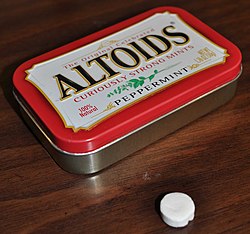
Altoids are a brand of mints, sold primarily in distinctive metal tins. The brand was created by the London-based Smith & Company in the 1780s, and became part of the Callard & Bowser company in the 19th century. Their advertising slogan is "The Original Celebrated Curiously Strong Mints", referring to the high concentration of peppermint oil used in the original flavour lozenge. The mints were originally conceived as a lozenge intended to relieve intestinal discomfort.

Marketing

[edit]

Callard & Bowser-Suchard once manufactured Altoids at a plant in Bridgend, Wales, but has since moved production to a Mars Wrigley plant in Chattanooga, Tennessee, United States, in order to manufacture the products closer to where they are primarily marketed.[1][2] They were marketed for a brief period in the 1990s under the "Nuttall's" brand when Callard and Bowser was under the ownership of Terry's.

Flavours and varieties

[edit]

Mints

[edit]

As of June 2022, Altoids mints are available in five flavours, namely peppermint, wintergreen, spearmint, cinnamon, and strawberry.[3][4] "Sugar-Free Smalls", tiny square mints sweetened with sorbitol and sucralose, are also available in peppermint, wintergreen, and cinnamon. In 2007, dark chocolate-dipped mints were introduced in three flavours, namely peppermint, cinnamon and ginger and in 2008, dark chocolate-dipped mints were introduced in crème de menthe. The chocolate-dipped varieties were discontinued in 2010. Also historically made, but no longer available, were liquorice, cool honey, and (non-chocolate dipped) ginger and crème de menthe varieties. Circa early 2011, Altoids altered the ingredients of their wintergreen mints, adding blue food colouring. Altoid mints other than those labelled "sugar-free smalls" contain gelatin.[citation needed]

Sours

[edit]

Sour hard candies in round tins were introduced in 2001 but were discontinued in 2010 due to low sales.[5] Flavours included raspberry, citrus, apple, tangerine, and mango. Limited edition passion fruit sours were also released around Valentine's Day in 2005 in a larger 2.3 oz (65 g) tin instead of the standard 1.76 oz (50 g) sours tins that had been released up until then.

Gum

[edit]

The sugar-free chewing gum, introduced in 2003, was made in the United States. Flavors include peppermint, cinnamon, spearmint, wintergreen and two sour flavours, cherry and apple. The gum has not been seen in stock in US stores since January 2010 and has been discontinued.[6]

Altoids Strips

[edit]

In 2003, breath strips in peppermint and cinnamon flavors were introduced. They were discontinued.[citation needed]

Altoids Arctic

[edit]

In 2014, Eclipse Mints, another Wrigley product, were rebranded as Altoids Arctic, with the tin remaining identical save for labelling. The rebranded mints were released in only Peppermint, Wintergreen, and Strawberry, doing away with the wider varieties of Eclipse such as Cinnamon, Winterfrost, and several other flavors, as well as the chewable. As before, each tin contains 1.2 oz (34 g), or about 50 mints.[citation needed]

Retro Sours

[edit]

In 2024, a revival of the discontinued Altoids Sours was introduced under the name Retro Sours. Produced by Iconic Candy, these candies feature flavors such as citrus, tangerine, and mango. Though not manufactured by the original brand, the re-release garnered attention for its nostalgic appeal.[7]

Tins

[edit]
A collection of Altoids tins
An Altoids tin used to house an amateur QRP rig

The distinctive tins in which Altoids mints are packaged are often reused for other purposes. They have long been used as containers for household items like paper clips, coins, sewing materials and other small items. Many people make "Altoids Wallets" out of the tins, decorating the interior to add personalization.[8][9]

Altoids tins have also been popular with outdoor enthusiasts for many years as first-aid or mini survival kit containers. A name for these kits is Bug-Out Altoids Tins, or BOATs.[10]

The tins are sometimes used to house electronics projects. BeagleBone, a single-board computer made by Texas Instruments, is deliberately shaped with rounded corners to fit inside the tin.[11]

A retrocomputing hobbyist computer, the Membership Card is a series of 1802/8080/Z80 based microcomputer kits, designed to fit in an Altoids tin,[12] and CMoy pocket headphone amplifiers often use the containers as an enclosure.[13]

The mintyPi is a kit that uses an Altoids tin to house a portable retro gaming machine.[14]

Altoids Award

[edit]

At the grand opening of The New Museum of Contemporary Art in 2007, Altoids announced the biennial Altoids Award, in which cash prizes of $25,000 are awarded to four artists from around the US. Winners have their art exhibited at the museum after the rigorous selection process is completed. The first winners were chosen by Paul McCarthy, Cindy Sherman and Rirkrit Tiravanija.[15]

See also

[edit]

References

[edit]

Further reading

[edit]
[edit]
Revisions and contributorsEdit on WikipediaRead on Wikipedia
from Grokipedia
Altoids are a of curiously strong mints, primarily peppermint-flavored, sold in distinctive rectangular metal tins and renowned for their intense flavor and breath-freshening properties. Originally developed in 1780 in by Smith Kendon of Smith & Company as a lozenge to relieve intestinal discomfort, the mints evolved from a medicinal remedy into a popular product due to their potent oil content. The brand was introduced to the in 1918 and gained widespread popularity in the through emphasizing their "curiously strong" nature, a rooted in their branding as an to stomach ailments. Over time, Altoids expanded beyond the original variety to include flavors such as (launched 1997), (1999), and sugar-free options like (2014) and Smalls (2009), while maintaining their signature tins that have become collectible items. transitioned through several companies: acquired by Callard & in the 19th century, then by , before Wm. Wrigley Jr. Company purchased the brand in 2004 for $1.48 billion as part of a deal including . In 2008, Mars, Incorporated acquired Wrigley, making Mars Wrigley the current producer and distributor of Altoids worldwide. Today, Altoids remain a staple in the confectionery market, celebrated for their bold taste and status in American pop culture.

History

Origins and early development

Altoids were invented in 1780 by Smith Kendon of the London-based confectionery firm Smith & Company, initially as lozenges designed to alleviate stomach discomfort. The product's original purpose stemmed from the medicinal properties attributed to peppermint oil, which was believed to soothe intestinal issues and serve as a remedy for digestive ailments, including . Smith & Company marketed these lozenges primarily as a aid rather than a confection, positioning them as an alternative to peppermint water for treating upset stomachs. The formulation, credited to Smith Kendon, consisted of peppermint oil, sugar, , and , creating compact tablets with an intensely strong flavor intended for gradual dissolution to provide relief. Early production occurred in , where the lozenges gained popularity among apothecaries and consumers seeking natural remedies for gastrointestinal problems. Initial sales were confined to the , with the product sold through pharmacies and general stores as "medicinal lozenges" emphasizing their therapeutic benefits over any pleasurable taste. During the 19th century, Smith & Company merged with the established business Callard & Bowser, founded in , which broadened the product's distribution and began shifting its perception from a strictly item to a more widely enjoyed . Under Callard & Bowser's ownership, Altoids retained their medicinal branding but increasingly appealed to a general audience, marking the gradual transition toward recognition as a while preserving the original strong profile. This evolution reflected broader trends in the British industry, where herbal remedies blended with sweets to meet both health and indulgence demands.

Expansion and ownership changes

Altoids were first introduced to the U.S. market in 1918 through imports from the , where the mints had been produced since the by London-based Smith & and later incorporated into Callard & Bowser's portfolio in the . Initially distributed in cardboard packaging, the brand gained gradual traction among American consumers, but remained a niche for decades. Full-scale production in the United States did not begin until the mid-2000s, marking a significant step in the brand's . The ownership of Altoids underwent several corporate transitions throughout the 20th and 21st centuries, reflecting broader consolidations in the industry. In 1951, Callard & Bowser was acquired by Son & Company, integrating the mints into a diversified portfolio that included beverages and sweets. The company changed hands again in 1982 when it was sold to of , followed by a sale to (Holdings) in 1988 for approximately $37 million. In 1993, divested its division, including Altoids, to Kraft as part of a strategic refocus, allowing the brand to leverage Kraft's North American distribution networks. Kraft further expanded Altoids' presence during the , when the brand adopted the "Curiously Strong" slogan to highlight its intense flavor during U.S. market expansion. By the late 1990s, Altoids had surged in popularity, becoming the best-selling mint in the United States with annual sales exceeding $60 million and ranking among the top breath mint brands overall. In 2004, Kraft sold its U.S. sugar confectionery business, including Altoids and , to Wm. Wrigley Jr. Company for $1.48 billion, a deal that underscored the mint's commercial value. Wrigley, in turn, was acquired by Mars, Incorporated in for $23 billion, transferring Altoids to Mars Wrigley Confectionery, its current owner as of 2025. A key aspect of the brand's expansion involved relocating production from the to the in the mid-2000s to better serve the growing North American demand and reduce import costs. In , Wrigley announced plans to shift manufacturing to a facility in , with operations commencing in 2006 at the former plant acquired as part of the Kraft deal. This move not only streamlined supply chains but also positioned Altoids for further global growth under Mars' oversight, while maintaining the traditional metal tin packaging synonymous with the brand.

Products and varieties

Classic mints

The classic Altoids mints form the foundational product line of the brand, consisting of hard tablet candies designed primarily for breath freshening with an intense flavor profile known as "curiously strong." These mints originated with as the flagship variety and have since expanded to include a core selection of enduring flavors: , , , and . The primary ingredients in classic Altoids mints are , , natural flavors (such as oil of for the peppermint variety), and , providing a hard, dissolvable texture. Cinnamon mints incorporate artificial flavors, , and red 40 coloring for their distinctive hue and taste. Sugar-free variants, such as those in the Smalls line, replace with as the main sweetener, along with artificial sweeteners like and acesulfame K, , and colors, while maintaining a similar intensity. Nutritionally, each classic mint delivers approximately 3 calories and 1 gram of total sugars, derived almost entirely from , with negligible , sodium, or serving of three mints totals about 10 calories and 3 grams of . This low-calorie profile supports their use as breath fresheners, where the "curiously strong" sensation stems from the concentrated essential oils, such as oil, which provide a high menthol-like cooling effect to combat effectively. These mints are packaged in the brand's rectangular metal tins, with the standard size being 1.76 ounces containing approximately 71 mints per tin. The tins' durable, collectible design enhances portability and preservation of the mints' freshness.

Sours and other flavored varieties

The Altoids Sours line was introduced in as a tangy counterpart to the brand's traditional mints, featuring hard candies coated in a sour shell for an intense puckering sensation. Initial flavors included , , and , with additional options like apple and added later to expand the sour profile. These varieties aimed to appeal to consumers seeking bolder, fruit-forward alternatives to the standard and staples. Despite initial popularity among fans of sour candies, the Sours line was discontinued in 2010 primarily due to declining sales and low national demand. Market performance lagged as consumer preferences shifted toward sugar-free and less intense breath-freshening options, contributing to the decision to phase out the product. Post-discontinuation, collector interest grew significantly, with unopened tins of original Sours flavors commanding premium prices—often exceeding $100—on resale platforms due to their nostalgic appeal. Revival efforts emerged in the through small-scale producers attempting to recreate the original recipe, though these were limited in distribution. A more widespread return occurred in 2024 when Iconic Candy relaunched the sours as "Retro Sours," retaining the classic , , and flavors in the signature round tins while emphasizing the original tangy intensity. In 2025, the line expanded with additional flavors including passionfruit, , , and red apple. Beyond the Sours, Altoids experimented with other flavored varieties, including the Apple Sours, which offered a crisp, tart apple taste before its discontinuation alongside the line. In 2007, the brand introduced Dark Chocolate Covered Altoids in , , and ginger flavors, providing a coated twist on core mint profiles, though these were later discontinued amid similar market challenges. Seasonal limited releases, such as holiday-inspired variants, have appeared sporadically up to 2025, often tying into broader trends in flavored confections but facing discontinuation risks from fluctuating demand.

Alternative formats

Altoids has developed several alternative formats to its traditional tablet mints, focusing on enhanced portability, quick dissolution, and intensified cooling sensations to appeal to consumers seeking convenient breath freshening options. Altoids Gum was introduced in as a sugar-free option, featuring flavors like and . The product utilized as a , aligning with growing demand for sugar-free oral care items during the early . It was packaged in compact tins similar to the classic mints, emphasizing portability for on-the-go use. Although discontinued in major markets like the by 2010 due to shifting consumer preferences toward other gum brands, Altoids Gum was also discontinued internationally around the same time. Altoids Strips, launched in 2003, represented an innovative thin-film dissolvable format designed for rapid breath freshening. Available in and flavors, these strips dissolved quickly on the , providing a portable alternative to tablets without the need for chewing or prolonged sucking. Packaged in sliding tins for and ease of carry, the strips targeted users prioritizing in social or settings. However, they were discontinued shortly after introduction as part of broader industry trends away from breath strip products, which saw declining by the mid-2000s. Altoids Arctic mints, introduced in 2003, offer an iced variant of the tablet form with a higher moisture content that delivers a pronounced cooling sensation upon consumption. Flavors include peppermint, wintergreen, and strawberry, distinguishing them from the drier classic mints through their smoother, more hydrating texture for extended freshness. Unlike the metal tins of traditional Altoids, Arctic mints are housed in plastic stand-up packaging to preserve their moisture levels and enhance shelf stability. This format has proven particularly successful, positioning Arctic as a bestseller among Altoids' non-traditional offerings and driving strong market performance through its appeal for intense, long-lasting refreshment. These alternative formats—gum and strips for chewable and dissolvable portability, and Arctic for iced cooling—extended the Altoids brand into diverse consumption styles, though only the Arctic line maintains widespread availability today.

Packaging

Tin design and production

Altoids' signature metal tins were introduced in the 1920s, transitioning from earlier cardboard packaging to provide better protection for the mints and ensure they remained securely closed during transport in pockets or handbags. This shift enabled airtight storage, which helped preserve the potency and freshness of the curiously strong mint flavors by preventing exposure to air and moisture. The tins feature a distinctive rectangular shape measuring approximately 3.75 x 2.25 x 0.75 inches, with a hinged lid for easy access and reliable sealing. The tins are constructed from high-quality tin-plated , offering and a premium feel while being fully recyclable as metal. The design includes embossed logos and brand elements directly on the surface for a aesthetic, complemented by colorful labels that vary by flavor to aid identification—such as the classic red tin with yellow lettering for , blue for , green for , and dark red for . These variations maintain brand consistency while distinguishing product lines visually. Production of the tins and mints originally occurred in the but shifted to the in the mid-2000s following the acquisition of the brand by Wm. Wrigley Jr. Company in 2004. The moved from a facility in , , to , in 2006, allowing for increased efficiency to meet growing American demand while retaining the traditional tin design. This relocation emphasized the tins' role in the brand's identity, as the metal packaging continues to be a key differentiator from plastic alternatives used by competitors. The recyclable nature of the supports modern efforts, contrasting with the non-recyclable used in pre-1920s packaging.

Collectibility and cultural reuse

The collectibility of Altoids tins gained prominence in the and , fueled by aggressive that emphasized their iconic packaging and the release of limited-edition variants, combined with the tins' robust metal design that lent itself to long-term preservation and secondary uses. Vintage tins predating the , identifiable by their decorative fonts, ornate borders, and softer lithographic colors, typically command values of $15 to $50 in good condition, with rarer specimens reaching up to $400 depending on . Discontinued editions like the Tangerine Sours tins, produced until 2010, hold significant appeal, with sealed examples selling for as much as $150 on secondary markets as of 2025; recreations of these sours flavors were introduced in 2024 by Iconic Candy under the "Retro Sours" name. Key determinants of a tin's value include its physical condition—mint examples without dents or rust fetch the highest prices—rarity stemming from early UK imports by Callard & Bowser before the 1980s, and exclusivity of limited releases such as holiday-themed or promotional designs. Platforms like eBay and Etsy have amplified demand by enabling global auctions and direct sales, often highlighting authenticated rarities to attract serious collectors. In cultural reuse, Altoids tins are frequently transformed into practical storage solutions, such as pill organizers, fishing lure cases, or holders for small craft tools, leveraging their hinged lids and compact dimensions for everyday utility. Representative DIY applications include assembling mini survival kits with essentials like and compasses or creating portable sets with bandages and antiseptics, practices that promote and contribute to reduced waste through lower discard rates compared to single-use plastics. Dedicated collector communities engage via specialized online forums, where members exchange valuation advice, showcase acquisitions, and coordinate swaps or virtual events to build networks around Altoids .

Marketing

Advertising campaigns and slogan

The "Curiously Strong" slogan was introduced in the mid-1990s during Altoids' relaunch , shifting the brand's positioning from its original 18th-century medicinal roots as a remedy for discomfort to a bold, intense-flavored that emphasized its high peppermint oil concentration. This tagline, developed by the advertising agency, highlighted the product's unusually potent taste through provocative and humorous imagery, marking a departure from traditional breath-freshener toward a more irreverent, curiosity-driven identity. In the 1990s, Altoids' advertising campaigns featured quirky TV and print ads that leaned into surreal humor to underscore the slogan's promise of intensity, such as spots depicting a in leopard print with the line "Pleasure in Pain" or a figure in a silver spacesuit amid extreme scenarios. These efforts, supported by an increasing ad budget from $1 million in 1997 to over $10 million in 1998, helped reposition the brand for a U.S. accustomed to milder mints. By the , campaigns evolved to include digital initiatives like the myaltoids.com website for user contests and engagement, alongside guerrilla sampling events in urban areas where "trend ambassadors" distributed samples in edgy, theatrical styles to build buzz. Partnerships with around 100 influencers, including writers and media personalities, promoted a "curious" aligned with the brand's adventurous . The marketing strategy gradually shifted the target audience from adults primarily seeking breath freshening to younger demographics, particularly males aged 18-34, through themes of edginess and exploration that appealed to upscale, tech-savvy consumers. This evolution was evident in the provocative visuals and underground tactics that contrasted with earlier, more utilitarian positioning. The "Curiously Strong" and associated campaigns were credited with driving significant sales growth, tripling U.S. revenue from approximately $30-40 million in the mid-1990s to $100 million by 1999, establishing Altoids as a leading player in the breath-freshener category. Later 2000s efforts, including the influencer seeding and sampling, contributed to a 21% sales uplift in targeted markets like .

Sponsorships and awards

Altoids has engaged in various sponsorships to align its "curiously strong" brand identity with creative and cultural initiatives, particularly in . From 1998 to the mid-2000s, the company sponsored the Altoids Curiously Strong Collection, an annual program showcasing works by emerging American visual artists across media such as , , , and . The initiative culminated in touring exhibitions at institutions like the and Los Angeles Contemporary Exhibitions (); for example, the third annual collection in 2001 featured 24 artists, including and Jonathan Horowitz, and ran from July 14 to August 4 at . In 2008, Altoids launched the Altoids Award (its sole edition) in partnership with the of , providing $25,000 to each of four emerging American artists selected from artist nominations by a jury of peers, such as and in the inaugural year. Recipients also receive a group exhibition at the museum; the first winners included Ei Arakawa, Michael Patterson-Carver, Lauren Kelley, and Michael Stickrod, highlighting innovative contemporary practices. Beyond the arts, Altoids sponsored niche events to reach targeted audiences. In 1997, the brand supported Campus Concepts' intramural sports programs at U.S. colleges, joining other marketers in experiential activations for young consumers. In 2006, it backed off-site events at the International Contemporary Furniture Fair (ICFF), enabling expanded production of design-focused installations that echoed the brand's unconventional ethos. Additionally, in 2007, Altoids sponsored Gay Pride Month activities within the virtual world of Second Life's "The L Word" community, featuring branded events and highlights compiled in promotional machinima. Altoids' marketing efforts have earned recognition in advertising industry awards, underscoring the effectiveness of its quirky, tin-centric campaigns. In 2006, the agency's Altoids print series in won the $100,000 Grand Kelly for best print campaign in , the 25th annual edition's top honor. The brand's interactive initiatives, such as the 2007 "Personalized Singing Love Telegram," received a Webby nomination in the Rich Media: Business-to-Consumer category. Campaigns have also garnered accolades at major creative festivals. The 2011 "Altoids Curiously Strong Awards" digital promotion earned a Shortlist Award, celebrating tied to social networks. Earlier work, including the "" spot, secured a Merit Award at , one of advertising's honors for broadcast excellence. The 2003 "Blossom" ad from the Curiously Sour Altoids campaign won an American Advertising Award (ADDY) for its innovative visual storytelling. Since the early , Altoids' marketing has shifted toward digital and engagement, though specific large-scale campaigns have been less prominent as of 2025.

References

Add your contribution
Related Hubs
User Avatar
No comments yet.