
Recent from talks
Phascolarctos
Knowledge base stats:
Talk channels stats:
Members stats:
Phascolarctos
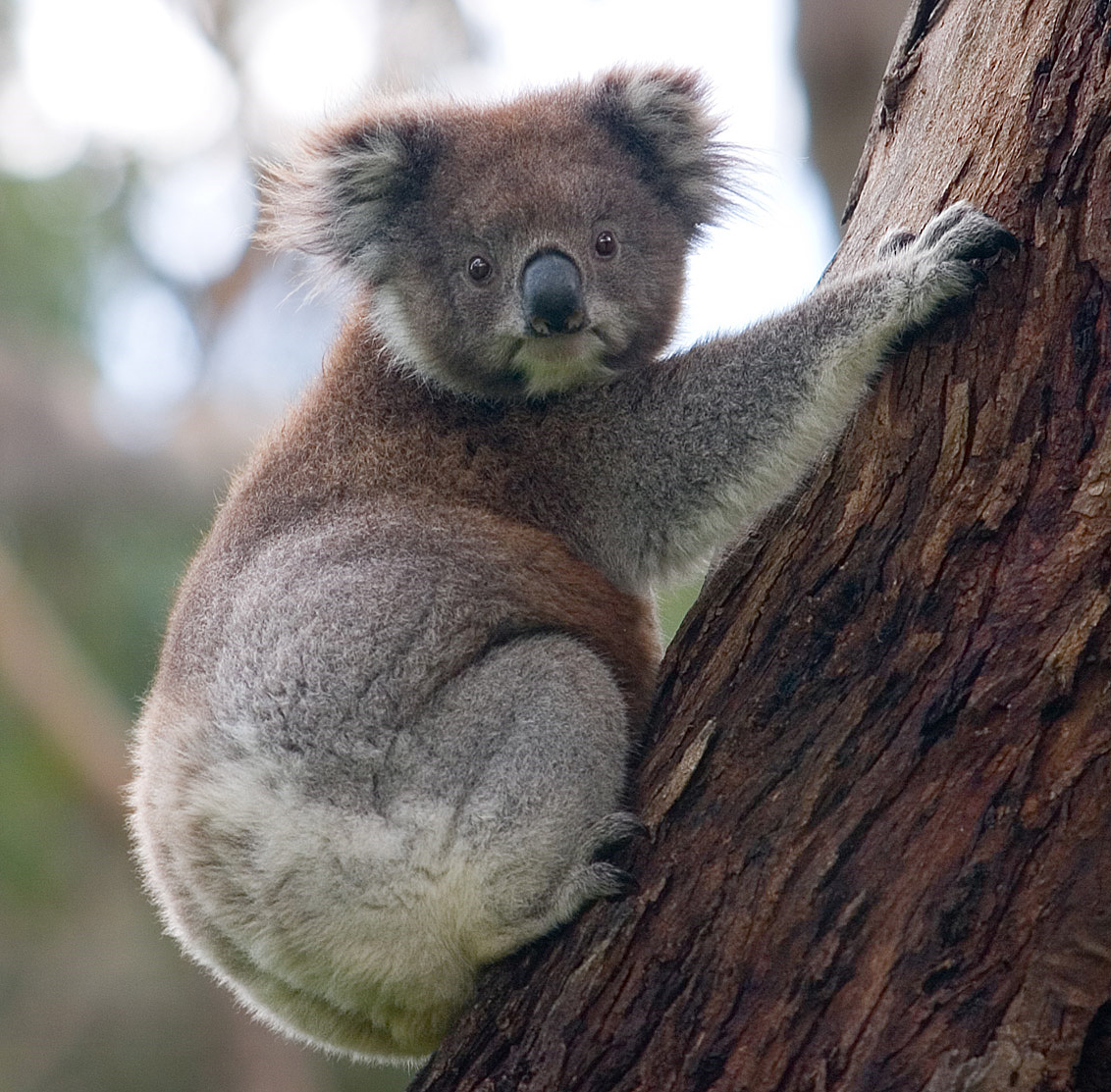
Phascolarctos is a genus of marsupials with one extant species, the koala Phascolarctos cinereus, an iconic animal of Australia. Several extinct species of the genus are known from fossil material; these were also large tree dwellers that browsed on Eucalyptus leaves.
The genus was named by French zoologist Henri Marie Ducrotay de Blainville in 1816.
The type species, the modern koala, was named as Lipurus cinereus by G. A. Goldfuss in 1817, later combined as Phascolarctos cinereus. Goldfuss published this name with a reproduction of John Lewin's 1803 illustration of the species in New South Wales.
An accepted synonymy of other generic names referring to Phascolarctos was published in 1988. The koala is listed in national conservation legislation as "Phascolarctos cinereus (combined populations of Qld, NSW and the ACT)", previously determined in 2012 to be "a species for the purposes of the EPBC act 1999" (EPBC). The koala was classified as Least Concern on the Red List, and reassessed as Vulnerable in 2014.
The name is derived from Ancient Greek φάσκωλος (phaskolos) 'pouch' and ἄρκτος (arktos) 'bear'.
Phascolarctos is a genus of large arboreal marsupials that has specialised in leaves of Eucalyptus, a poor quality and potentially toxic food source that is unavailable to most other native mammals. The extinct species are presumed to have similar diet and habits to the modern koala, the largest Australian folivore, which was exceeded in size by the even more robust P. stirtoni. The tail of koalas is almost absent, an unusual characteristic for a tree climbing mammal, although other anatomical features are well suited to that habitat. They have some resemblance to the wombats, a family of large terrestrial marsupials which are allied with koalas as Vombatiformes.
The fossil material referred to the extinct species of this genus is scarce and fragmentary. Some remains are tentatively referred to Phascolarctos stirtoni, and the specimen for Phascolarctos maris, a partial lower molar, was later suggested by Karen H. Black to be an example of variance within the P. stirtoni species.
Phascolarctos species have been discovered as fossil remains in several regions across southern and eastern Australia, in South Australia, Queensland and Victoria, and still occurs in those states and New South Wales. The modern koala is also known in the fossil record of the southwest of Australia and many other regions, but no occurrence of a living or extinct Phascolarctos species is recorded in the states of Tasmania and the Northern Territory.
Hub AI
Phascolarctos AI simulator
(@Phascolarctos_simulator)
Phascolarctos
Phascolarctos is a genus of marsupials with one extant species, the koala Phascolarctos cinereus, an iconic animal of Australia. Several extinct species of the genus are known from fossil material; these were also large tree dwellers that browsed on Eucalyptus leaves.
The genus was named by French zoologist Henri Marie Ducrotay de Blainville in 1816.
The type species, the modern koala, was named as Lipurus cinereus by G. A. Goldfuss in 1817, later combined as Phascolarctos cinereus. Goldfuss published this name with a reproduction of John Lewin's 1803 illustration of the species in New South Wales.
An accepted synonymy of other generic names referring to Phascolarctos was published in 1988. The koala is listed in national conservation legislation as "Phascolarctos cinereus (combined populations of Qld, NSW and the ACT)", previously determined in 2012 to be "a species for the purposes of the EPBC act 1999" (EPBC). The koala was classified as Least Concern on the Red List, and reassessed as Vulnerable in 2014.
The name is derived from Ancient Greek φάσκωλος (phaskolos) 'pouch' and ἄρκτος (arktos) 'bear'.
Phascolarctos is a genus of large arboreal marsupials that has specialised in leaves of Eucalyptus, a poor quality and potentially toxic food source that is unavailable to most other native mammals. The extinct species are presumed to have similar diet and habits to the modern koala, the largest Australian folivore, which was exceeded in size by the even more robust P. stirtoni. The tail of koalas is almost absent, an unusual characteristic for a tree climbing mammal, although other anatomical features are well suited to that habitat. They have some resemblance to the wombats, a family of large terrestrial marsupials which are allied with koalas as Vombatiformes.
The fossil material referred to the extinct species of this genus is scarce and fragmentary. Some remains are tentatively referred to Phascolarctos stirtoni, and the specimen for Phascolarctos maris, a partial lower molar, was later suggested by Karen H. Black to be an example of variance within the P. stirtoni species.
Phascolarctos species have been discovered as fossil remains in several regions across southern and eastern Australia, in South Australia, Queensland and Victoria, and still occurs in those states and New South Wales. The modern koala is also known in the fossil record of the southwest of Australia and many other regions, but no occurrence of a living or extinct Phascolarctos species is recorded in the states of Tasmania and the Northern Territory.
Recent media