Recent from talks
All channels
Be the first to start a discussion here.
Welcome to the community hub built to collect knowledge and have discussions related to Vombatiformes.
Nothing was collected or created yet.
Vombatiformes
View on Wikipediafrom Wikipedia
| Vombatiformes Temporal range:
| |
|---|---|
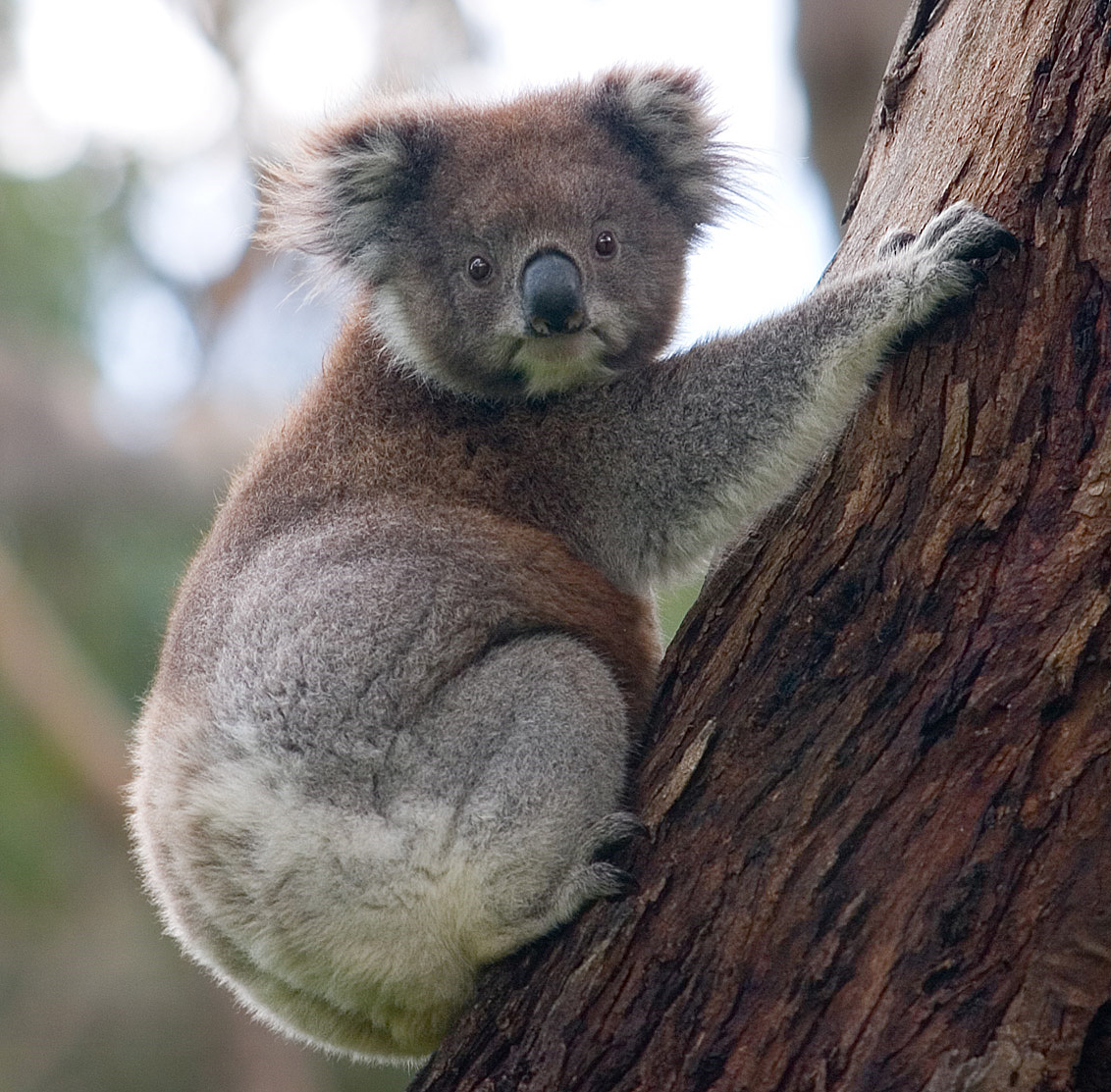
| Phascolarctos cinereus | |
| Scientific classification | |
| Kingdom: | Animalia |
| Phylum: | Chordata |
| Class: | Mammalia |
| Infraclass: | Marsupialia |
| Order: | Diprotodontia |
| Suborder: | Vombatiformes Burnett, 1830 |
| Families | |
| |
The Vombatiformes are one of the three suborders of the large marsupial order Diprotodontia. Seven of the nine known families within this suborder are extinct; only the families Phascolarctidae, with the koala, and Vombatidae, with three extant species of wombat, survive.
Among the extinct families are the Diprotodontidae, which includes the largest marsupials ever, including the rhinoceros sized Diprotodon, as well as the "marsupial lions" Thylacoleonidae and "marsupial tapirs" Palorchestidae.
Classification
[edit]Suborder Vombatiformes
- Family †Thylacoleonidae: (marsupial lions)[3]
- Genus Microleo
- Genus Priscileo
- Genus Thylacoleo
- Genus Wakaleo
- Infraorder Phascolarctomorphia
- Family Phascolarctidae: koala[4]
- Genus Phascolarctos (one living species)
- Genus †Koobor
- Genus †Litokoala
- Genus †Madakoala
- Genus †Nimiokoala
- Genus †Perikoala
- Family Phascolarctidae: koala[4]
- Infraorder Vombatomorphia
- Family †Ilariidae
- Genus Ilaria
- Genus Koalemas
- Genus Kuterintja
- Family †Wynyardiidae
- Genus Muramura
- Genus Namilamadeta
- Genus Wynyardia
- Superfamily Vombatoidea
- Family Vombatidae: wombats (two living genera)
- Genus Lasiorhinus
- Genus Vombatus
- Genus †Rhizophascolonus
- Genus †Phascolonus
- Genus †Warendja
- Genus †Ramsayia
- Genus †Sedophascolomys
- Family †Maradidae
- Genus Nimbavombatus (either considered the most basal vombatid[2] or just outside Vombatidae[1])
- Family †Mukupirnidae
- Genus Mukupirna
- Family Vombatidae: wombats (two living genera)
- Superfamily †Diprotodontoidea[6]
- Genus †Silvabestius
- Genus †Ngapakaldia
- Genus †Nimbadon
- Genus †Neohelos
- Family †Diprotodontidae:[6]
- Genus Alkwertatherium
- Genus Bematherium
- Genus Diprotodon
- Genus Euowenia
- Genus Euryzygoma
- Genus Meniscolophus
- Genus Nototherium
- Genus Pyramios
- Genus Sthenomerus
- Subfamily †Zygomaturinae[6]
- Genus Hulitherium
- Genus Kolopsis[6]
- Genus Kolopsoides
- Genus Maokopia
- Genus Neohelos[6]
- Genus Plaisiodon
- Genus Raemeotherium
- Genus Zygomaturus
- Family †Palorchestidae: (marsupial tapirs)[6]
- Genus Palorchestes
- Genus Pitikantia
- Genus Propalorchestes
- Family †Ilariidae
References
[edit]Wikimedia Commons has media related to Vombatiformes.
Wikispecies has information related to Vombatiformes.
- Groves, C. P. (2005). Wilson, D. E.; Reeder, D. M. (eds.). Mammal Species of the World: A Taxonomic and Geographic Reference (3rd ed.). Baltimore: Johns Hopkins University Press. pp. 43–44. ISBN 0-801-88221-4. OCLC 62265494.
- ^ a b Beck, Robin M. D.; Louys, Julien; Brewer, Philippa; Archer, Michael; Black, Karen H.; Tedford, Richard H. (2020-06-25). "A new family of diprotodontian marsupials from the latest Oligocene of Australia and the evolution of wombats, koalas, and their relatives (Vombatiformes)". Scientific Reports. 10 (1): 9741. doi:10.1038/s41598-020-66425-8. ISSN 2045-2322. PMC 7316786. PMID 32587406.
- ^ a b Crichton, Arthur I.; Worthy, Trevor H.; Camens, Aaron B.; Yates, Adam M.; Couzens, Aidan M. C.; Prideaux, Gavin J. (2023-03-19). "A new species of Mukupirna (Diprotodontia, Mukupirnidae) from the Oligocene of Central Australia sheds light on basal vombatoid interrelationships". Alcheringa: An Australasian Journal of Palaeontology. 47 (4): 446–474. doi:10.1080/03115518.2023.2181397. ISSN 0311-5518.
- ^ Naish, Darren. "Of koalas and marsupial lions: the vombatiform radiation, part I". Scientific American. Scientific American, Inc. Retrieved 24 October 2015.
- ^ McKenna, Malcolm C.; Bell, Susan K. (1997). Classification of mammals – above the species level. New York: Columbia University Press. pp. xii–631. ISBN 9780231110129.
- ^ BLACK, K., March 2007. Maradidae: a new family of vombatomorphian marsupial from the late Oligocene of Riversleigh, northwestern Queensland. Alcheringa 31, 17-32. ISSN 0311-5518
- ^ a b c d e f Black, K. (2012). "Revision in the marsupial diprotodontid genus Neohelos: Systematics and biostratigraphy". Acta Palaeontologica Polonica. doi:10.4202/app.2012.0001. hdl:1959.4/unsworks_36970.
Vombatiformes
View on Grokipediafrom Grokipedia
Vombatiformes is a suborder of the marsupial order Diprotodontia, one of the two primary clades within this order alongside Phalangerida, and it encompasses the only two surviving families: Phascolarctidae (koalas) and Vombatidae (wombats), along with at least seven extinct families.[1] The suborder is defined by its members' diprotodont dentition—a single pair of enlarged lower incisors—and includes a range of herbivorous and formerly carnivorous forms adapted to diverse Australian environments.[1]
Living vombatiforms are endemic to Australia, with the koala (Phascolarctos cinereus), the sole member of Phascolarctidae, being a specialized arboreal folivore that inhabits eucalypt forests and woodlands, feeding almost exclusively on eucalyptus leaves.[2] The Vombatidae family comprises three extant species—the common wombat (Vombatus ursinus), southern hairy-nosed wombat (Lasiorhinus latifrons), and northern hairy-nosed wombat (Lasiorhinus krefftii)—all of which are robust, fossorial herbivores that construct extensive burrow systems in grasslands, woodlands, and semi-arid regions across southeastern and southern Australia.[2] These species exhibit convergent adaptations with rodents, such as continuously growing incisors for gnawing and powerful forelimbs for digging, reflecting their burrowing lifestyles.[1]
The evolutionary history of Vombatiformes traces back to the late Oligocene to early Miocene, approximately 26–25 million years ago, when early forms like Mukupirna nambensis—a scratch-digging herbivore estimated at 143–171 kg—represent primitive members sister to modern wombats.[1] A 2025 molecular study using ancient collagen sequences further confirmed the placement of carnivorous Thylacoleonidae within Vombatiformes and linked several extinct megafauna species to their modern relatives.[3] The suborder once boasted high diversity, with extinct families such as Diprotodontidae (giant herbivores up to 2,500 kg), Palorchestidae (tapir-like browsers), Thylacoleonidae (carnivorous "marsupial lions"), Mukupirnidae, Wynyardiidae, Ilariidae, and Maradidae showcasing at least six independent evolutions of body masses exceeding 100 kg and a variety of ecological roles from grazing to predation.[1] However, Vombatiformes underwent extensive extinctions during the Pleistocene, with the last survivors of most families vanishing, leaving only the two modern lineages amid Australia's megafaunal collapse.[1]
Diversity within Vombatiformes peaked during the Miocene, with numerous giant herbivorous forms dominating assemblages, reflecting at least six independent acquisitions of body sizes over 100 kg across lineages.[1] The two extant families represent less than 5% of the suborder's original species diversity, as fossil records document dozens of genera compared to the four surviving species today.[1] This stark reduction underscores the profound impact of Pleistocene extinctions on the group.[1]
Taxonomy and Classification
Placement in Diprotodontia
Vombatiformes is recognized as a suborder within the marsupial order Diprotodontia, formally established by Burnett in 1830.[4] Diprotodontia as a whole is defined by its characteristic diprotodont dentition, featuring a single pair of enlarged, procumbent lower incisors that function in a manner analogous to rodent incisors for gnawing and cropping vegetation.[2] This subordinal placement underscores the shared evolutionary adaptations among vombatiforms for specialized herbivorous lifestyles. Phylogenetically, Vombatiformes forms the basal lineage within Diprotodontia, serving as the sister group to Phalangerida, which encompasses the suborders Phalangeriformes and Macropodiformes.[5] Molecular analyses of nuclear genes, including protamine and beta-fibrinogen sequences, alongside fossil evidence, strongly support the monophyly of Vombatiformes, with divergence from other diprotodontians estimated around 53 million years ago in the early Eocene, and the earliest fossil evidence from the late Oligocene (~26–25 Ma).[6] This early split highlights Vombatiformes as a distinct clade adapted to Australian continental conditions from the Paleogene onward. Key diagnostic features of Vombatiformes include hypsodont or hypselodont cheek teeth in many lineages, enabling continuous growth and wear resistance suited to abrasive diets, as seen in the ever-growing molars of wombats.[7] Additionally, members exhibit robust crania with reinforced zygomatic arches and powerful masseter muscles, adaptations that facilitate either intensive herbivory through grinding or digging behaviors involving soil excavation.[8] Historically, early classifications by Burnett encompassed a broader array of diprotodonts under Vombatiformes, but subsequent revisions refined its scope. Aplin and Archer (1987) proposed a syncretic classification that delimited Vombatiformes based on shared derived traits, such as serial homology in the dentition where premolars and molars exhibit homologous cusp patterns and crest morphologies. Today, only two families persist: Phascolarctidae (koalas) and Vombatidae (wombats).[1]Families and Diversity
Vombatiformes encompasses nine recognized families within the suborder Diprotodontia, with only two surviving today while seven are extinct.[1] The extant families are Phascolarctidae, comprising a single species, the koala (Phascolarctos cinereus), and Vombatidae, which includes three species of wombats: the common wombat (Vombatus ursinus), southern hairy-nosed wombat (Lasiorhinus latifrons), and northern hairy-nosed wombat (Lasiorhinus krefftii).[9][1] The extinct families span from the late Oligocene to the Pleistocene epochs, showcasing a range of morphologies from carnivorous forms to massive herbivores.[1] Diprotodontidae, known for megafaunal herbivores exceeding 100 kg (sometimes classified to include Zygomaturinae), includes over 10 genera such as Diprotodon optatum (the largest known marsupial, reaching over 2 tonnes), Zygomaturus, and Neohelos.[1][10] Thylacoleonidae, the marsupial lions, features carnivorous genera like Thylacoleo carnifex (approximately 57 kg) and Wakaleo.[1] Palorchestidae, resembling tapirs with retracted nasal regions, is represented by genera including Palorchestes.[1] Ilariidae contains the genus Ilaria (around 160 kg), Maradidae includes Marada, and the recently described Mukupirnidae (2020) features Mukupirna nambensis (143–171 kg) from the late Oligocene. Wynyardiidae encompasses early genera such as Namilamadeta and Muramura.[1][11]| Family | Status | Temporal Range | Key Genera (Examples) |
|---|---|---|---|
| Phascolarctidae | Extant | Recent | Phascolarctos |
| Vombatidae | Extant | Recent (extinct genera from Miocene–Pleistocene) | Vombatus, Lasiorhinus (extinct: Nimbavombatus, Rhizophascolonus) |
| Diprotodontidae | Extinct | Oligocene–Pleistocene | Diprotodon, Zygomaturus, Neohelos (10+ genera) |
| Thylacoleonidae | Extinct | Miocene–Pleistocene | Thylacoleo, Wakaleo |
| Palorchestidae | Extinct | Miocene–Pleistocene | Palorchestes, Propalorchestes |
| Ilariidae | Extinct | Late Oligocene | Ilaria |
| Maradidae | Extinct | Late Oligocene | Marada |
| Mukupirnidae | Extinct | Late Oligocene | Mukupirna |
| Wynyardiidae | Extinct | Oligo-Miocene | Namilamadeta, Muramura |
