
Recent from talks
Phase-contrast X-ray imaging
Knowledge base stats:
Talk channels stats:
Members stats:
Phase-contrast X-ray imaging
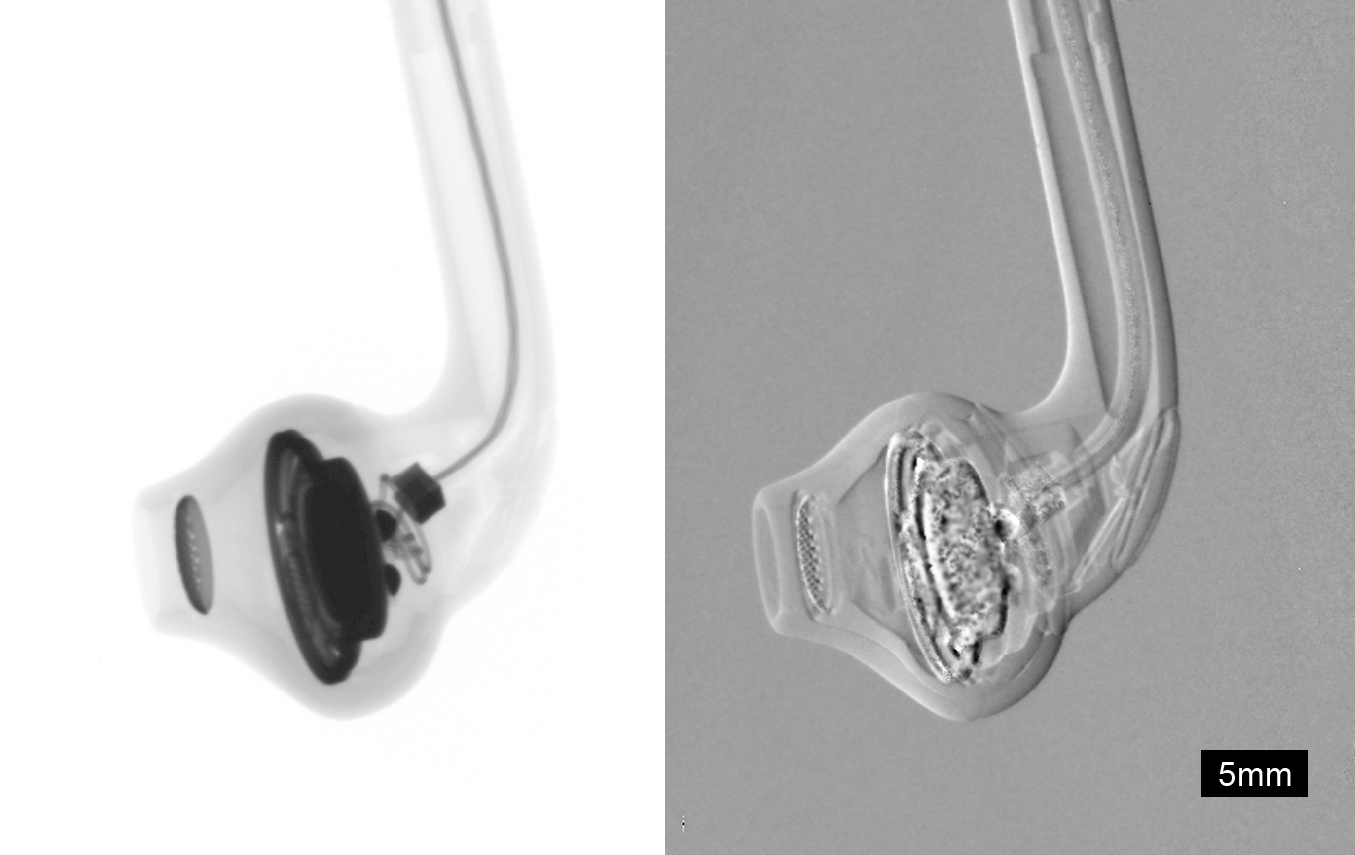
Phase-contrast X-ray imaging or phase-sensitive X-ray imaging is a general term for different technical methods that use information concerning changes in the phase of an X-ray beam that passes through an object in order to create its images. Standard X-ray imaging techniques like radiography or computed tomography (CT) rely on a decrease of the X-ray beam's intensity (attenuation) when traversing the sample, which can be measured directly with the assistance of an X-ray detector. However, in phase contrast X-ray imaging, the beam's phase shift caused by the sample is not measured directly, but is transformed into variations in intensity, which then can be recorded by the detector.
In addition to producing projection images, phase contrast X-ray imaging, like conventional transmission, can be combined with tomographic techniques to obtain the 3D distribution of the real part of the refractive index of the sample. When applied to samples that consist of atoms with low atomic number Z, phase contrast X-ray imaging is more sensitive to density variations in the sample than conventional transmission-based X-ray imaging. This leads to images with improved soft tissue contrast.
In the last several years, a variety of phase-contrast X-ray imaging techniques have been developed, all of which are based on the observation of interference patterns between diffracted and undiffracted waves. The most common techniques are crystal interferometry, propagation-based imaging, analyzer-based imaging, edge-illumination and grating-based imaging (see below).
The first to discover X-rays was Wilhelm Conrad Röntgen in 1895, where he found that they had the ability to penetrate opaque materials. He recorded the first X-ray image, displaying the hand of his wife. He was awarded the first Nobel Prize in Physics in 1901 "in recognition of the extraordinary services he has rendered by the discovery of the remarkable rays subsequently named after him". Since then, X-rays have been used as a tool to safely determine the inner structures of different objects, although the information was for a long time obtained by measuring the transmitted intensity of the waves only, and the phase information was not accessible.
The principle of phase-contrast imaging was first developed by Frits Zernike during his work with diffraction gratings and visible light. The application of his knowledge to microscopy won him the Nobel Prize in Physics in 1953. Ever since, phase-contrast microscopy has been an important field of optical microscopy.
The transfer of phase-contrast imaging from visible light to X-rays took a long time, due to slow progress in improving the quality of X-ray beams and the inaccessibility of X-ray lenses. In the 1970s, it was realized that the synchrotron radiation, emitted from charged particles circulating in storage rings constructed for high-energy nuclear physics experiments, may have been a more intense and versatile source of X-rays than X-ray tubes; this, combined with progress in the development of X-rays optics, was fundamental for the further advancement of X-ray physics.
The pioneer work to the implementation of the phase-contrast method to X-ray physics was presented in 1965 by Ulrich Bonse and Michael Hart, Department of Materials Science and Engineering of Cornell University, New York. They presented a crystal interferometer, made from a large and highly perfect single crystal. Not less than 30 years later the Japanese scientists Atsushi Momose, Tohoru Takeda and co-workers adopted this idea and refined it for application in biological imaging, for instance by increasing the field of view with the assistance of new setup configurations and phase retrieval techniques. The Bonse–Hart interferometer provides several orders of magnitude higher sensitivity in biological samples than other phase-contrast techniques, but it cannot use conventional X-ray tubes because the crystals only accept a very narrow energy band of X-rays (ΔE/E ~ 10−4). In 2012, Han Wen and co-workers took a step forward by replacing the crystals with nanometric phase gratings. The gratings split and direct X-rays over a broad spectrum, thus lifting the restriction on the bandwidth of the X-ray source. They detected sub nanoradian refractive bending of X-rays in biological samples with a grating Bonse–Hart interferometer.
At the same time, two further approaches to phase-contrast imaging emerged with the aim to overcome the problems of crystal interferometry. The propagation-based imaging technique was primarily introduced by the group of Anatoly Snigirev at the ESRF (European Synchrotron Radiation Facility) in Grenoble, France, and was based on the detection of "Fresnel fringes" that arise under certain circumstances in free-space propagation. The experimental setup consisted of an inline configuration of an X-ray source, a sample and a detector and did not require any optical elements. It was conceptually identical to the setup of Dennis Gabor's revolutionary work on holography in 1948.
Hub AI
Phase-contrast X-ray imaging AI simulator
(@Phase-contrast X-ray imaging_simulator)
Phase-contrast X-ray imaging
Phase-contrast X-ray imaging or phase-sensitive X-ray imaging is a general term for different technical methods that use information concerning changes in the phase of an X-ray beam that passes through an object in order to create its images. Standard X-ray imaging techniques like radiography or computed tomography (CT) rely on a decrease of the X-ray beam's intensity (attenuation) when traversing the sample, which can be measured directly with the assistance of an X-ray detector. However, in phase contrast X-ray imaging, the beam's phase shift caused by the sample is not measured directly, but is transformed into variations in intensity, which then can be recorded by the detector.
In addition to producing projection images, phase contrast X-ray imaging, like conventional transmission, can be combined with tomographic techniques to obtain the 3D distribution of the real part of the refractive index of the sample. When applied to samples that consist of atoms with low atomic number Z, phase contrast X-ray imaging is more sensitive to density variations in the sample than conventional transmission-based X-ray imaging. This leads to images with improved soft tissue contrast.
In the last several years, a variety of phase-contrast X-ray imaging techniques have been developed, all of which are based on the observation of interference patterns between diffracted and undiffracted waves. The most common techniques are crystal interferometry, propagation-based imaging, analyzer-based imaging, edge-illumination and grating-based imaging (see below).
The first to discover X-rays was Wilhelm Conrad Röntgen in 1895, where he found that they had the ability to penetrate opaque materials. He recorded the first X-ray image, displaying the hand of his wife. He was awarded the first Nobel Prize in Physics in 1901 "in recognition of the extraordinary services he has rendered by the discovery of the remarkable rays subsequently named after him". Since then, X-rays have been used as a tool to safely determine the inner structures of different objects, although the information was for a long time obtained by measuring the transmitted intensity of the waves only, and the phase information was not accessible.
The principle of phase-contrast imaging was first developed by Frits Zernike during his work with diffraction gratings and visible light. The application of his knowledge to microscopy won him the Nobel Prize in Physics in 1953. Ever since, phase-contrast microscopy has been an important field of optical microscopy.
The transfer of phase-contrast imaging from visible light to X-rays took a long time, due to slow progress in improving the quality of X-ray beams and the inaccessibility of X-ray lenses. In the 1970s, it was realized that the synchrotron radiation, emitted from charged particles circulating in storage rings constructed for high-energy nuclear physics experiments, may have been a more intense and versatile source of X-rays than X-ray tubes; this, combined with progress in the development of X-rays optics, was fundamental for the further advancement of X-ray physics.
The pioneer work to the implementation of the phase-contrast method to X-ray physics was presented in 1965 by Ulrich Bonse and Michael Hart, Department of Materials Science and Engineering of Cornell University, New York. They presented a crystal interferometer, made from a large and highly perfect single crystal. Not less than 30 years later the Japanese scientists Atsushi Momose, Tohoru Takeda and co-workers adopted this idea and refined it for application in biological imaging, for instance by increasing the field of view with the assistance of new setup configurations and phase retrieval techniques. The Bonse–Hart interferometer provides several orders of magnitude higher sensitivity in biological samples than other phase-contrast techniques, but it cannot use conventional X-ray tubes because the crystals only accept a very narrow energy band of X-rays (ΔE/E ~ 10−4). In 2012, Han Wen and co-workers took a step forward by replacing the crystals with nanometric phase gratings. The gratings split and direct X-rays over a broad spectrum, thus lifting the restriction on the bandwidth of the X-ray source. They detected sub nanoradian refractive bending of X-rays in biological samples with a grating Bonse–Hart interferometer.
At the same time, two further approaches to phase-contrast imaging emerged with the aim to overcome the problems of crystal interferometry. The propagation-based imaging technique was primarily introduced by the group of Anatoly Snigirev at the ESRF (European Synchrotron Radiation Facility) in Grenoble, France, and was based on the detection of "Fresnel fringes" that arise under certain circumstances in free-space propagation. The experimental setup consisted of an inline configuration of an X-ray source, a sample and a detector and did not require any optical elements. It was conceptually identical to the setup of Dennis Gabor's revolutionary work on holography in 1948.
Recent media