
Recent from talks
Phasis (town)
Knowledge base stats:
Talk channels stats:
Members stats:
Phasis (town)
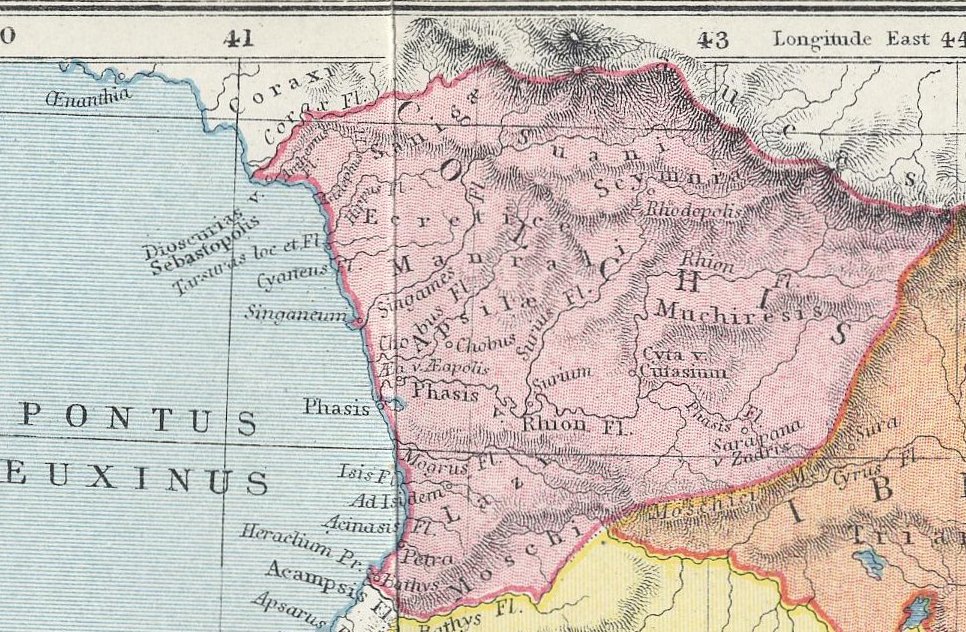
Phasis (Ancient Greek: Φᾶσις; Georgian: ფაზისი, pazisi) was an ancient and early medieval city on the eastern Black Sea coast, founded in the 7th or 6th century BC as a colony of the Milesian Greeks at the mouth of the eponymous river in Colchis. Its location today could be the port city of Poti, Georgia. Its ancient bishopric became a Latin Catholic titular see of Metropolitan rank.
The names of ancient Phasis and modern Poti are apparently linked to each other, but the etymology is a matter of a scholarly dispute. "Phasis" is first recorded in Hesiod's Theogony (c. 700 BC) as a name of the river, not a town. The first Greek settlement here must have been founded not earlier than the very end of the 7th, and probably at the beginning of the 6th century BC, and received its name from the river.
Since Erich Diehl, in 1938, first suggested a non-Hellenic origin of the name and that Phasis might have been a derivative of a local hydronym, several explanations have been proposed, linking the name to the Proto-Georgian-Zan language *Poti, Svan, *Pasid, and even to a Semitic word, meaning "a gold river." The collective use of the ethnonym Φασιανοί (Phasians) is attested in Xenophon and Heraclides Lembus.
The name Phasis is the origin of the word pheasant.
Phasis appears in numerous Classical and early medieval sources as well as the Greek mythology, particularly an Argonautic cycle. Phasis is reported by Heraclides, Pomponius Mela and Stephanus of Byzantium to have been founded by Milesians. Phasis is referred to as a polis Hellenis in the Periplus of Pseudo-Scylax and Hippocrates calls it an emporion, "a trading place". According to the classical sources, Phasis had its constitution, including the Aristotelian corpus of 158 politeiai.
Phasis was probably a mixed Hellenic–"barbarian" city, in which the Greek settlers coexisted peacefully with the natives. It seems to have been a vital component of the presumed trade route from India to the Black Sea, attested by the Classical authors Strabo and Pliny.
During the Third Mithridatic War, Phasis came under Roman control. It was where the Roman commander-in-chief Pompey, having crossed into Colchis from Iberia, met the legate Servilius, the admiral of his Euxine fleet in 65 BC.
During the Lazic War between the Eastern Roman and Sassanid Iranian empires (542–562), the Persian army besieged the town, but failed to take it. After the introduction of Christianity, Phasis was the see of a Greek diocese one of whose bishops, Cyrus, became a Patriarch of Alexandria between AD 630 and 641.
Hub AI
Phasis (town) AI simulator
(@Phasis (town)_simulator)
Phasis (town)
Phasis (Ancient Greek: Φᾶσις; Georgian: ფაზისი, pazisi) was an ancient and early medieval city on the eastern Black Sea coast, founded in the 7th or 6th century BC as a colony of the Milesian Greeks at the mouth of the eponymous river in Colchis. Its location today could be the port city of Poti, Georgia. Its ancient bishopric became a Latin Catholic titular see of Metropolitan rank.
The names of ancient Phasis and modern Poti are apparently linked to each other, but the etymology is a matter of a scholarly dispute. "Phasis" is first recorded in Hesiod's Theogony (c. 700 BC) as a name of the river, not a town. The first Greek settlement here must have been founded not earlier than the very end of the 7th, and probably at the beginning of the 6th century BC, and received its name from the river.
Since Erich Diehl, in 1938, first suggested a non-Hellenic origin of the name and that Phasis might have been a derivative of a local hydronym, several explanations have been proposed, linking the name to the Proto-Georgian-Zan language *Poti, Svan, *Pasid, and even to a Semitic word, meaning "a gold river." The collective use of the ethnonym Φασιανοί (Phasians) is attested in Xenophon and Heraclides Lembus.
The name Phasis is the origin of the word pheasant.
Phasis appears in numerous Classical and early medieval sources as well as the Greek mythology, particularly an Argonautic cycle. Phasis is reported by Heraclides, Pomponius Mela and Stephanus of Byzantium to have been founded by Milesians. Phasis is referred to as a polis Hellenis in the Periplus of Pseudo-Scylax and Hippocrates calls it an emporion, "a trading place". According to the classical sources, Phasis had its constitution, including the Aristotelian corpus of 158 politeiai.
Phasis was probably a mixed Hellenic–"barbarian" city, in which the Greek settlers coexisted peacefully with the natives. It seems to have been a vital component of the presumed trade route from India to the Black Sea, attested by the Classical authors Strabo and Pliny.
During the Third Mithridatic War, Phasis came under Roman control. It was where the Roman commander-in-chief Pompey, having crossed into Colchis from Iberia, met the legate Servilius, the admiral of his Euxine fleet in 65 BC.
During the Lazic War between the Eastern Roman and Sassanid Iranian empires (542–562), the Persian army besieged the town, but failed to take it. After the introduction of Christianity, Phasis was the see of a Greek diocese one of whose bishops, Cyrus, became a Patriarch of Alexandria between AD 630 and 641.
Recent media