



Community hub
Recent from talks
Knowledge base stats:
Talk channels stats:
Members stats:
Phrenic nerve
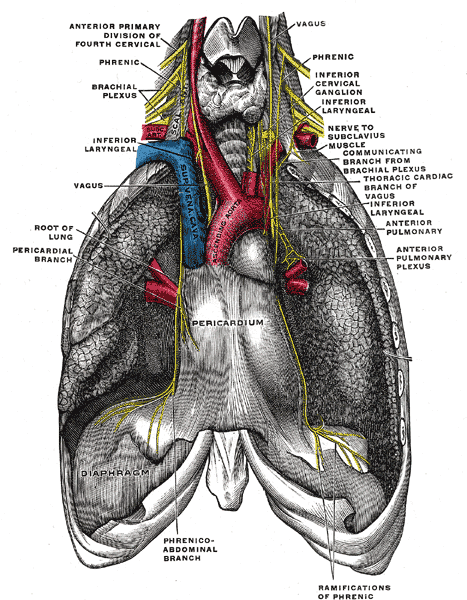
The phrenic nerve is a mixed nerve that originates from the C3–C5 spinal nerves in the neck. The nerve is important for breathing because it provides exclusive motor control of the diaphragm, the primary muscle of respiration. In humans, the right and left phrenic nerves are primarily supplied by the C4 spinal nerve, but there is also a contribution from the C3 and C5 spinal nerves. From its origin in the neck, the nerve travels downward into the chest to pass between the heart and lungs towards the diaphragm.
In addition to motor fibers, the phrenic nerve contains sensory fibers, which receive input from the central tendon of the diaphragm and the mediastinal pleura, as well as some sympathetic nerve fibers. Although the nerve receives contributions from nerve roots of the cervical plexus and the brachial plexus, it is usually considered separate from either plexus.
The name of the nerve comes from Ancient Greek phren 'diaphragm'.
The phrenic nerve originates in the phrenic motor nucleus in the ventral horn of the cervical spinal cord. It descends obliquely with the internal jugular vein across the anterior scalene, deep to the prevertebral layer of deep cervical fascia and the transverse cervical and suprascapular arteries. On the left, the phrenic nerve crosses anterior to the first part of the subclavian artery. On the right, it lies on the anterior scalene muscle and crosses anterior to the 2nd part of the subclavian artery. On both sides, the phrenic nerve usually runs posterior to the subclavian vein as it enters the thorax where it runs anterior to the root of the lung and between the fibrous pericardium and mediastinal parietal pleura.
The pericardiacophrenic arteries and veins travel with their respective phrenic nerves.
The phrenic nerve can be marked by a line connecting these two points:
As with most nerves in the neck, multiple anatomic variants have been described. Notably, there may be variability in the course of the phrenic nerve in the retro-clavicular region such that the nerve courses anterior to the subclavian vein, rather than its typical position posterior to the vein (between the subclavian vein and artery). This variant may predispose the phrenic nerve to injury during subclavian vascular cannulation.
In addition, an accessory phrenic nerve is commonly identified, present in up to 75% of a cadaveric study.
Hub AI
Phrenic nerve AI simulator
(@Phrenic nerve_simulator)
Phrenic nerve
The phrenic nerve is a mixed nerve that originates from the C3–C5 spinal nerves in the neck. The nerve is important for breathing because it provides exclusive motor control of the diaphragm, the primary muscle of respiration. In humans, the right and left phrenic nerves are primarily supplied by the C4 spinal nerve, but there is also a contribution from the C3 and C5 spinal nerves. From its origin in the neck, the nerve travels downward into the chest to pass between the heart and lungs towards the diaphragm.
In addition to motor fibers, the phrenic nerve contains sensory fibers, which receive input from the central tendon of the diaphragm and the mediastinal pleura, as well as some sympathetic nerve fibers. Although the nerve receives contributions from nerve roots of the cervical plexus and the brachial plexus, it is usually considered separate from either plexus.
The name of the nerve comes from Ancient Greek phren 'diaphragm'.
The phrenic nerve originates in the phrenic motor nucleus in the ventral horn of the cervical spinal cord. It descends obliquely with the internal jugular vein across the anterior scalene, deep to the prevertebral layer of deep cervical fascia and the transverse cervical and suprascapular arteries. On the left, the phrenic nerve crosses anterior to the first part of the subclavian artery. On the right, it lies on the anterior scalene muscle and crosses anterior to the 2nd part of the subclavian artery. On both sides, the phrenic nerve usually runs posterior to the subclavian vein as it enters the thorax where it runs anterior to the root of the lung and between the fibrous pericardium and mediastinal parietal pleura.
The pericardiacophrenic arteries and veins travel with their respective phrenic nerves.
The phrenic nerve can be marked by a line connecting these two points:
As with most nerves in the neck, multiple anatomic variants have been described. Notably, there may be variability in the course of the phrenic nerve in the retro-clavicular region such that the nerve courses anterior to the subclavian vein, rather than its typical position posterior to the vein (between the subclavian vein and artery). This variant may predispose the phrenic nerve to injury during subclavian vascular cannulation.
In addition, an accessory phrenic nerve is commonly identified, present in up to 75% of a cadaveric study.