


Community hub
Recent from talks
Contribute something
Nothing was collected or created yet.
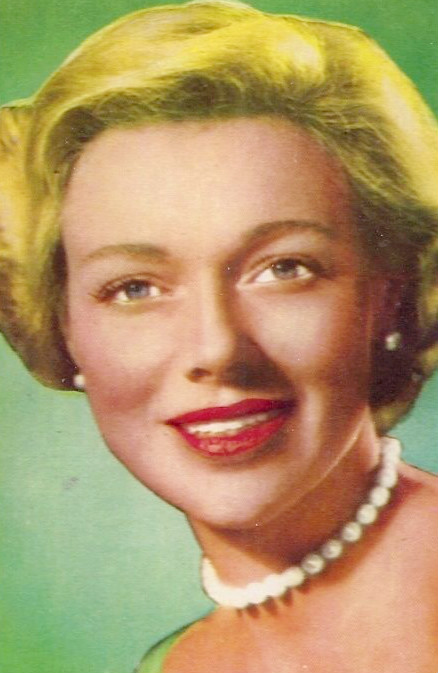
Phyllis Hill
View on WikipediaPhyllis Hill (October 27, 1920 – January 1, 1993)[1] was an American dancer and actress.[2][self-published source]
Key Information


Early years
[edit]Hill was born in New York City.[3] Her mother was actress Peggy Johnson Hill. Her sister, Joyce Hill Rainier, danced with the Monte Carlo Ballets Russes.[4]
Hill began her career in the late 1940s, appearing on stage and in small television roles in New York.
Stage
[edit]Her theatrical debut came "as one of George Balanchine's 'Baby Ballerinas' in New York."[4] Her Broadway credits include Rosalinda, Cyrano de Bergerac, The Fifth Season,[4] The Alchemist (1947), Angel Street (1947), Volpone (1947), Helen Goes to Troy (1943), What's Up? (1943) and Sons and Soldiers (1942).[5]
She also appeared with the Metropolitan Opera Company ballet as well as Radio City Music Hall's Ballet Corps.[4]
Television
[edit]Hill portrayed Poco Thurman in the NBC drama Three Steps to Heaven,[6]: 1079 Mrs. Allison in the NBC serial Morning Star,[6] and Agnes Adams in the ABC comedy That Girl.[6]: 1065
Among Hill's television appearances were three Dr. Kildare shows during the 1964–1965 season. She appeared in three Perry Mason episodes during the final three years of the series, including the title role of Katherine Stewart in "The Case of the Wednesday Woman", and Rachel Gordon in "The Case of the Sleepy Slayer" (both in 1964). She made four appearances on The F.B.I. (1966–70).
Marriages
[edit]She was married twice, both times to actors and both unions were childless:
- José Ferrer (June 19, 1948 – July 7, 1953; divorced)[7]
- Frank Overton (1962 – 24 April 1967; his death)
Death
[edit]Hill died from lung cancer in Los Angeles[3] on New Year's Day 1993, aged 72. She was survived by a niece.[4]
Filmography
[edit]| Year | Title | Role | Notes |
|---|---|---|---|
| 1948 | Joan of Arc | Court Lady | Uncredited |
| 1949 | Whirlpool | Party Guest | Uncredited |
| 1950 | Crisis | Barmaid | Uncredited |
| 1956 | Singing in the Dark | Ruth | |
| 1969 | Pendulum | Mrs. Wilma Elliot |
References
[edit]- ^ Ellenberger, Allan R. (2001). Celebrities in Los Angeles Cemeteries: A Directory. McFarland. p. 131. ISBN 9780786409839. Retrieved 6 July 2019.
- ^ Scott, Tony (2001). The Stars of Hollywood Forever. Lulu.com. ISBN 9781312916975. Retrieved 16 October 2016.
- ^ a b Willis, John; Lynch, Tom, eds. (1995). "Phyllis Hill (Ferris Overton)". John Willis Theatre World 1992-1993 Season Volume 49. Applause Theatre Book Publishers. p. 222. ISBN 1-55783-203-X. Retrieved 2021-05-07.
- ^ a b c d e "Phyllis Hill Ferrer Overton". Variety. January 7, 1993. Retrieved 17 October 2016.
- ^ "("Phyllis Hill" search results)". Playbill Vault. Retrieved 17 October 2016.
- ^ a b c Terrace, Vincent (2011). Encyclopedia of Television Shows, 1925 through 2010 (2nd ed.). Jefferson, N.C.: McFarland & Company, Inc., Publishers. p. 716. ISBN 978-0-7864-6477-7.
- ^ Donnelley, Paul (2003). Fade to Black: A Book of Movie Obituaries. Music Sales Group. p. 246. ISBN 9780711995123. Retrieved 17 October 2016.
External links
[edit]
Phyllis Hill
View on GrokipediaEarly life
Family background
Phyllis Hill was born on October 27, 1920, in New York City, New York, U.S.[3] She was the daughter of actress Peggy Johnson Hill, whose career in the performing arts exposed Hill to the world of theater from an early age.[2] Hill's uncle, Nolan Leary, was a character actor in Hollywood, further embedding the entertainment industry within her familial circle.[2] She also had a sister, Joyce Hill Rainer, who was a leading dancer with the Ballets Russes de Monte Carlo, highlighting the depth of performing arts talent in the family.[2] Raised in New York during the vibrant cultural landscape of the 1920s and 1930s, Hill grew up in a show business-oriented environment that naturally oriented her toward the performing arts, surrounded by relatives actively engaged in acting and dance.[2]Dance beginnings
Phyllis Hill entered the world of professional ballet in her youth, beginning her career as one of George Balanchine's young dancers in New York.[2] Her sister was also active in ballet with the Ballets Russes de Monte Carlo.[2] In the 1940s, Hill performed with the Metropolitan Opera Company's ballet group, contributing to opera productions through dance sequences that highlighted her classical training.[4] She also joined the Radio City Music Hall Ballet Corps, where she took on ensemble roles in the venue's renowned stage shows, showcasing precision and synchronicity in large-scale performances.[5] By the early 1940s, Hill transitioned from dedicated ballet ensembles to broader stage opportunities, applying her rigorous dance foundation to musical theater and dramatic roles.[3]Career
Stage work
Phyllis Hill's professional stage career on Broadway commenced in the early 1940s, building on her background as a dancer to establish her presence in both musical and dramatic theater. Initially known for her ballet work, she leveraged her rigorous training—one of George Balanchine's "Baby Ballerinas"—to excel in physically demanding roles, gradually shifting toward character acting in New York productions.[2] Her Broadway debut was in the musical The Lady Comes Across (1942) as part of the dancing ensemble, followed by her role as a ballet dancer in the operetta Rosalinda, an adaptation of Die Fledermaus.[3][6] Hill followed this with a featured role as Leila in the 1944 light comedy Helen Goes to Troy, marking an early foray into more prominent onstage presence beyond ensemble dance.[7] These appearances highlighted her versatility in blending movement with narrative elements during the wartime theater era. A pivotal moment came in the 1946–1947 revival of Cyrano de Bergerac, where Hill starred opposite her then-husband José Ferrer—who directed and portrayed the title role—playing the dual parts of A Flower Girl and Sister Claire.[8] This production, which ran for 193 performances at the Alvin Theatre, underscored her growing command of dramatic roles in classic repertoire.[2] Throughout the late 1940s and into the 1950s, Hill's stage work in New York emphasized this transition, with appearances in comedies like Volpone (1948) as Celia and The Insect Comedy (1948) as Iris, followed by co-starring as Lorraine McKay in the long-running The Fifth Season (1953–1954), a domestic drama that enjoyed 642 performances.[3] Her contributions during this period reflected a sustained commitment to live theater, focusing on ensemble dynamics and character depth in both revivals and original plays.[2]Film work
Phyllis Hill made her film debut in an uncredited role as a court lady in Victor Fleming's historical epic Joan of Arc (1948), starring Ingrid Bergman as the titular saint.[9] She followed this with two more uncredited supporting parts: a party guest in Otto Preminger's psychological thriller Whirlpool (1949), featuring Gene Tierney and José Ferrer, and a barmaid in Richard Brooks' political drama Crisis (1950), which also starred Ferrer alongside Cary Grant and Paula Raymond.[10][11] Hill's first credited film role arrived in 1956 as Ruth, a supporting character in the independent drama Singing in the Dark, directed by Max Nosseck and centered on a Holocaust survivor's struggle with amnesia and recovery through music. After an extended absence from cinema during the 1950s and 1960s, Hill returned in 1969 with the role of Mrs. Wilma Elliot in the crime thriller Pendulum, directed by George Schaefer and starring George Peppard as a district attorney entangled in murder and scandal. Throughout her acting career, Hill's contributions to film were limited to these five roles between 1948 and 1969, a sparsity attributable to her primary emphasis on stage productions and television appearances, where she sustained activity into the early 1980s.[12]Television work
Phyllis Hill began her television career in the 1950s with a lead role as the aspiring model Poco Thurman in the NBC soap opera Three Steps to Heaven, which aired from 1953 to 1954 and depicted the challenges of young women in New York City.[13] This early serial role showcased her ability to portray determined characters in dramatic narratives, marking her transition from stage performances to broadcast television.[5] In 1965, Hill appeared as Grace Allison in the NBC daytime series Morning Star, a soap opera centered on family and community dynamics, where she featured in at least two episodes as a supporting character involved in interpersonal conflicts.[14] Her work in such daytime programs highlighted her skill in sustaining emotional depth across serialized storytelling. Hill made a notable guest appearance as Mrs. Agnes Adams in the 1971 episode "Soot Yourself" of the ABC sitcom That Girl, playing the mother of a character entangled in a comedic misunderstanding involving a dry cleaning mishap.[15] This role demonstrated her versatility in lighter fare, contrasting her more dramatic outings. Throughout the 1960s, Hill secured recurring roles in prominent procedural dramas, appearing in three episodes of Dr. Kildare from 1964 to 1965, including as Mrs. Holmes in the two-part "Tyger, Tyger" storyline about a patient's psychological struggles and as Mrs. Beaton in "A Miracle for Margaret," which explored medical ethics and family bonds.[16][17][18] She also featured in three episodes of Perry Mason during the mid-1960s, portraying Rachel Gordon in "The Case of the Sleepy Slayer" (1964), Mrs. Katherine Stewart in "The Case of the Wednesday Woman" (1964), and Alma Farley in "The Case of the Golfer's Gambit" (1966), often as witnesses or suspects in intricate legal mysteries.[19][20][21] Additionally, she appeared in four episodes of The F.B.I. spanning 1966 to 1970, including roles such as Joan Merriman in "The Architect" (1970) and Mrs. Legros in "Death of a Fixer" (1968), contributing to tense investigations involving espionage and crime.[22][23][24] From 1970 onward, Hill had a long-running recurring role as Mrs. Dawson on the ABC soap opera General Hospital, appearing in numerous episodes through the early 1980s.[2] Hill's television output, from small guest spots in anthology series like Suspicion (1957) and One Step Beyond (1959) to these recurring procedural parts and soap opera work, underscored her adaptability across genres, particularly in medical dramas and crime thrillers, until her semi-retirement in 1983 following an automobile accident.[25][26][5]Personal life
Marriages and family
Phyllis Hill married actor and director José Ferrer on June 19, 1948, in Greenwich, Connecticut.[27] The couple had met while costarring in the Broadway production of Cyrano de Bergerac (1946–1947), where Hill portrayed a flower girl and Ferrer starred as the titular character, bonding over their mutual dedication to the theater.[8] Their collaboration extended to professional opportunities, with the marriage influencing Hill's early stage work alongside Ferrer. In 1950, they relocated to Burlington, Vermont.[28] The marriage ended in divorce on July 7, 1953.[29] Hill's first marriage was childless. In 1962, she wed actor Frank Overton in Los Angeles, prompting their move to the city to pursue television and film opportunities.[2] This union lasted until Overton's death on April 24, 1967, and produced no children.[1] Hill had no children from either marriage and was survived by a niece, Alexandra Rainer.[2]Later years and death
Following a serious automobile accident in 1983 that severely limited her ability to perform, Phyllis Hill entered semi-retirement, spending the subsequent decade in relative seclusion in Los Angeles.[2] In the early 1990s, Hill was diagnosed with lung cancer, a disease she battled until her death on January 1, 1993, at the age of 72 in Los Angeles, California.[2] She was buried the following day at Hollywood Forever Cemetery (formerly Hollywood Memorial Park), where she was interred alongside her second husband, Frank Overton, in the Garden of Memory section.[2][4] Hill was survived by her niece, Alexandra Rainer.[2]Works
Stage credits
Phyllis Hill began her stage career in the 1930s as one of George Balanchine's "Baby Ballerinas" in New York City productions.[2] She subsequently performed with the Metropolitan Opera Company's ballet group and the Radio City Music Hall Ballet Corps before transitioning to acting roles.[2] Her Broadway credits, listed chronologically, are as follows:| Production | Dates | Role |
|---|---|---|
| The Lady Comes Across | January 9–10, 1942 | Dancing Ensemble |
| Rosalinda | October 28, 1942–January 22, 1944 | Ballet Dancer |
| Sons and Soldiers | May 4–22, 1943 | Carol |
| What's Up | November 11, 1943–January 4, 1944 | Jennifer |
| Helen Goes to Troy | April 24–July 15, 1944 | Leila |
| Cyrano de Bergerac | October 8, 1946–March 22, 1947 | A Flower Girl, Sister Claire |
| Volpone | January 8–18, 1948 | Celia |
| Angel Street | January 22–February 1, 1948 | Nancy |
| The Alchemist | May 6–16, 1948 | Dame Pliant |
| The Insect Comedy | June 3–12, 1948 | Iris |
| The Shrike | January 15–May 31, 1952 | Miss Cardell |
| The Fifth Season | January 23, 1953–October 23, 1954 | Lorraine McKay |
Film credits
Phyllis Hill appeared in five feature films throughout her career, primarily in supporting or uncredited roles.[1]| Year | Title | Director | Role | Billing |
|---|---|---|---|---|
| 1948 | Joan of Arc | Victor Fleming | Court Lady | Uncredited[30][9] |
| 1949 | Whirlpool | Otto Preminger | Party Guest | Uncredited[31][10] |
| 1950 | Crisis | Richard Brooks | Barmaid | Uncredited[32][11] |
| 1956 | Singing in the Dark | Max Nosseck | Ruth | Credited[33][34] |
| 1969 | Pendulum | George Schaefer | Mrs. Wilma Elliot | Credited[35][36] |
Television credits
Phyllis Hill appeared in numerous television productions, primarily as a guest star and in serial roles, spanning from the early 1950s to the mid-1970s. Her work encompassed dramas, soaps, and anthology series, with notable recurring appearances in medical and legal dramas.| Year | Series | Role | Episode(s)/Details |
|---|---|---|---|
| 1953–1954 | Three Steps to Heaven | Mary Claire 'Poco' Thurmond Morgan #3 | Serial; multiple episodes as the aspiring model Poco Thurmond.[37][13][24] |
| 1957 | Suspicion | Joyce | Guest appearance; episode unspecified.[1] |
| 1959 | Naked City | Jane Whitmore | Guest appearance; "The Bloodhounds".[38] |
| 1959 | Naked City | Betty Fleischman | Guest appearance; "Beyond Truth".[39] |
| 1959 | One Step Beyond | Phyllis Warren | Guest appearance; episode "The Devil's Laughter".[1] |
| 1960 | Route 66 | Mrs. Nickerson / Frances Swanson | Two guest appearances; episodes "A Fury Slinging Flame" (Season 1, Episode 11) and "Narcissus on an Old Red Fire Engine" (Season 3, Episode 18).[1] |
| 1961 | Outlaws | Theodora Cabot | Guest appearance; "The Bell".[40] |
| 1964 | Dr. Kildare | Mrs. Holmes | "Tyger, Tyger" (Parts 1 and 2, Season 3, Episodes 17–18).[16][17][41] |
| 1964 | Perry Mason | Mrs. Katherine Stewart | "The Case of the Wednesday Woman" (Season 7, Episode 13).[20][42] |
| 1964 | Perry Mason | Rachel Gordon | "The Case of the Sleepy Slayer" (Season 8, Episode 4).[19][43] |
| 1965 | Dr. Kildare | Mrs. Beaton | "A Miracle for Margaret" (Season 4, Episode 22).[18][44][45] |
| 1965 | Morning Star | Grace Allison | Two episodes in the NBC serial.[46][24][47] |
| 1965 | Perry Mason | Alma Farley | "The Case of the Sad Sicilian" (Season 9, Episode 3).[48] |
| 1966 | The F.B.I. | Doris Brighton | "List for a Firing Squad" (Season 2, Episode 13).[49][24] |
| 1966 | Jericho | Madame Danielle Demere | Guest appearance; "Both Ends Against the Riddle".[50] |
| 1966 | The Road West | Mrs. Oliver | Guest appearance; one episode.[1] |
| 1967 | Felony Squad | Paula Mears | Guest appearance; "Who'll Take Care of Joey?".[51] |
| 1967 | Bonanza | Grace Benson | Guest appearance; "Napoleon's Children".[52] |
| 1968 | The F.B.I. | Mrs. Legros | "Death of a Fixer" (Season 4, Episode 5).[23][53][24] |
| 1968 | The F.B.I. | Joan Merriman | "The Enemies" (Season 4, Episode 9).[24][54] |
| 1970 | The F.B.I. | Edith Eldon | "The Inside Man" (Season 6, Episode 8).[24] |
| 1970–1974 | General Hospital | Mrs. Dawson | Recurring role as Howie Dawson's mother.[55][47][13] |
| 1971 | That Girl | Mrs. Agnes Adams | "Soot Yourself" (Season 5, Episode 23).[15][24][56] |
| 1972 | Haunts of the Very Rich | Rita | TV movie.[24][1] |
| 1975 | Barnaby Jones | Mary Archer | Guest appearance; one episode.[24][1] |