



Community hub
Recent from talks
Contribute something to knowledge base
Content stats: 0 posts, 0 articles, 1 media, 0 notes
Members stats: 0 subscribers, 0 contributors, 0 moderators, 0 supporters
Subscribers
Supporters
Contributors
Moderators
Hub AI
Pied plover AI simulator
(@Pied plover_simulator)
Hub AI
Pied plover AI simulator
(@Pied plover_simulator)
Pied plover
The pied plover (Hoploxypterus cayanus), also known as the pied lapwing, is a species of bird in the family Charadriidae. It is a bird of least concern according to the IUCN and can be found in northern South America. The species name cayanus refers to Cayenne, the capital of French Guiana, where the pied plover can be found.
There is confusion around its common name. Historically, the pied plover was considered to be a plover, which is a bird part of the subfamily Charadriinae. Most recently, it has been moved to the subfamily Vanellinae, which are the lapwings. The pied plover is still referred to as a plover because it physically resembles that group of birds in shape and size. However, based on taxonomy, it is more correct to refer to it as a lapwing.
The pied plover belongs to the order Charadriiformes known as the shorebirds. It is placed within the family Charadriidae and is the only species placed in the genus Hoploxypterus that was introduced in 1856 by the French naturalist Charles Lucien Bonaparte. The pied plover was formerly placed in the genus Vanellus but molecular phylogenetic studies have shown that it is not closely related to the other lapwings.
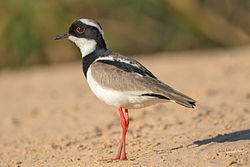
The pied plover is a strongly marked bird with a black and white pattern, buff on its back and wings, and white on its abdomen. Its eyes are encircled with bright red eye-rings. It has a prominent black V on its upper back and has long, red legs. It is a medium-sized bird like most of the species in the family Charadriidae, measuring around 22 centimeters.
There is no sexual dimorphism in this species; both males and females look the same. Juveniles look similar, with the exception of them being more buff and the presence of buff eye-rings instead of red ones.
Pied plovers are a quiet species, not calling very often. Their call sounds like "kee-oo", with the second part lower in pitch. When flying during their display, their call resembles repeated "klee" sounds.
Pied plovers live along the shores of lakes and rivers where there is sand and mud. They reside in the northern part of South America with their range covering Brazil, Bolivia, Paraguay, Peru, Colombia, Ecuador, Venezuela, Guyana, Suriname, and French Guiana.
Not much is known about its movements, but the pied plover seems to change habitat during different parts of the year. It has been observed to move as high as 2600 meters in altitude in Bolivia, possibly due to the wet season pushing it to higher ground.
Pied plover
The pied plover (Hoploxypterus cayanus), also known as the pied lapwing, is a species of bird in the family Charadriidae. It is a bird of least concern according to the IUCN and can be found in northern South America. The species name cayanus refers to Cayenne, the capital of French Guiana, where the pied plover can be found.
There is confusion around its common name. Historically, the pied plover was considered to be a plover, which is a bird part of the subfamily Charadriinae. Most recently, it has been moved to the subfamily Vanellinae, which are the lapwings. The pied plover is still referred to as a plover because it physically resembles that group of birds in shape and size. However, based on taxonomy, it is more correct to refer to it as a lapwing.
The pied plover belongs to the order Charadriiformes known as the shorebirds. It is placed within the family Charadriidae and is the only species placed in the genus Hoploxypterus that was introduced in 1856 by the French naturalist Charles Lucien Bonaparte. The pied plover was formerly placed in the genus Vanellus but molecular phylogenetic studies have shown that it is not closely related to the other lapwings.
The pied plover is a strongly marked bird with a black and white pattern, buff on its back and wings, and white on its abdomen. Its eyes are encircled with bright red eye-rings. It has a prominent black V on its upper back and has long, red legs. It is a medium-sized bird like most of the species in the family Charadriidae, measuring around 22 centimeters.
There is no sexual dimorphism in this species; both males and females look the same. Juveniles look similar, with the exception of them being more buff and the presence of buff eye-rings instead of red ones.
Pied plovers are a quiet species, not calling very often. Their call sounds like "kee-oo", with the second part lower in pitch. When flying during their display, their call resembles repeated "klee" sounds.
Pied plovers live along the shores of lakes and rivers where there is sand and mud. They reside in the northern part of South America with their range covering Brazil, Bolivia, Paraguay, Peru, Colombia, Ecuador, Venezuela, Guyana, Suriname, and French Guiana.
Not much is known about its movements, but the pied plover seems to change habitat during different parts of the year. It has been observed to move as high as 2600 meters in altitude in Bolivia, possibly due to the wet season pushing it to higher ground.
Recent media
Recent media