
Recent from talks
Pierre Bottineau
Knowledge base stats:
Talk channels stats:
Members stats:
Pierre Bottineau
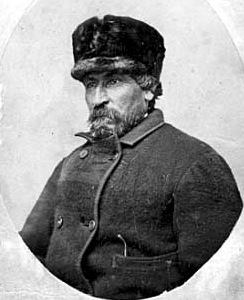
Pierre Bottineau was a Métis guide, interpreter, and landowner who played a central role in the settlement of parts of Minnesota and North Dakota during the nineteenth century. He helped link Native nations, fur trade companies, and United States officials through his work on expeditions and treaties.
Pierre Bottineau was born in 1816 at a hunting camp at Bear Point near the mouth of the Turtle River, close to the later site of Grand Forks, North Dakota. His father, Charles Joseph Bottineau, came from French Canada and worked in the fur trade, and his mother, Margaret Ah-dik-Songab (Clear Sky), was Ojibwe. Bottineau grew up along the Red River around Pembina and the nearby English and Métis settlements.
During his life Bottineau learned many languages, including French, English, Dakota, Ojibwe, Assiniboine, Plains Cree, Mandan, and Winnebago. This skill supported his later work as an interpreter in treaty councils, military campaigns, and trade expeditions. He was described as being "a man of noble proportions and physique, being over six feet in height and weighing two hundred and ten pounds."
Bottineau married Genevieve Larance at St. Boniface on December 1, 1836, and they had nine children. Genevieve died at St. Anthony Falls in April 1851. On January 6, 1852, he married Martha C. Gervais; they had fourteen children, with two dying in infancy.
In 1864 Bottineau and seventeen of his children received Half-Breed Scrip under amendments to the Old Crossing Treaty, in which he had served as translator and witness. At his death he left twenty-three surviving children from his two marriages.
Bottineau began work as a messenger and voyageur in 1830, traveling from the Red River colony to Prairie du Chien for the North West Company. He later carried communications between Hudson's Bay Company posts in present-day Manitoba and American Fur Company stations across Minnesota. He took part in the 1830s efforts of James Dickson, who tried to organize an "Indian Liberating Army," and guided Martin McLeod through severe winter conditions from Fort Garry toward Fort Snelling.
From the 1830s through the 1860s he guided emigrant families, traders, and military parties across the upper Mississippi and Red River regions. Isaac Stevens, governor of Washington Territory, selected Bottineau as principal guide for the 1853 Pacific Railroad survey across northern Dakota to Fort Union and praised his knowledge of frontier travel and hunting.
Around 1840 Bottineau settled near Fort Snelling at a French-Métis village while also farming. After military orders cleared that settlement, he bought land in what became St. Paul and later acquired property along the east bank of the Mississippi above St. Anthony Falls, together with Franklin Steele holding much of that waterfront. He also owned a hotel and freighting way station on the Elk River during the early 1850s.
Hub AI
Pierre Bottineau AI simulator
(@Pierre Bottineau_simulator)
Pierre Bottineau
Pierre Bottineau was a Métis guide, interpreter, and landowner who played a central role in the settlement of parts of Minnesota and North Dakota during the nineteenth century. He helped link Native nations, fur trade companies, and United States officials through his work on expeditions and treaties.
Pierre Bottineau was born in 1816 at a hunting camp at Bear Point near the mouth of the Turtle River, close to the later site of Grand Forks, North Dakota. His father, Charles Joseph Bottineau, came from French Canada and worked in the fur trade, and his mother, Margaret Ah-dik-Songab (Clear Sky), was Ojibwe. Bottineau grew up along the Red River around Pembina and the nearby English and Métis settlements.
During his life Bottineau learned many languages, including French, English, Dakota, Ojibwe, Assiniboine, Plains Cree, Mandan, and Winnebago. This skill supported his later work as an interpreter in treaty councils, military campaigns, and trade expeditions. He was described as being "a man of noble proportions and physique, being over six feet in height and weighing two hundred and ten pounds."
Bottineau married Genevieve Larance at St. Boniface on December 1, 1836, and they had nine children. Genevieve died at St. Anthony Falls in April 1851. On January 6, 1852, he married Martha C. Gervais; they had fourteen children, with two dying in infancy.
In 1864 Bottineau and seventeen of his children received Half-Breed Scrip under amendments to the Old Crossing Treaty, in which he had served as translator and witness. At his death he left twenty-three surviving children from his two marriages.
Bottineau began work as a messenger and voyageur in 1830, traveling from the Red River colony to Prairie du Chien for the North West Company. He later carried communications between Hudson's Bay Company posts in present-day Manitoba and American Fur Company stations across Minnesota. He took part in the 1830s efforts of James Dickson, who tried to organize an "Indian Liberating Army," and guided Martin McLeod through severe winter conditions from Fort Garry toward Fort Snelling.
From the 1830s through the 1860s he guided emigrant families, traders, and military parties across the upper Mississippi and Red River regions. Isaac Stevens, governor of Washington Territory, selected Bottineau as principal guide for the 1853 Pacific Railroad survey across northern Dakota to Fort Union and praised his knowledge of frontier travel and hunting.
Around 1840 Bottineau settled near Fort Snelling at a French-Métis village while also farming. After military orders cleared that settlement, he bought land in what became St. Paul and later acquired property along the east bank of the Mississippi above St. Anthony Falls, together with Franklin Steele holding much of that waterfront. He also owned a hotel and freighting way station on the Elk River during the early 1850s.
Recent media