
Recent from talks
Pilatus PC-9
Knowledge base stats:
Talk channels stats:
Members stats:
Pilatus PC-9
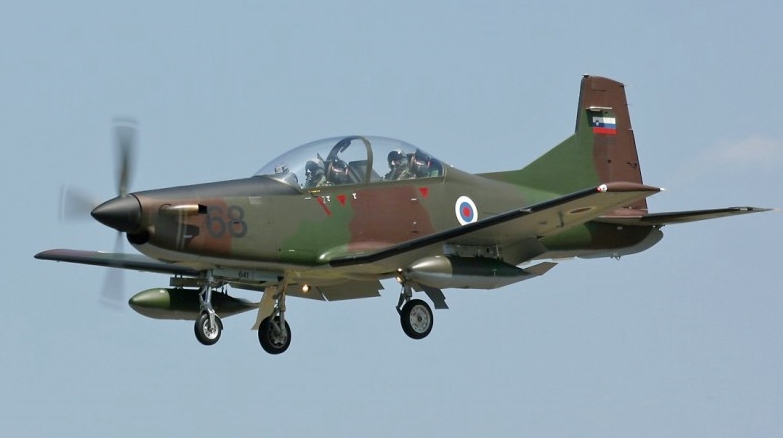
The Pilatus PC-9 is a single-engine, low-wing tandem-seat turboprop training aircraft designed and manufactured by Pilatus Aircraft of Switzerland.
Developed as a more powerful evolution of the preceding Pilatus PC-7, the PC-9 features an enlarged cockpit and a ventral airbrake while possessing only a low level of structural commonality with its predecessor. During May 1985, the maiden flight of the prototype PC-9 was conducted; four months later, type certification was received and permitting deliveries to commence that same year. During the mid-1980s, Pilatus teamed up with British Aerospace to market the PC-9; the first production order for the type was placed by the Royal Saudi Air Force.
Production of the PC-9 has continued into the twenty-first century and in excess of 250 aircraft have been produced across five different variants. One of these variants, the Beechcraft T-6A Texan II, has been produced under licence by the American firm Beechcraft in the United States. The PC-9 has also been assembled by the Australian company Hawker de Havilland. The PC-9 has been employed by a number of military and civilian operators around the world, including the Swiss Air Force, Croatian Air Force, Royal Thai Air Force and the Irish Air Corps. It has been flown by aerobatics teams, such as the Royal Thai Air Force's Blue Phoenix and the Royal Australian Air Force's Roulettes. Furthermore, the type has occasionally been involved in combat operations.
The origins of the PC-9 can be traced back to the earlier PC-7 from which it evolved. This preceding trainer aircraft had been developed during the mid-1970s and became one of the most successful turboprop trainers of that decade. Rapid changes in the global trainer market, particularly the availability of more powerful fighter and light attack aircraft, led to training syllabuses undergoing major shifts and impacted customer expectations for trainer aircraft. Specifically, operators sought to reduce the number of stages and aircraft types involved in training in order to reduce both time and cost.
During the early 1980s, Pilatus commenced work on a series of design studies towards what would become the PC-9. From the onset, the PC-9 was designed to function as both an ab initio and advanced trainer without the need for an intermediate stage. It is suitable for performing primary, intermediate, transition, aerobatic and weapons training, amongst other tasks.
The PC-9 is a tandem-seat single-engine military trainer aircraft capable of relatively high performance. In comparison to the PC-7, this new aircraft was almost 300 kg heavier, possessing a lengthened nose along with an elongated cockpit and canopy. It was largely an all-new design, despite the similarities to its predecessor. Amongst other improvements, the ejection seats within the cockpit were stepped (providing better visibility from the rear position) while a ventral airbrake was also added.[citation needed]
During 1982, the PC-9 program was officially launched. Although some aerodynamic elements were tested on a PC-7 during 1982 and 1983, the maiden flight of the first PC-9 prototype took place on 7 May 1984. A second prototype flew on 20 July of the same year; this prototype featured all the standard electronic flight instrumentation and environmental control systems installed and was thus almost fully representative of the production version.[citation needed] While not fitted as standard, a head-up display (HUD) and onboard oxygen generation system could be optionally fitted.
During 1984, Pilatus teamed up with British Aerospace to promote the PC-9 to fill a requirement to replace the Royal Air Force’s (RAF) BAC Jet Provost trainer fleet. In September 1985, type certification was achieved. However, by this point, the PC-9 had lost the RAF trainer competition to the Short Tucano. However, the marketing links that Pilatus built up with British Aerospace during this competition remained in place, and reportedly contributed to the type's first order, for 30 aircraft, being received from Saudi Arabia.
Hub AI
Pilatus PC-9 AI simulator
(@Pilatus PC-9_simulator)
Pilatus PC-9
The Pilatus PC-9 is a single-engine, low-wing tandem-seat turboprop training aircraft designed and manufactured by Pilatus Aircraft of Switzerland.
Developed as a more powerful evolution of the preceding Pilatus PC-7, the PC-9 features an enlarged cockpit and a ventral airbrake while possessing only a low level of structural commonality with its predecessor. During May 1985, the maiden flight of the prototype PC-9 was conducted; four months later, type certification was received and permitting deliveries to commence that same year. During the mid-1980s, Pilatus teamed up with British Aerospace to market the PC-9; the first production order for the type was placed by the Royal Saudi Air Force.
Production of the PC-9 has continued into the twenty-first century and in excess of 250 aircraft have been produced across five different variants. One of these variants, the Beechcraft T-6A Texan II, has been produced under licence by the American firm Beechcraft in the United States. The PC-9 has also been assembled by the Australian company Hawker de Havilland. The PC-9 has been employed by a number of military and civilian operators around the world, including the Swiss Air Force, Croatian Air Force, Royal Thai Air Force and the Irish Air Corps. It has been flown by aerobatics teams, such as the Royal Thai Air Force's Blue Phoenix and the Royal Australian Air Force's Roulettes. Furthermore, the type has occasionally been involved in combat operations.
The origins of the PC-9 can be traced back to the earlier PC-7 from which it evolved. This preceding trainer aircraft had been developed during the mid-1970s and became one of the most successful turboprop trainers of that decade. Rapid changes in the global trainer market, particularly the availability of more powerful fighter and light attack aircraft, led to training syllabuses undergoing major shifts and impacted customer expectations for trainer aircraft. Specifically, operators sought to reduce the number of stages and aircraft types involved in training in order to reduce both time and cost.
During the early 1980s, Pilatus commenced work on a series of design studies towards what would become the PC-9. From the onset, the PC-9 was designed to function as both an ab initio and advanced trainer without the need for an intermediate stage. It is suitable for performing primary, intermediate, transition, aerobatic and weapons training, amongst other tasks.
The PC-9 is a tandem-seat single-engine military trainer aircraft capable of relatively high performance. In comparison to the PC-7, this new aircraft was almost 300 kg heavier, possessing a lengthened nose along with an elongated cockpit and canopy. It was largely an all-new design, despite the similarities to its predecessor. Amongst other improvements, the ejection seats within the cockpit were stepped (providing better visibility from the rear position) while a ventral airbrake was also added.[citation needed]
During 1982, the PC-9 program was officially launched. Although some aerodynamic elements were tested on a PC-7 during 1982 and 1983, the maiden flight of the first PC-9 prototype took place on 7 May 1984. A second prototype flew on 20 July of the same year; this prototype featured all the standard electronic flight instrumentation and environmental control systems installed and was thus almost fully representative of the production version.[citation needed] While not fitted as standard, a head-up display (HUD) and onboard oxygen generation system could be optionally fitted.
During 1984, Pilatus teamed up with British Aerospace to promote the PC-9 to fill a requirement to replace the Royal Air Force’s (RAF) BAC Jet Provost trainer fleet. In September 1985, type certification was achieved. However, by this point, the PC-9 had lost the RAF trainer competition to the Short Tucano. However, the marketing links that Pilatus built up with British Aerospace during this competition remained in place, and reportedly contributed to the type's first order, for 30 aircraft, being received from Saudi Arabia.
Recent media