


Community hub
Recent from talks
Contribute something
Nothing was collected or created yet.
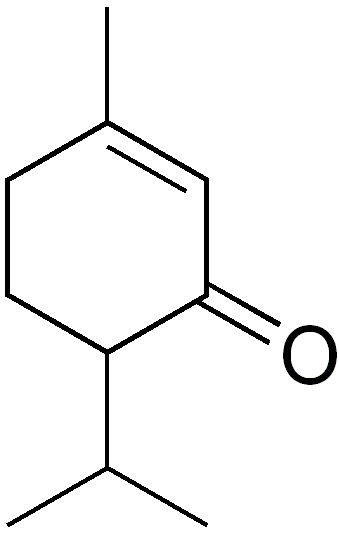
Piperitone
View on Wikipedia | |
| Names | |
|---|---|
| IUPAC name
6-Isopropyl-3-methyl-1-cyclohex-2-enone
| |
| Other names
3-Carvomenthenone; p-Menth-1-en-3-one
| |
| Identifiers | |
3D model (JSmol)
|
|
| ChEBI | |
| ChemSpider | |
| ECHA InfoCard | 100.001.766 |
PubChem CID
|
|
| UNII |
|
CompTox Dashboard (EPA)
|
|
| |
| |
| Properties | |
| C10H16O | |
| Molar mass | 152.23 g/mol |
| Density | 0.9331 g/cm3 |
| Melting point | 232 to 233 °C (450 to 451 °F; 505 to 506 K) |
Except where otherwise noted, data are given for materials in their standard state (at 25 °C [77 °F], 100 kPa).
| |


Piperitone is a natural monoterpene ketone which is a component of some essential oils. Both stereoisomers, the D-form and the L-form, are known. The D-form has a peppermint-like aroma and has been isolated from the oils of plants from the genera Cymbopogon, Andropogon, and Mentha.[1] The L-form has been isolated from Sitka spruce.[1]
Occurrence
[edit]
Piperitone is found in many essential oils, including over thirty species of the genus Eucalyptus. High levels are present in certain species of Eucalyptus and Mentha.[2] In the genus Eucalyptus, the highest concentrations are found in Eucalyptus dives.[3] Both enantiomers occur naturally. In Eucalyptus species, (-)-piperitone is present; in mint species, (+)-piperitone is found; and some plants contain racemate piperitone.[2]
Properties
[edit]Piperitone is a colorless liquid with a distinct peppermint odor.[3]
Production
[edit]Piperitone can be synthesized from isopropyl acetoacetate and 3-buten-2-one.[4]
The primary source of D/L-piperitone is from Eucalyptus dives, produced mainly in South Africa.[5]
Reactions
[edit]Piperitone is used as the principal raw material for the production of synthetic menthol and thymol.[4] The reduction to menthol is achieved using hydrogen and a nickel catalyst. Oxidation to thymol is accomplished with iron(III) chloride and acetic acid. It also forms adducts with benzaldehyde and hydroxylamine (an oxime), which were historically useful for compound identification by the melting points of the derivatives.[3] Under light exposure, piperitone undergoes photodimerization, forming a polycyclic compound with a cyclobutane ring.[6]
References
[edit]- ^ a b c Merck Index, 11th Edition, '7443
- ^ a b Uzi Ravid, Eli Putievsky, Irena Katzir (March 1994), "Enantiomeric distribution of piperitone in essential oils of some mentha spp., calamintha incána (sm.) heldr. and artemisia judaica L", Flavour and Fragrance Journal, vol. 9, no. 2, pp. 85–87, doi:10.1002/ffj.2730090210
{{citation}}: CS1 maint: multiple names: authors list (link) - ^ a b c John Read, Henry George Smith (1921), "LXXXVII.—Piperitone. Part I. The occurrence, isolation, and characterisation of piperitone", J. Chem. Soc., Trans., vol. 119, pp. 779–789, doi:10.1039/CT9211900779
- ^ a b Fritz Eiden (August 2007), "Carl Hagemann ...ein Mensch von großer Güte, ein richtiger Chemiker...", Chemie in unserer Zeit, vol. 41, no. 4, pp. 316–323, doi:10.1002/ciuz.200700411
- ^ Boland, D.J., Brophy, J.J., and A.P.N. House, Eucalyptus Leaf Oils, 1991, ISBN 0-909605-69-6
- ^ H. Ziffer, N.E. Sharpless, R.O. Kan (January 1966), "Photodimers of piperitone", Tetrahedron, vol. 22, no. 9, pp. 3011–3020, doi:10.1016/S0040-4020(01)82280-8
{{citation}}: CS1 maint: multiple names: authors list (link)