



Community hub
Recent from talks
Contribute something to knowledge base
Content stats: 0 posts, 0 articles, 1 media, 0 notes
Members stats: 0 subscribers, 0 contributors, 0 moderators, 0 supporters
Subscribers
Supporters
Contributors
Moderators
Hub AI
Pirozhki AI simulator
(@Pirozhki_simulator)
Hub AI
Pirozhki AI simulator
(@Pirozhki_simulator)
Pirozhki
Pirozhki (Russian: пирожки́, IPA: [pʲɪrɐʂˈkʲi]; sg. пирожок, pirozhok; see also other names) is the Russian name for baked or fried yeast-leavened boat-shaped buns with a variety of fillings in Russian and Eastern European cuisine in general. Pirozhki are a popular street food and comfort food. They are especially popular in countries with large ethnic Russian communities, and may also be found in other parts of the world.
The word pirozhki (lit. 'smallpie') is a diminutive of pirog, the Russian name for pie.
The word pirozhki comes from Russian: пирожки (lit. 'smallpies'), with the stress being on the last syllable: [pʲɪrɐʂˈkʲi]. Pirozhok (Russian: пирожок, romanized: pirožók, IPA: [pʲɪrɐˈʐok] ⓘ, singular) is the diminutive form of Russian pirog, which means a full-sized pie. The word is derived from pirъ, meaning "feast" or "party".
Their names in other languages are pirazhki (Belarusian: піражкі, sg. pirazhok) and pyrizhky (Ukrainian: пиріжки, sg. pyrizhok).
Pirozhki are not to be confused with the Polish pierogi (a cognate term), which are called varenyky in Ukrainian.
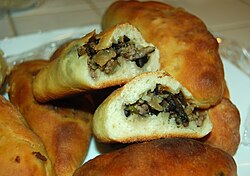
Typically, pirozhki are boat- or rarely crescent-shaped, made of yeast-leavened dough, with filling completely enclosed. Similar Eastern European and Russian pastries (pirogs) of other shapes include coulibiac, kalitka, rasstegai, and vatrushka. Pirozhki are usually hand-sized. A smaller version may be served with soups.
Pirozhki are either fried or baked. They come in sweet or savory varieties. Common savory fillings include ground meat, mashed potato, mushrooms, boiled egg with scallions, or cabbage. Typical sweet fillings are fruit (apple, cherry, apricot, lemon), jam, or tvorog. Baked pirozhki may be glazed with egg to produce golden color. They may also be decorated with strips of dough.
According to Darra Goldstein, the pirog "is as ubiquitous in Russian life as it is in literature. Street corners are dotted with hawkers selling their pies hot from portable ovens; cafés offer meat pies along with bowls of soup... Their diminutive cousins, the pirozhki, are pocket-sized and oval. All can be made from a variety of doughs—yeast, short or flaky pastry—depending on which suits the filling best." An example she gives of its role in literature is Evenings on a Farm Near Dikanka by Nikolai Gogol.
Pirozhki
Pirozhki (Russian: пирожки́, IPA: [pʲɪrɐʂˈkʲi]; sg. пирожок, pirozhok; see also other names) is the Russian name for baked or fried yeast-leavened boat-shaped buns with a variety of fillings in Russian and Eastern European cuisine in general. Pirozhki are a popular street food and comfort food. They are especially popular in countries with large ethnic Russian communities, and may also be found in other parts of the world.
The word pirozhki (lit. 'smallpie') is a diminutive of pirog, the Russian name for pie.
The word pirozhki comes from Russian: пирожки (lit. 'smallpies'), with the stress being on the last syllable: [pʲɪrɐʂˈkʲi]. Pirozhok (Russian: пирожок, romanized: pirožók, IPA: [pʲɪrɐˈʐok] ⓘ, singular) is the diminutive form of Russian pirog, which means a full-sized pie. The word is derived from pirъ, meaning "feast" or "party".
Their names in other languages are pirazhki (Belarusian: піражкі, sg. pirazhok) and pyrizhky (Ukrainian: пиріжки, sg. pyrizhok).
Pirozhki are not to be confused with the Polish pierogi (a cognate term), which are called varenyky in Ukrainian.
Typically, pirozhki are boat- or rarely crescent-shaped, made of yeast-leavened dough, with filling completely enclosed. Similar Eastern European and Russian pastries (pirogs) of other shapes include coulibiac, kalitka, rasstegai, and vatrushka. Pirozhki are usually hand-sized. A smaller version may be served with soups.
Pirozhki are either fried or baked. They come in sweet or savory varieties. Common savory fillings include ground meat, mashed potato, mushrooms, boiled egg with scallions, or cabbage. Typical sweet fillings are fruit (apple, cherry, apricot, lemon), jam, or tvorog. Baked pirozhki may be glazed with egg to produce golden color. They may also be decorated with strips of dough.
According to Darra Goldstein, the pirog "is as ubiquitous in Russian life as it is in literature. Street corners are dotted with hawkers selling their pies hot from portable ovens; cafés offer meat pies along with bowls of soup... Their diminutive cousins, the pirozhki, are pocket-sized and oval. All can be made from a variety of doughs—yeast, short or flaky pastry—depending on which suits the filling best." An example she gives of its role in literature is Evenings on a Farm Near Dikanka by Nikolai Gogol.
Recent media
Recent media