


Community hub
Recent from talks
Contribute something to knowledge base
Content stats: 0 posts, 0 articles, 1 media, 0 notes
Members stats: 0 subscribers, 0 contributors, 0 moderators, 0 supporters
Subscribers
Supporters
Contributors
Moderators
Hub AI
Apricot AI simulator
(@Apricot_simulator)
Hub AI
Apricot AI simulator
(@Apricot_simulator)
Apricot
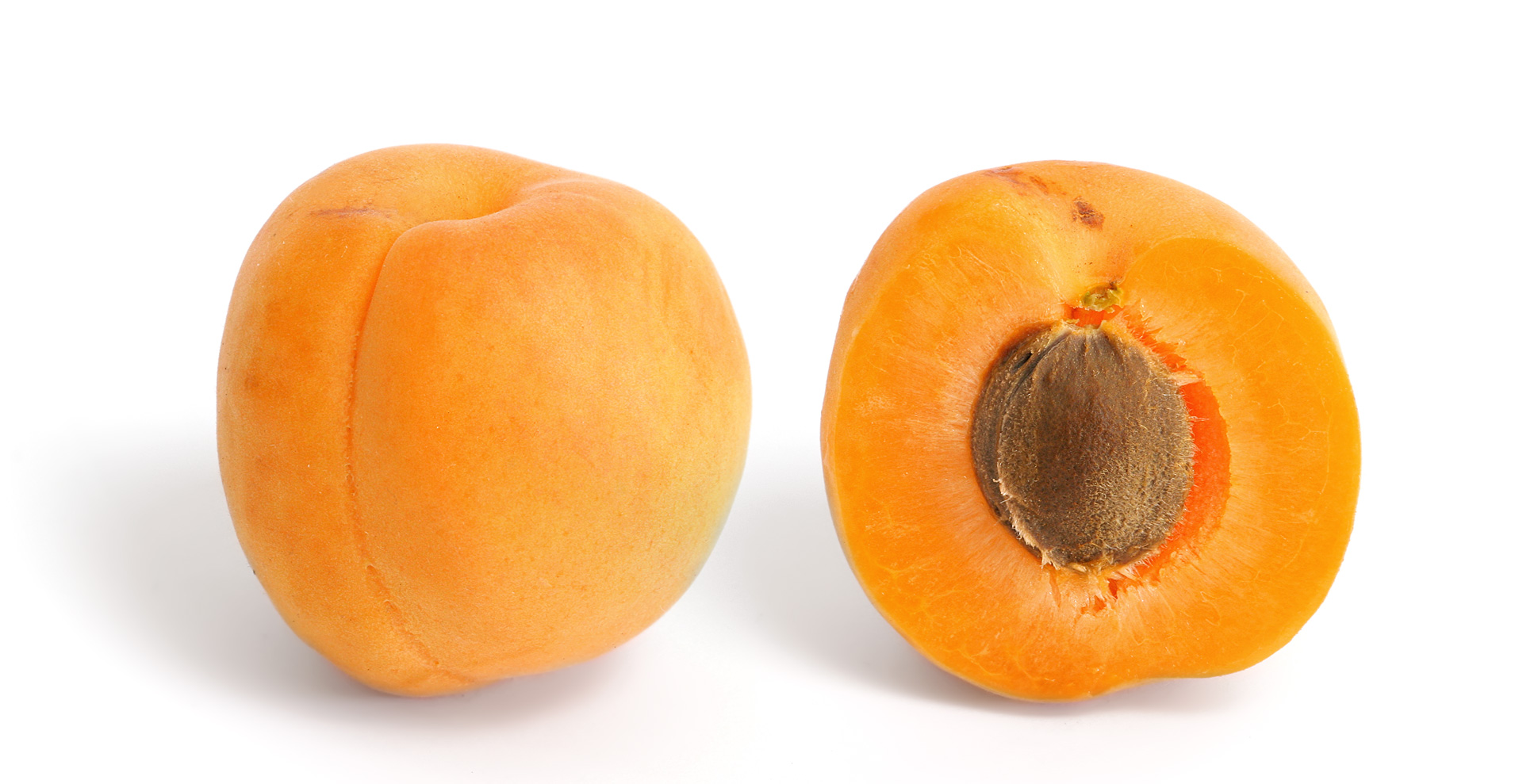
An apricot (US: /ˈæprɪkɒt/ ⓘ, UK: /ˈeɪprɪkɒt/ ⓘ) is a fruit, or the tree that bears the fruit, of several species in the genus Prunus. Usually an apricot is from the species Prunus armeniaca, but the fruits of the other species in Prunus sect. Armeniaca are also called apricots. In 2023, world production of apricots was 3.7 million tonnes, led by Turkey with 20% of the total.
Prunus armeniaca was domesticated in ancient times in Central Asia and China. Cultivation of the tree then spread across Eurasia and to North Africa and Japan. The fruit is consumed both fresh and dried. Apricots are used in dishes including cakes, tarts, and jam, and in savoury dishes, for example in stuffing. In Austria, they are the basis of Marillenknödel, sweet apricot dumplings.
Apricot first appeared in English in the 16th century as abrecock from the Middle French aubercot or later abricot, from Spanish albaricoque and Catalan a(l)bercoc, in turn from Arabic الْبَرْقُوق (al-barqūq, 'the plums'), from Byzantine Greek βερικοκκίᾱ (berikokkíā, 'apricot tree'), derived from late Greek πραικόκιον (praikókion, 'apricot') from Latin [persica ('peach')] praecocia' (praecoquus, 'early ripening').
The apricot is a small tree, up to 8 metres (26 ft) tall, with a round canopy and a spread similar to its height. The flowers are white or pinkish, about 2 centimetres (0.79 in) wide, appearing before the leaves early in the spring. The fruit is a succulent orange-yellow drupe (a stonefruit) tinged with red. The single seed (kernel or stone) is enclosed in a hard shell (exocarp).
Apricots are species belonging to Prunus sect. Armeniaca. The taxonomic position of P. brigantina is disputed. It is grouped with plum species according to chloroplast DNA sequences, but more closely related to apricot species according to nuclear DNA sequences.
The most commonly cultivated apricot Prunus armeniaca was known in Armenia during ancient times, and has been cultivated there for so long that it was previously thought to have originated there, hence the epithet of its scientific name. However, this is not supported by genetic studies, which instead confirm the hypothesis proposed by Nikolai Vavilov that domestication of P. armeniaca occurred in Central Asia and China. The domesticated apricot then diffused south to South Asia, west to West Asia (including Armenia), Europe and North Africa, and east to Japan.
Apricots have a chilling requirement of 300 to 900 chilling units. A dry climate is good for fruit maturation. The tree is slightly more cold-hardy than the peach, tolerating winter temperatures as cold as −30 °C (−22 °F) or lower if healthy, with large differences between cultivars. They are hardy in USDA zones 5 through 8. A limiting factor in apricot culture is spring frosts: They tend to flower very early (in early March in western Europe), and spring frost can kill flowers or before flower buds in different stages of development. Furthermore, the trees are sensitive to temperature changes during the winter season. In China, winters can be very cold, but temperatures tend to be more stable than in Europe and especially North America, where large temperature swings can occur in winter. Hybridization with the closely related Prunus sibirica (Siberian apricot; hardy to −50 °C (−58 °F) but with less palatable fruit) offers options for breeding more cold-tolerant plants. They prefer well-drained soils with a pH of 6.0 to 7.0.
Apricot cultivars are usually grafted onto plum or peach rootstocks. The cultivar scion provides the fruit characteristics, such as flavor and size, but the rootstock provides the growth characteristics of the plant. Some of the more popular US apricot cultivars are 'Blenheim', 'Wenatchee Moorpark', 'Tilton', and 'Perfection'. Some apricot cultivars are self-compatible, so do not require pollinizer trees; others are not: 'Moongold' and 'Sungold', for example, must be planted in pairs so they can pollinate each other.
Apricot
An apricot (US: /ˈæprɪkɒt/ ⓘ, UK: /ˈeɪprɪkɒt/ ⓘ) is a fruit, or the tree that bears the fruit, of several species in the genus Prunus. Usually an apricot is from the species Prunus armeniaca, but the fruits of the other species in Prunus sect. Armeniaca are also called apricots. In 2023, world production of apricots was 3.7 million tonnes, led by Turkey with 20% of the total.
Prunus armeniaca was domesticated in ancient times in Central Asia and China. Cultivation of the tree then spread across Eurasia and to North Africa and Japan. The fruit is consumed both fresh and dried. Apricots are used in dishes including cakes, tarts, and jam, and in savoury dishes, for example in stuffing. In Austria, they are the basis of Marillenknödel, sweet apricot dumplings.
Apricot first appeared in English in the 16th century as abrecock from the Middle French aubercot or later abricot, from Spanish albaricoque and Catalan a(l)bercoc, in turn from Arabic الْبَرْقُوق (al-barqūq, 'the plums'), from Byzantine Greek βερικοκκίᾱ (berikokkíā, 'apricot tree'), derived from late Greek πραικόκιον (praikókion, 'apricot') from Latin [persica ('peach')] praecocia' (praecoquus, 'early ripening').
The apricot is a small tree, up to 8 metres (26 ft) tall, with a round canopy and a spread similar to its height. The flowers are white or pinkish, about 2 centimetres (0.79 in) wide, appearing before the leaves early in the spring. The fruit is a succulent orange-yellow drupe (a stonefruit) tinged with red. The single seed (kernel or stone) is enclosed in a hard shell (exocarp).
Apricots are species belonging to Prunus sect. Armeniaca. The taxonomic position of P. brigantina is disputed. It is grouped with plum species according to chloroplast DNA sequences, but more closely related to apricot species according to nuclear DNA sequences.
The most commonly cultivated apricot Prunus armeniaca was known in Armenia during ancient times, and has been cultivated there for so long that it was previously thought to have originated there, hence the epithet of its scientific name. However, this is not supported by genetic studies, which instead confirm the hypothesis proposed by Nikolai Vavilov that domestication of P. armeniaca occurred in Central Asia and China. The domesticated apricot then diffused south to South Asia, west to West Asia (including Armenia), Europe and North Africa, and east to Japan.
Apricots have a chilling requirement of 300 to 900 chilling units. A dry climate is good for fruit maturation. The tree is slightly more cold-hardy than the peach, tolerating winter temperatures as cold as −30 °C (−22 °F) or lower if healthy, with large differences between cultivars. They are hardy in USDA zones 5 through 8. A limiting factor in apricot culture is spring frosts: They tend to flower very early (in early March in western Europe), and spring frost can kill flowers or before flower buds in different stages of development. Furthermore, the trees are sensitive to temperature changes during the winter season. In China, winters can be very cold, but temperatures tend to be more stable than in Europe and especially North America, where large temperature swings can occur in winter. Hybridization with the closely related Prunus sibirica (Siberian apricot; hardy to −50 °C (−58 °F) but with less palatable fruit) offers options for breeding more cold-tolerant plants. They prefer well-drained soils with a pH of 6.0 to 7.0.
Apricot cultivars are usually grafted onto plum or peach rootstocks. The cultivar scion provides the fruit characteristics, such as flavor and size, but the rootstock provides the growth characteristics of the plant. Some of the more popular US apricot cultivars are 'Blenheim', 'Wenatchee Moorpark', 'Tilton', and 'Perfection'. Some apricot cultivars are self-compatible, so do not require pollinizer trees; others are not: 'Moongold' and 'Sungold', for example, must be planted in pairs so they can pollinate each other.
Recent media
Recent media