Hubbry Logo
Pixel BudsPixel BudsMain
Open search
Pixel Buds
Community hub
Pixel Buds
logo
8 pages, 0 posts
0 subscribers
Be the first to start a discussion here.
Pixel Buds
Pixel Buds
from Wikipedia

First-generation Pixel Buds
DeveloperGoogle
ManufacturerGoertek (first-generation)
Product familyPixel
TypeWireless earbuds
Release date
First-generation:
November 2017
  • Canada
  • United States
February 2018
  • Australia
  • Germany
  • United Kingdom

Second-generation:

April 2020
  • United States
July 2020
  • Australia
  • Canada
  • France
  • Germany
  • Ireland
  • Italy
  • Singapore
  • Spain
  • United Kingdom

Pixel Buds A-Series:

June 2021
  • Canada
  • United States
August 2021
  • France
  • Germany
  • Ireland
  • India
  • Italy
  • Spain
  • United Kingdom

Pixel Buds Pro:

July 2022
  • Australia
  • Canada
  • France
  • Germany
  • Ireland
  • Italy
  • Japan
  • Singapore
  • Spain
  • Taiwan
  • United Kingdom
  • United States

Pixel Buds Pro 2:

September 2024
  • Australia
  • Canada
  • France
  • Germany
  • Ireland
  • Italy
  • Japan
  • Singapore
  • Spain
  • Taiwan
  • United Kingdom
  • United States
InputMicrophone, accelerometer, capacitive touchpad[1]
Connectivity
Current firmware553 (February 2021)
Dimensions
  • Earbuds
  • 0.8 x 0.8 x 0.8 in
  • (20.4 x 20.4 x 20.5 mm)
  • Charging Case
  • 2.6 x 2.6 x 1.1 in
  • (66.2 x 65.5 x 28.6 mm)[1]
Weight
  • Earbuds
  • 0.49 ounces (14 g)
  • Charging Case
  • 1.5 ounces (43 g)[1]
WebsiteGoogle Store

The Pixel Buds is a line of wireless earbuds developed and marketed by Google. The first-generation Pixel Buds were launched on October 4, 2017, at the Made by Google launch event, and became available for preorder on the Google Store the same day.[1][2] They have the Google Assistant built-in and support Google Translate.

The second-generation Pixel Buds (sometimes known as Pixel Buds 2 or Pixel Buds 2020 to distinguish them from the first-generation earbuds) were announced at the Pixel 4 hardware event on October 15, 2019. They were released on April 27, 2020 and debuted to positive reviews.[3][4][5]

In June 2021, Google announced the Pixel Buds A-Series, a mid-range variant of the second-generation Pixel Buds. In May 2022, Google announced the Pixel Buds Pro, a premium variant of the Pixel Buds with additional features including active noise cancellation. In August 2024, Google announced the Pixel Buds Pro 2 with Gemini and with improved active noise cancellation.

First-generation

[edit]

The Pixel Buds were announced at Google's annual hardware event on October 4, 2017, alongside its second-generation Pixel 2 smartphone.[6] Color choices for the Pixel Buds complemented the Pixel 2, and carried the same names: Just Black, Clearly White, and Kinda Blue, referring to the color of the circular plastic cap visible in the ear.[7] After the second-generation Pixel Buds were announced in October 2019, Google removed the first-generation from its store.[8]

Physical design

[edit]

The industrial design team was led by Gina Reimann.[9]

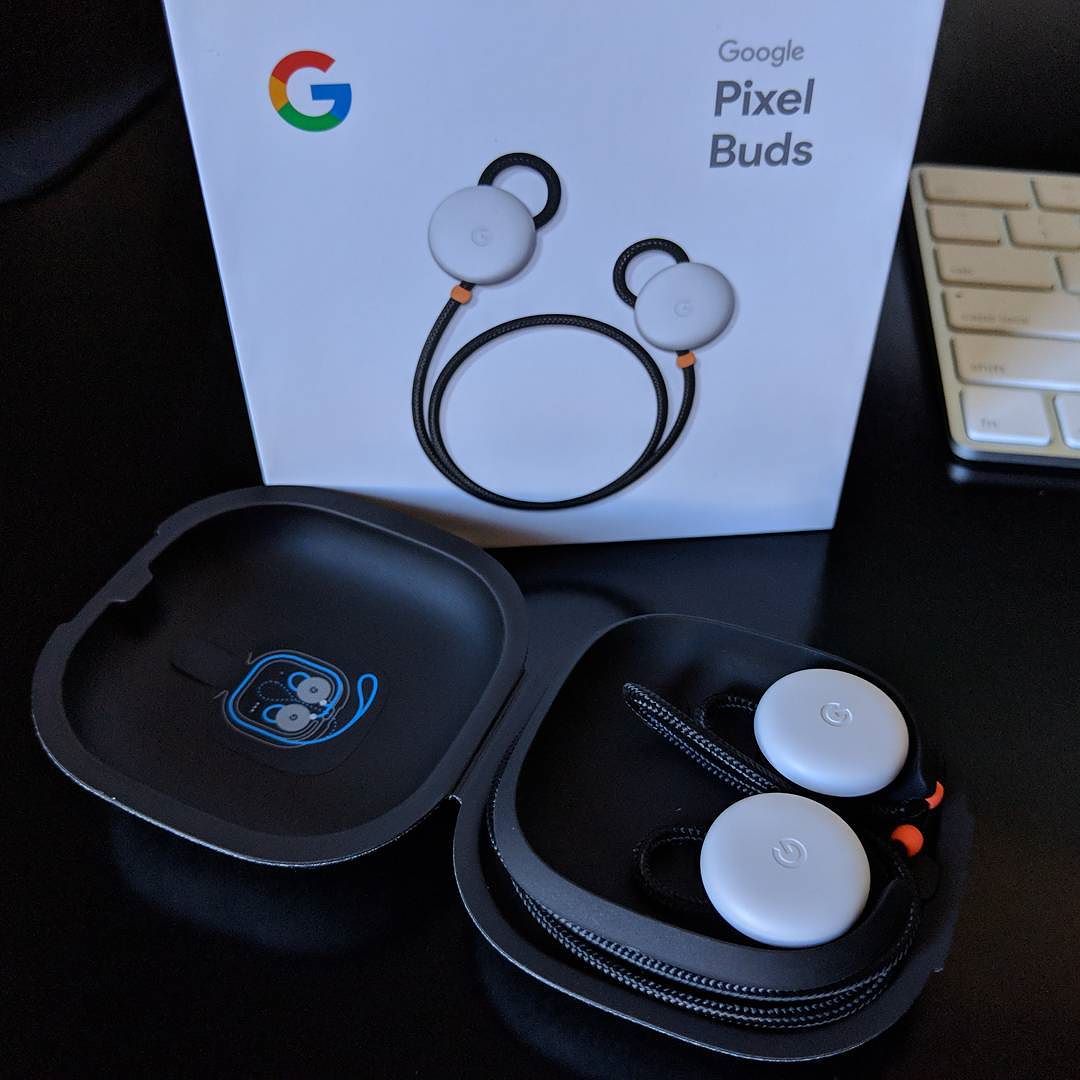
The first-generation Pixel Buds consist of two earbuds linked by a fabric-covered cord, which connect wirelessly over a Bluetooth 4.2 connection.[10] The earbuds are an "open-air" design, where the driver rests just outside the user's ear canal, and there is relatively little isolation from outside sounds.[10] Each earbud is secured physically into the user's concha by a short loop of the cord; the length of the loop is individually adjustable to better fit each user.[11] The earbuds are powered by a 120 mA-hr battery stored in the left earbud,[12] and provide five hours of listening time before needing to be recharged.[13]

The earbuds are stored in a fabric-covered case with an internal battery and USB-C connection; the storage case charges the earbuds, and the USB-C port charges the battery of the storage case. Once the earbuds have been placed in the appropriate sockets, the cord connecting them is wound and stored in a specific manner, illustrated on the inside of the upper lid, to allow the case to close.[10] The case also has a button to pair the earbuds manually and LED indicators to communicate the state of charge and pairing readiness.[14] The battery in the charging case has a 2.39 W-hr capacity,[12] providing enough energy for 24 hours of earbud operation.[13]

Pixel Buds (Gen 1) color schemes
Name Cap Accent
Just Black Black White
Clearly White White Coral
Kinda Blue Blue Seafoam

Features

[edit]

The distinguishing feature of Pixel Buds is their inclusion of the Google Assistant, a smart voice assistant. This allows the earbuds to translate conversations in real-time, among other standard features such as web search and media connectivity.[15][16][17] It supports translation of 40 different languages.[17] Based on the October 2017 demonstration, early coverage compared the Pixel Buds' translation capabilities to that of the fictional Babel fish from The Hitchhiker's Guide to the Galaxy by Douglas Adams;[18] however, in a review for Wired, James Temperton called the feature as released "a bit of a con", as the Pixel Buds merely provided a microphone and speaker for transcription and machine translation powered by Google Translate running on a smartphone: "to speak English to a German who then replies in German that's translated into English you will need: two Google Pixel 2 phones and two Google Pixel Buds headsets. And even then you'll likely spend most of the conversation staring awkwardly into middle-distance while Assistant tries to work out what the hell is going on. Long rant cut short: you don't actually need the Pixel Buds to do this, they're an entirely pointless accessory."[19]

The surface of the right earbud is touch-sensitive: a tap will play or pause audio, swiping forward or backward will raise or lower the volume, respectively, and tapping and holding will bring up the Google Assistant prompt.[10] Double-tapping will read a notification aloud. Triple-Tapping will connect/disconnect the Pixel Buds from their source. The Pixel Buds do not have ear-sensing features, so audio playback does not automatically pause and the touch-sensitive surface remains active after the earbuds are removed; the surface is deactivated once the earbuds are seated properly in the charging case.[11]

The Pixel Buds also introduced a "fast pair" feature to Android; with a smartphone that runs Android 6.0 (Marshmallow) or higher with the Bluetooth radio active, opening the lid of the case will bring up a notification prompting the user to pair the earbuds with the phone. The button of the case also can be used to pair the Pixel Buds manually as needed.[20]

Criticism

[edit]

Reception of the Pixel Buds was mostly negative, with much of the criticism aimed towards its storage case and the awkward steps required to seat the earbuds and wind the cord properly.[10][21][22] Google's support page tells the user to "press down to make sure the charging pins are firmly in place", despite the presence of magnets to help align and retain the Pixel Buds in their storage case.[14]

In 2018, Google announced "Google Translate is available on all Assistant-optimized headphones and Android phones."[23] By opening the service to more devices, researcher Matic Horvat hypothesized that Google was seeking more inputs to train its neural network for real-time, natural-language speech recognition.[24]

Second-generation

[edit]
Pixel Buds (Gen 2) colors
Name Cap
Clearly White White
Oh So Orange Orange
Quite Mint Green
Almost Black Black

The second-generation Pixel Buds 2 were first announced at a Google hardware event on October 15, 2019[25] and released in the United States in April 2020. They were released in Australia, Canada, France, Germany, Ireland, Italy, Singapore, Spain, and the United Kingdom in July 2020.[26] Initially, only the Clearly White color was available; the other three colors (Oh So Orange, Quite Mint (green), and Almost Black) were released four months later in the United States on August 20, 2020.[27][28][29] Google quietly discontinued the orange color in April 2021,[30] and all second-generation Pixel Buds were discontinued in favor of the Pixel Buds A-Series shortly after the latter were announced in June 2021.[31]

Design & features

[edit]

The design of the second-generation Pixel Buds was led by Luke Mastrangelo.[32] For Google, Isabelle Olsson, Kenny Sweet, and Gina Reimann led the product design team.[33]

Unlike the first-generation Pixel Buds, which had the earbud modules linked by a fabric-covered cable, the second-generation were implemented as two separate earbud modules. Each earbud has a small wing that rests against the concha to secure it in place instead of the short cord loop.[34] In addition, each earbud has a soft rubber tip designed to slide into the user's ear canal, providing some passive noise cancellation; three pairs of tips in different sizes to customize the fit are bundled with the second-generation Pixel Buds.[35] The colored circular dome that protrudes slightly from the ear uses the same touch and gesture controls from the first-generation Pixel Buds, with double-tap (skip track) and triple-tap (go back one track) inputs added. In addition, for the second-generation, both earbuds are touch-sensitive.[36]

The second-generation Pixel Buds also featured hands-free Google Assistant activation; instead of having to tap and hold, users could use the voice prompt "Hey Google" to bring up the Assistant.[37]

The storage case, which also charged the earbuds, measures 63 mm × 47 mm × 25 mm (2.48 in × 1.85 in × 0.98 in) and is comparable in size and design to the storage/charging case that Apple supplies with its AirPods.[38] Its shape and size were inspired by a weathered rock taken from Asilomar State Beach.[32] The sockets are equipped with magnets to secure each earbud and align it with the charging pins.[35] Compared to the first-generation Pixel Buds storage case, the second-generation added wireless charging and retained the USB-C charging port for its internal battery.[35]

Reception

[edit]

Reports of audio dropouts and intermittent connectivity began circulating soon after the second-generation Pixel Buds were delivered to customers, occurring most notably outdoors or when the user turned their head.[39] Multiple firmware updates were issued to address connectivity issues,[40] but some users reported having to turn off features to retain basic functionality.[41] Google later explained the second-generation Pixel Buds connect in series: the right earbud connects to the phone, and the left earbud connects to the right, which serves to relay signals to and from the left earbud;[42][43] the issue later was attributed to interference over the Bluetooth connection.[44] Because the serial connection scheme was part of the basic design, the connection issues could not be fixed in firmware.[31]

Pixel Buds A-Series

[edit]
Pixel Buds (A) colors
Name Cap
Clearly White White
Dark Olive Green
Charcoal Gray
Sea Light blue

On June 3, 2021, Google announced the Pixel Buds A-Series, a mid-range variant of the second-generation Pixel Buds that largely share the same external design.[45] They were released on June 17, 2021 in the United States and Canada.[46] In August, they were further released in France, Germany, India, Ireland, Italy, Spain, and the United Kingdom.[47] As released in June 2021, the A-Series was available initially in Clearly White and Dark Olive (green) colors; in October 2022, a Charcoal (dark grey) color was added;[48] in May 2023, a Sea (light blue) color was added.[49]

Design & features

[edit]

Industrial design of the Pixel Buds A-Series again was led by Gina Reimann for Google, heading a team that included Dustin Lee and Jeremiah Baker.[50]

The Pixel Buds A-Series share the design of the second-generation Pixel Buds, made up of three components: two independent earbud modules stored in a flip-top charging case. The A-Series earbuds also share the rubber "stabilizer arc" design to secure the earbud into the user's concha; Google stated they had softened the rubber in the A-Series to enhance user comfort.[44] In addition, the A-Series retained the enhanced touch controls from the second-generation Pixel Buds, with one exception: the swipe volume control gestures were removed.[44] To address the connectivity issues of the second-generation Pixel Buds, the A-Series earbuds each connect to the device independently rather than using a serial/relay connection scheme.[42] Externally, the second-generation Pixel Buds use three charging pins and have a metal output nozzle, while the A-Series have two pins and a plastic nozzle.[51]

The A-series case is the same size as the second-generation Pixel Buds case[52] and likewise is equipped with magnets to hold the earbuds in place and secure the lid; it also has a USB-C connection to charge the case battery. However, unlike the second-generation Pixel Buds case, the A-Series charging case did not have wireless charging capability. Physically, the interior of the A-Series charging case is finished in glossy plastic matching the color of the earbuds; the second-generation Pixel Buds charging case interior is always black with a pebbled finish. In addition, the second-generation Pixel Buds charging case has two LED indicators, one inside the lid (for the charging status of the earbuds) and one external (for the charging and pairing statuses of the case); the A-Series charging case has only the one external indicator that combines both functions.[44]

Pixel Buds Pro

[edit]
Pixel Buds Pro (coral), in case

On May 11, 2022, Google announced the Pixel Buds Pro, a premium variant of the Pixel Buds, during the 2022 Google I/O keynote.[53] They were released on July 28, 2022, in Australia, Canada, France, Germany, Ireland, Italy, Japan, Singapore, Spain, Taiwan, the United Kingdom, and the United States.[54] They were available initially in four colors: Charcoal (dark grey), Coral (orange-red), Fog (light blue), and Lemongrass (light yellow-green).[55] With the launch of the Pixel 8 in October 2023, Google introduced two additional colors: Bay (pastel blue) and Porcelain (light gray).[56]

Design & features

[edit]

Pixel Buds Pro was the first generation to introduce Active Noise Cancellation (ANC) and transparency modes; in ANC mode, the Pixel Buds Pro will reduce background noise, while in transparency mode, the Pro will amplify external noises to facilitate conversations without removing the earbuds.[52] The touch-and-hold gesture can be set independently for the left and right earbuds; by default, one is set to activate the Google Assistant while the other is set to toggle between ANC and transparency modes.[57] Physically, the earbuds have removed the "stabilizer arc" that is used on both the second-generation and A-Series Pixel Buds; the Pro earbuds sit deeper in the wearer's cavum to overcome the Pro's increased size resulting from the larger battery and acoustic elements required for ANC.[58] Each earbud has a silicone tip designed to slide into the user's ear canal, providing some passive noise cancellation.

Pixel Buds Pro colors
Name Cap
Coral Orange
Fog Light Blue
Charcoal Dark Gray
Lemongrass Yellow-Green
Bay Blue
Porcelain Light Gray

The charging case is largely similar to the prior second-generation and A-Series cases, but the Pro case is slightly larger to accommodate the larger earbuds and measures 63.2 mm × 50 mm × 25 mm (2.49 in × 1.97 in × 0.98 in).[52][59]

Firmware updates after its initial release have added several features to the Pixel Buds Pro, including a five-band equalizer (Oct 2022)[60] and a scheduled update for spatial audio with head tracking (Jan 2023).[61] Conversation detection and further noise reduction features were added in October 2023.[56]

Reception

[edit]

Pixel Buds Pro received positive reviews from major tech review sources, being lauded for its comfort, improved antenna performance, and premium feel.[62][63][64]

Pixel Buds Pro 2

[edit]

On August 13, 2024, Google announced the Pixel Buds Pro 2, an updated version of the Pixel Buds Pro, during a Made by Google press event. They will be available starting from September 26,[65] available initially in four colors: Porcelain (off-white), Hazel (gray-green), Wintergreen (light green), and Peony (pink),[66] and a new Moonstone (gray-blue) color in August 2025 that replaced the Wintergreen color.[67]

Design & features

[edit]
Pixel Buds Pro 2 colors
Name Cap
Porcelain Off-white
Hazel Gray-green
Wintergreen Light green
Peony Pink
Moonstone Gray-blue

The Pixel Buds Pro 2 also offer ANC and transparency modes with conversation detection, which detects when the user is speaking and pauses playback;[66] compared to the first-generation Pixel Buds Pro, the Pro 2 includes the "Tensor A1" chipset and 11 mm drivers, resulting in earbuds that are 27% smaller and offer up to eight hours of listening with ANC.[65]

The earbuds have restored the physical "stabilizer" which was used on both the second-generation and A-Series Pixel Buds to help secure the earbud in the external ear canal.[66]

See also

[edit]

References

[edit]
[edit]
Revisions and contributorsEdit on WikipediaRead on Wikipedia
from Grokipedia
The Pixel Buds are a line of earbuds developed and manufactured by , first introduced in 2017 as part of the company's Pixel hardware ecosystem to provide high-quality audio, hands-free integration, and seamless connectivity with Android devices. These earbuds, with later generations being true wireless, emphasize comfort, durability with IPX4 water and sweat resistance in most models, and advanced features like active noise cancellation (ANC), spatial audio, and AI-enhanced call clarity powered by the A1 chip in newer iterations. Designed for everyday use, they support multipoint connectivity, fast pairing via Google's technology, and ecosystem-specific perks such as real-time language translation and Gemini AI interactions, making them a direct competitor to products like Apple's . As of November 2025, the product line evolved from the initial first-generation , announced on October 4, 2017, which featured a unique fabric-wrapped cable connecting the earbuds and emphasized access but lacked true wireless design and received mixed reviews for fit and sound quality. The second-generation model, announced October 15, 2019, and released April 27, 2020, shifted to a true wireless form factor with improved stability wings, up to 5 hours of battery life per charge (24 hours total with the case), and enhanced audio tuning, though it omitted ANC. In 2021, launched the budget-oriented Pixel Buds A-Series on June 15, priced at $99, retaining the open-fit design without ANC but adding better call microphones and up to 24 hours total battery life for cost-conscious users. Subsequent premium models expanded capabilities significantly: the Pixel Buds Pro, announced May 11, 2022, introduced ANC, transparency mode, and wireless charging for $199, with 7 hours of battery life (31 hours total). The Buds Pro 2, released September 26, 2024, refined this with a 27% smaller design, double the ANC strength via Silent Seal 2.0, adaptive audio, and up to 6 hours of battery with ANC on (30 hours total with the case) or 8 hours without ANC, priced at $229, while integrating deeper Gemini AI features like live conversation detection. Across generations, Pixel Buds have prioritized ecosystem synergy, with ongoing software updates enhancing functionality like Super Wideband for clearer calls on compatible Pixel phones.

History

Development

Google entered the wireless audio market in 2017 with the launch of the first-generation , aiming to complement its smartphones by providing seamless integration with the for hands-free voice commands and daily assistance. This move was particularly timely, as the series removed the traditional headphone jack, positioning the Buds as a natural accessory to enhance the Android ecosystem's connectivity and user experience. The development was driven by 's broader strategy to deepen AI integration in wearables, allowing users to access search, navigation, and smart replies without pulling out their phones. The first-generation model was manufactured by , a Chinese electronics firm known for producing audio components for major brands, enabling to scale production efficiently for its initial foray into true wireless earbuds. Key technological foundations included the adoption of 4.2 for reliable connectivity across Android and iOS devices, the introduction of the protocol to simplify pairing via notifications on compatible Android phones, and built-in support for offering real-time audio translation in 40 languages when paired with a phone. These features underscored 's emphasis on ecosystem-specific innovations, such as effortless Android pairing and AI-driven utilities, to differentiate from competitors. Motivated by the success of Apple's , which had popularized wireless earbuds since 2016, Google sought to counter with strengths in search, services, and AI to create a more intelligent alternative tailored to Android users. Over time, AI capabilities in the Pixel Buds line evolved from basic voice-activated commands in the 2017 model to advanced on-device processing in later iterations, powered by custom Tensor A1 chips that enable faster audio handling, enhanced noise cancellation, and integration with models like Gemini for more contextual assistance. This progression reflects Google's ongoing investment in hardware-software synergy, building on early foundations to support more sophisticated, privacy-focused AI features without constant reliance.

Release timeline

The Pixel Buds lineup began with the first-generation model, announced on October 4, 2017, during Google's Made by Google event alongside the Pixel 2 smartphones. These earbuds were initially bundled for free with Pixel 2 and Pixel 2 XL pre-orders, with standalone pre-orders opening at $159 shortly after the announcement. Due to production delays, full retail availability did not occur until February 2018. The second-generation Pixel Buds faced their own setbacks, originally teased in prototype form during an October 2018 event and officially announced on October 15, 2019, at the Made by Google event. They launched in the United States on April 27, 2020, at $179, with international availability following in July 2020. As a more affordable option, the Pixel Buds A-Series were announced on June 3, 2021—though leaks had surfaced in May 2020—and became available starting June 17, 2021, priced at $99. Google introduced the premium Pixel Buds Pro on May 11, 2022, at the conference, with pre-orders beginning July 21 and full availability on July 28, 2022, for $199. The Pixel Buds Pro 2 followed on August 13, 2024, announced during a Made by Google event, and went on sale September 26, 2024, at $229. Most recently, the Pixel Buds 2a were announced on August 20, 2025, during another Pixel hardware event, with availability starting October 9, 2025, at $129. Key firmware updates have enhanced the lineup over time, including a full 5-band EQ and bug fixes for the Pixel Buds Pro in October 2022 via version 3.14, and Gemini AI integration for the Pixel Buds Pro 2 through a September 2025 update (version 4.467).

First-generation Pixel Buds

Design

The first-generation Pixel Buds employ a distinctive corded design, with the left and right earbuds connected by a short fabric-covered cable measuring approximately 2.75 inches, which enhances stability during wear and prevents the buds from falling out easily. The earbuds feature open-ear hooks made of flexible silicone that rest over the outer ear without inserting into the ear canal or using tips, promoting situational awareness by allowing ambient sounds to pass through. This ergonomic approach prioritizes comfort for extended use while maintaining an open-fit profile. Each earbud measures 20.4 × 20.4 × 20.5 mm and weighs about 7 g, for a combined weight of 14 g, while the charging case dimensions are 66.2 × 65.5 × 28.6 mm and it weighs 57 g including the earbuds (43 g empty). The earbuds are constructed from smooth, durable , with the connecting cable encased in soft fabric for a premium feel, and the charging case features a plastic interior wrapped in a fabric exterior reminiscent of other products. Charging is handled exclusively via port on the case, with no built-in wireless charging capability; a USB-C to USB-A cable is included in the box. The battery setup includes a 120 mAh capacity in each earbud, delivering up to 5 hours of continuous playback on a single charge, with the 620 mAh case providing an additional 19–24 hours of total runtime depending on usage. A 15-minute yields approximately 3 hours of listening time, emphasizing efficient recharging for on-the-go needs. The Pixel Buds were offered in three color options: Just Black, Clearly White, and Kinda Blue, allowing users to match their aesthetic preferences.

Features

The first-generation Pixel Buds integrate deeply with the , enabling hands-free activation via the "Hey Google" command for tasks such as making queries, controlling music playback, and managing notifications, provided the connected device has the feature enabled. Initially launched with touch-and-hold activation on the right earbud, hands-free voice activation was added through a software update in 2019, enhancing usability without requiring physical interaction. This integration allows users to perform actions like sending messages or getting directions seamlessly while on the move. A standout functionality is the real-time translation feature, powered by the app, which supports 40 languages for conversational use; users touch and hold the right earbud to speak in their native language, with the translation played through the phone's speaker for the counterpart to hear, while the counterpart's response is translated and played back through the earbuds. This enables fluid bilingual interactions, such as during travel, by providing immediate audio output in the earbuds for the user's side of the conversation. Connectivity relies on Bluetooth 4.2, supporting quick pairing with Google Fast Pair technology for instant setup on compatible Android devices like the and later, including a single-tap process from the charging case. The earbuds offer touch-sensitive controls on the right bud, with taps for play/pause and call management, and swipe gestures for volume adjustment, though advanced swipe functionality was initially limited to phones before broader Android support. Audio performance features 12 mm dynamic drivers for balanced sound reproduction, with built-in sensors that detect fit and talking states to adjust audio output accordingly, such as pausing playback when an earbud is removed; however, the buds lack active noise cancellation or user-customizable EQ settings. Compatibility is optimized for Pixel 2 and subsequent models running Android Nougat or later, unlocking full Assistant and translation capabilities, while pairing with other Android or iOS devices via Bluetooth provides basic audio streaming but restricts smart features.

Reception and criticism

The first-generation Pixel Buds garnered mixed reviews following their 2017 launch, with initial praise centered on their seamless integration and the novelty of real-time translation capabilities. Reviewers highlighted the earbuds' ability to provide quick, hands-free access to the Assistant for tasks like music playback and notifications, as well as support for 40 languages through the app when paired with a Pixel phone. rated them 6.8 out of 10, noting the innovative features as a standout despite execution flaws. Similarly, SoundGuys awarded a 6.9 score, commending the smooth touch controls and reliable Android pairing. However, criticisms dominated discussions of hardware and usability, particularly the uncomfortable fit for extended wear. The adjustable ear loops often required frequent readjustment and failed to create a secure seal, leading to slippage during movement and poor noise isolation in noisy environments. Battery life also underperformed in real-world testing, delivering under five hours of continuous playback per charge, while the charging case—though providing up to 24 hours total—suffered from unreliable fast-charging and a clunky design that demanded precise cord wrapping for proper reinsertion. described the fit as painful after prolonged use and the case as frustratingly awkward. Connectivity issues further hampered the experience, with reviewers citing cumbersome manual pairing processes and occasional sync delays, especially with translation features. The Verge noted the overall frustration from these "little flaws," rating the buds 2.5 out of 5 and emphasizing their first-generation limitations. Sales were limited, with the $159 standalone price deterring widespread adoption compared to rivals like the , though bundling with the helped initial distribution. Google discontinued the product in October 2019, influencing a pivot to true wireless earbuds in the subsequent generation.

Second-generation Pixel Buds

Design and features

The second-generation Pixel Buds, announced on October 15, 2019, and released on April 27, 2020, adopted a true wireless design without the connecting cable of the first generation. Each earbud measures approximately 20.5 x 20.4 x 18.2 mm and weighs 4.5 g, featuring a low-profile, flush-fitting shape with a stabilizer arc (also called a wing) that hooks into the outer ear for improved stability during activities. They include three sizes of silicone eartips for a customizable fit, though the open design does not provide a tight seal. The charging case is compact at 66 x 65 x 29 mm and supports wireless charging via Qi standard, with a matte plastic exterior in four colors: Clearly White, Oh So Orange, Quite Mint, and Almost Black. The earbuds and case are rated IPX4 for sweat and water resistance, suitable for workouts. Battery life offers up to 5 hours of continuous listening or 4 hours of talk time per charge, extending to 24 hours total with the case; a 15-minute provides about 3 hours of playback. Audio is delivered through 12 mm dynamic drivers tuned by , supporting 5.0 with SBC and AAC codecs for balanced sound with emphasis on mids and highs, but lacking deep bass or active noise cancellation (ANC). Key features include hands-free activation via "Hey Google" for voice commands, real-time language translation in 40 languages, and Adaptive Sound that automatically adjusts volume based on ambient noise levels. Call quality is enhanced by dual microphones per earbud and a voice to detect speech vibrations, reducing background noise. Controls use capacitive touch surfaces for play/pause (tap), volume adjustment (swipe), and Assistant summoning (hold), customizable via the Pixel Buds app. Additionally, spoken notifications can be enabled through the Pixel Buds app by ensuring the buds are connected, navigating to the Digital Assistant section, toggling on Spoken notifications, and selecting desired apps. Firmware updates can be performed via the app's settings menu under More settings > Firmware update to access the latest improvements and features. Connectivity supports for quick Android pairing and multipoint for up to two devices. Priced at $179, the earbuds integrate seamlessly with devices for features like spatial audio simulation.

Reception

The second-generation Pixel Buds received generally positive reviews for their comfortable fit and strong Google ecosystem integration, though criticized for average sound quality and lack of advanced features like ANC. CNET awarded them 8.5/10, praising the stabilizer arc for secure all-day wear, excellent call clarity, and hands-free Assistant as standout for Android users, noting they "stack up well against the competition" at $179. The Verge highlighted the improved true wireless design and seamless Assistant access, calling it a "solid upgrade" from the first generation, with good battery life and Adaptive Sound working reliably in varied environments. SoundGuys gave a 7/10, commending the lightweight build (5.3 g per earbud) and clear calls but noting the neutral sound profile lacks bass punch, making it suitable for podcasts and casual listening rather than audiophiles. Criticisms focused on audio performance and reliability issues. TechRadar scored them 3/5, describing the sound as "tinny" with insufficient low-end response and no ANC, limiting appeal for immersive listening or noisy settings. Wired noted sub-par audio fidelity compared to rivals like , and some users reported intermittent connectivity dropouts post-launch, though software updates in 2020 improved stability. Android Police acknowledged strong features like translation but called it "too many compromises" for the price, especially without wireless charging on the earbuds themselves. Overall, the buds were seen as a step forward for but not class-leading, with sales boosted by phone bundles in 2020. No major hardware updates occurred after release, though firmware enhancements continued support for newer Android versions as of 2025.

Pixel Buds A-Series

Design and features

The Pixel Buds A-Series feature an open-fit design with a stabilizer arc and spatial vent for a secure and comfortable fit during everyday activities, including workouts. They are available in Clearly White and Dark Olive colors, with each earbud weighing approximately 5.1 grams. The charging case is compact, measuring about 63 x 50 x 25 mm, and supports USB-C charging but not wireless charging. The earbuds are rated IPX4 for sweat and water resistance, making them suitable for light exercise. Battery life provides up to 5 hours of listening time per charge and up to 24 hours total with the charging case. A 15-minute delivers about 3 hours of playback. Audio is powered by custom 12 mm dynamic speaker drivers, delivering clear and natural sound with Adaptive Sound technology that automatically adjusts volume based on the user's environment. The earbuds support Bluetooth 5.0 connectivity with for quick Android pairing and multipoint connection to two devices. They include beamforming microphones for improved call quality and hands-free access, enabling features like real-time translation in over 40 languages and spoken notifications, which can be enabled through the Pixel Buds app by ensuring the buds are connected, navigating to the Digital Assistant section, toggling on Spoken notifications, and selecting desired apps. Firmware updates can be performed via the app's settings menu to access the latest improvements and features. Unlike premium models, the A-Series do not include active noise cancellation (ANC). Priced at $99, they were announced on June 3, 2021, and released on June 17, 2021, in the United States and .

Reception

The Pixel Buds A-Series received positive reviews for their value at $99, emphasizing comfort, sound quality, and seamless integration with Android devices. praised the attractive design and enjoyable audio performance, awarding them 8.2/10 and calling them an excellent deal for budget-conscious users. The Verge highlighted the improved comfort over the second-generation Pixel Buds, noting the enjoyable sound signature suitable for most listeners, though it lacks the premium features of higher-end competitors. gave them 4/5 stars, commending the good sound quality and hands-free functionality as a strong affordable option. Criticisms focused on the absence of ANC and wireless charging, with SoundGuys rating them 6.6/10 and pointing out that while the microphone performs well for calls and the IPX4 rating suits active use, the sound can feel bass-light compared to pricier earbuds. Reviewers generally agreed that the A-Series excels as an entry-level choice for Google ecosystem users but may not satisfy those seeking advanced noise isolation or extended battery without the case. As of , the model remains available alongside newer iterations like the Pixel Buds 2a.

Pixel Buds 2a

Design and features

The Pixel Buds 2a feature a lightweight in-ear design with twist-to-adjust stabilizer fins for a secure and customizable fit, measuring 23.1 mm x 16.0 mm x 17.8 mm per earbud (with medium eartip) and weighing 4.7 g each. They include four eartip sizes (XS, S, M, L) for better seal and comfort during activities like workouts. The charging case is compact at 50.0 mm x 24.5 mm x 57.2 mm and 47.6 g (with earbuds), featuring a port but no wireless charging. Materials consist of with a matte finish, and the earbuds are rated IP54 for and resistance, while the case is IPX4-rated. Available in Iris and Hazel colors, they are priced at $129. Battery life offers up to 7 hours per charge with active noise cancellation (ANC) on (20 hours total with the case) and 10 hours with ANC off (27 hours total). A 5-minute quick charge provides 1 hour of playback with ANC on. Key features include ANC powered by the Google Tensor A1 chip and Silent Seal 1.5 technology for adaptive noise reduction based on ear fit and environment, along with transparency mode and in-ear pressure relief. Audio is handled by 11 mm dynamic drivers with support for spatial audio, a 5-band equalizer via the Pixel Buds app, and LDAC codec for high-resolution streaming. Connectivity uses Bluetooth 5.4 with multipoint support for up to two devices, Fast Pair, and Super Wideband for clear calls. Controls are capacitive touch-based (taps, swipes, holds), customizable in the app, with three microphones per earbud and wind protection for improved call quality. AI integrations include hands-free Gemini assistance for tasks like real-time translation and conversation summaries. Spoken notifications can be enabled through the Pixel Buds app by ensuring the buds are connected, navigating to the Digital Assistant section, toggling on Spoken notifications, and selecting desired apps. Firmware updates can be performed via the app's settings menu to access the latest improvements and features. Announced on August 20, 2025, and released October 9, 2025, the Pixel Buds 2a mark the first A-Series model with ANC and the Tensor A1 chip.

Reception

The Pixel Buds 2a have received positive reviews for their value, comfort, and integration with Google's ecosystem, positioning them as an affordable entry into ANC-equipped earbuds at $129. The Verge praised the twist-to-adjust fit and lightweight design (4.7 g per bud) as superior to AirPods for all-day wear, awarding 4.5/5 and noting crisp, balanced sound tunable via EQ, though not the most dynamic. CNET highlighted the strong sound quality matching higher-end models like the Pixel Buds Pro 2 despite the price difference, with effective ANC for budget buds blocking low-frequency noise like traffic, earning a 4/5 rating and commending the secure fit for workouts. PCMag described them as the best budget earphones for Android users (4/5), emphasizing excellent noise suppression, natural sound signature, and easy controls, suitable for calls and media in noisy environments. Android Authority gave 9/10, calling them a perfect Pixel companion with seamless Gemini features and 7-hour ANC battery life, though ANC is decent rather than class-leading. SoundGuys rated 7.4/10, appreciating the comfortable stabilizers and transparency mode but noting the neutral sound may lack bass emphasis for some, and ANC performs well for the price but trails premium rivals like Sony WF-1000XM5. Criticisms focused on the absence of wireless charging, a plastic build lacking premium feel, and ANC/transparency modes that, while improved over prior A-Series, do not match top-tier competitors in intensity or adaptability. SoundGuys and Android Police (3.8/5) pointed out the sound as pleasant but unexciting out-of-box, requiring EQ tweaks for vibrancy, and occasional fit issues for smaller ears despite options. Some users on reported stability problems during intense activity, contrasting the original A-Series' open design. Overall, the buds saw strong initial sales post-October 9, 2025 release, bundled with 10 devices, with software updates enhancing Gemini interactions and call clarity as of November 2025.

Pixel Buds Pro

Design and features

The Pixel Buds Pro feature an in-ear design with silicone eartips in small, medium (pre-installed), and large sizes for a customizable fit, along with stabilizing wings for secure placement during activities. Each earbud measures 22.33 x 22.03 x 23.72 mm and weighs 6.2 g including the medium eartip, while the charging case is 63.2 x 50 x 25 mm and 62.4 g. The earbuds have a stemless, two-tone matte finish for a premium look, available in colors including Charcoal, Fog, Coral, Bay, Porcelain, and Lemongrass. They are rated IPX4 for water resistance on the earbuds and IPX2 for the case, suitable for workouts but not submersion. The case supports wireless charging via Qi standard and USB-C. Battery life offers up to 11 hours per charge with active noise cancellation (ANC) off (31 hours total with case) or 7 hours with ANC on (20 hours total), depending on volume and usage; a 5-minute quick charge provides 60 minutes of playback. Key features include ANC powered by a custom Google 6-core audio chip with Silent Seal technology for adaptive noise blocking based on ear fit and environment, plus transparency mode for ambient awareness. Audio is handled by 11 mm dynamic drivers supporting high-resolution codecs like AAC and SBC, with spatial audio and head-tracking added via software update in October 2022; the Pixel Buds app allows 5-band EQ customization via Volume EQ. Connectivity uses Bluetooth 5.0 with multipoint pairing for two devices, and controls via touch sensors for play/pause, volume swipes, and holds for Assistant. Three beamforming microphones per earbud enhance call quality, with voice pickup optimized for windy conditions. Additional integrations include hands-free Google Assistant for real-time translation in 40+ languages, powered by Google Translate with Conversation Mode and Transcribe Mode; the feature requires an internet connection and works best in quiet environments with clear speech from one speaker, though it has some latency and is not instantaneous. and find-my-device functionality. Spoken notifications can be enabled through the Pixel Buds app by ensuring the buds are connected, navigating to the Digital Assistant section, toggling on Spoken notifications, and selecting desired apps. Firmware updates can be performed via the app's settings menu to access the latest improvements and features. The earbuds were priced at $199 upon launch.

Reception

The Pixel Buds Pro received generally positive reviews upon their July 2022 release, praised for strong ecosystem integration, effective ANC, and comfortable fit for most users, though some noted initial connectivity bugs addressed by updates. RTINGS.com rated them 7.9/10 overall, highlighting excellent noise isolation for commutes and balanced suitable for neutral listening, with ANC effectively reducing low-frequency rumble like engine noise. SoundGuys gave 6.9/10, commending the redesigned case and ANC but criticizing occasional fit issues and a sound profile lacking deep bass for bass-heavy genres. awarded 3.5/5 stars, appreciating battery life and call quality but finding ANC inferior to Sony WF-1000XM4 and noting early software glitches. Criticisms focused on the $199 price not fully matching premium competitors in ANC strength or sound dynamism, with Android Police noting good hardware but uneven software rollout in 2022. XDA Developers praised the 31-hour total battery and multipoint as upgrades over prior Pixel Buds, suitable for Android users seeking Assistant perks. Over time, software updates improved functionality, including spatial audio (October 2022), better call clarity (2023), and support for Bluetooth LE Audio as of 2024, enhancing longevity into 2025. Best Buy customer reviews averaged 4.6/5 from over 1,500 ratings, with high marks for sound and comfort but some mentions of durability concerns after extended use.

Pixel Buds Pro 2

Design and features

The Pixel Buds Pro 2 feature a compact in-ear design that is 27% smaller compared to the original Pixel Buds Pro, with each earbud measuring 22.74 x 23.08 x 17.03 mm. This reduction in size enhances comfort, achieved through a twist-to-adjust stabilizer fin that returns from previous models, allowing users to customize fit for activities like workouts. The earbuds include four eartip sizes (XS, S, M, L) for a secure seal, and the charging case measures 49.9 x 63.3 x 25 mm, maintaining a similar footprint to its predecessor while supporting charging. Materials include a glossy plastic exterior with aluminum accents on the stabilizer and touch surfaces, contributing to a premium feel; the earbuds are rated IP54 for dust and water resistance, while the case is IPX4-rated. Battery performance provides up to 12 hours of listening time per charge with active noise cancellation (ANC) off, extending to 48 hours total with the case; with ANC on, this drops to 8 hours per charge and 30 hours total. A quick 5-minute charge yields up to 1.5 hours of playback with ANC off. Key features include enhanced ANC powered by the A1 chip, which delivers twice the noise cancellation of the previous generation through adaptive Silent Seal 2.0 technology that adjusts to environmental sounds and ear fit. Additional audio modes encompass adaptive audio (added via September 2025 software update) for dynamic sound adjustment, transparency mode, and conversation detection that automatically lowers during talks. Connectivity supports multipoint 5.4 for seamless switching between two devices, alongside Super Wideband for high-quality calls; controls are handled via capacitive touch sensors for taps, swipes, and holds, customizable through the Pixel Buds app. Additionally, spoken notifications can be enabled through the Pixel Buds app by ensuring the buds are connected, navigating to the Digital Assistant section, toggling on Spoken notifications, and selecting desired apps. Firmware updates can be performed via the app's settings menu to access the latest improvements and features. The Pixel Buds Pro 2 are compatible with non-Pixel Android phones running Android 6.0 or higher via Bluetooth 4.0 or later. Most features are accessible through the Pixel Buds app from the Google Play Store, including active noise cancellation, adaptive audio, Gemini support (requiring Android 10 or later along with the latest Gemini, Google, and Pixel Buds apps), touch controls, Find My Device, sound customization, and real-time translation. Certain advanced features remain exclusive to specific Pixel phone models: Clear Calling on Pixel 7 and later, Super Wideband and low-latency gaming mode on Pixel 8 and later, and spatial audio with head tracking on Pixel 6 and newer Pixel phones (excluding Pixel A-series). As of early 2026, these reflect the current feature set with no new changes announced specifically for 2026. Audio quality is driven by 11 mm dynamic drivers paired with the Tensor A1 chip for real-time processing, including spatial audio and head-tracking; the earbuds support LDAC codec for high-resolution audio streaming and a 5-band equalizer for personalized sound tuning via the companion app. Unique AI integrations feature Gemini Live for natural voice conversations and an AI-powered conversation boost that enhances nearby voices while reducing background noise. The earbuds also support real-time translation through integration with Gemini AI and Google Translate, enabling Conversation Mode for over 40 languages and Transcribe Mode for a limited set of languages, requiring an internet connection and a compatible Android device. Performance is optimized for accuracy in quiet environments with clear speech from a single speaker, though latency is not instantaneous and can be noticeable in dynamic settings; user reports indicate ongoing challenges with delays, mitigated somewhat by the Tensor A1 chip's enhanced AI processing for lower audio latency compared to prior models. Reviews note the feature's utility for travel but highlight environmental limitations affecting reliability. Call clarity is improved with three beamforming microphones per earbud, a voice accelerometer, and wind-blocking mesh covers, enabling clear communication even in breezy conditions. The Pixel Buds Pro 2 are available in Porcelain, Hazel, Peony, and Wintergreen at launch in 2024, with Wintergreen replaced by Moonstone in 2025, priced at $229.

Reception

The Pixel Buds Pro 2 have been widely acclaimed for their exceptional comfort and seamless integration of AI features, positioning them as a strong contender in the premium wireless earbuds market. Reviewers highlighted the redesigned form factor, which is 27% smaller and 24% lighter than the original Pixel Buds Pro, making them the most comfortable earbuds tested by The Verge, earning a 9/10 rating overall. echoed this sentiment, praising the twist-to-adjust stabilizer fin and multiple eartip options for a secure, all-day fit that outperforms many competitors. The incorporation of Google's Gemini AI, powered by the Tensor A1 chip, allows for hands-free conversational interactions like real-time and query responses, which described as a seamless enhancement for Pixel ecosystem users. Noise isolation received particular praise, with the upgraded active noise cancellation (ANC) delivering up to twice the effectiveness of the predecessor by targeting a broader range, including higher-pitched sounds. The Verge noted that the ANC and transparency modes represent a marked improvement, providing clear environmental awareness comparable to the AirPods Pro 2. RTINGS.com confirmed the buds' lightweight design and effective ANC make them suitable for office and commuting scenarios, effectively blocking ambient noise like chatter and engine hum. These features contribute to the buds' strong performance in dynamic environments, solidifying their appeal for Android users seeking integrated smart capabilities. Criticisms primarily centered on the $229 , a $30 increase over the original Pixel Buds Pro, which some reviewers felt was not fully justified despite the upgrades. The Verge pointed out that while the buds excel in comfort and AI, the ANC falls short of top-tier rivals like Bose's QuietComfort Ultra Earbuds. Additionally, the sound signature was described as clean, balanced, and neutral across multiple outlets, with noting a balanced response suitable for most genres but lacking sparkle in high frequencies; SoundGuys characterized it as relatively neutral with a moderate bass shelf, which may disappoint listeners preferring a more bass-heavy or dynamic profile. The Pixel Buds Pro 2 experienced rapid adoption following their September 2024 launch alongside the 9 series, benefiting from bundled promotions and strong phone sales momentum in late 2024 and early 2025. In September 2025, rolled out a significant software update (version 4.467) introducing adaptive audio, which automatically adjusts based on surroundings to balance immersion and awareness, along with loud noise protection and head gesture controls for calls and notifications. Android Authority reported that these refinements enhance the overall audio experience, addressing initial feedback on environmental adaptability and further integrating Gemini AI functionalities.

References

Add your contribution
Related Hubs
User Avatar
No comments yet.