



Community hub
Recent from talks
Knowledge base stats:
Talk channels stats:
Members stats:
Plastic model kit
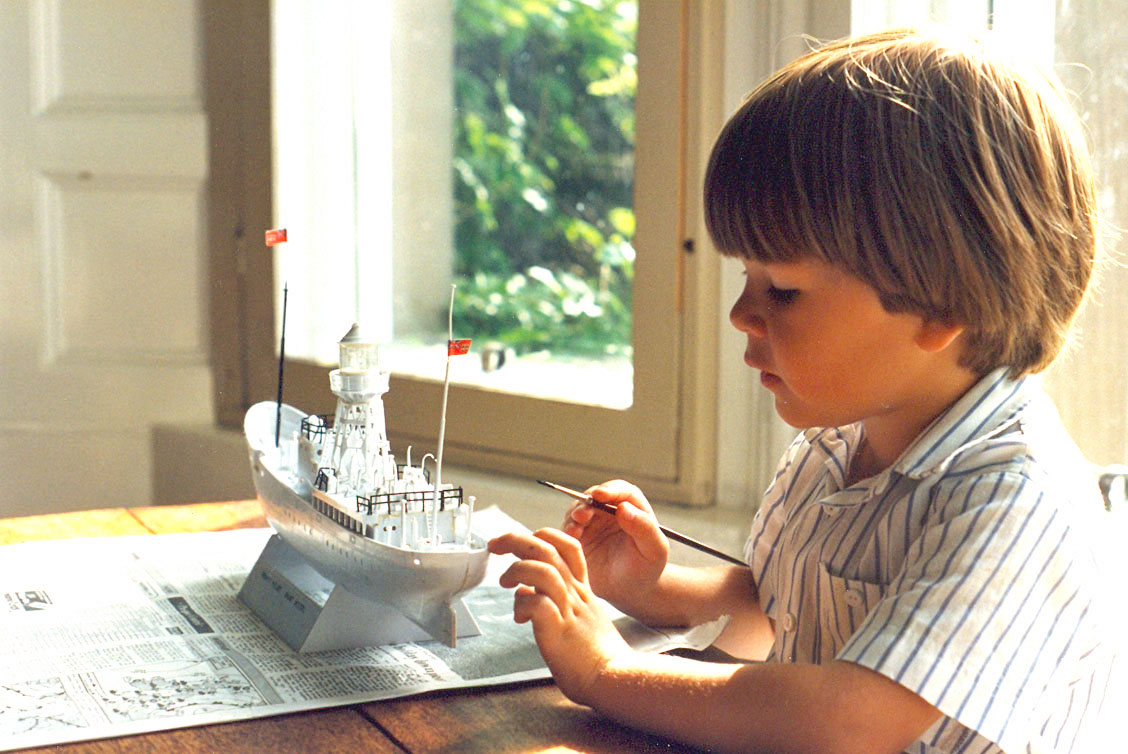
A plastic model kit, (plamo in Eastern influenced parlance),[citation needed] is a consumer-grade plastic scale model manufactured as a kit, primarily assembled by hobbyists, and intended primarily for display. A plastic model kit depicts various subjects, ranging from real life military and civilian vehicles to characters and machinery from original kit lines and pop fiction, especially from eastern pop culture. A kit varies in difficulty, ranging from a "snap-together" model that assembles straight from the box, to a kit that requires special tools, paints, and plastic cements.
The most popular subjects of plastic models by far are vehicles such as aircraft, ships, automobiles, and armored vehicles such as tanks. The majority of models throughout its early history depict military vehicles,[citation needed] due to the wider variety of form and historical context compared to civilian vehicles. Other subjects include science fiction vehicles and mecha, real spacecraft, buildings, animals, human(oid) dolls/action figures, and characters from pop culture.
While military, ship, and aircraft modelers prize accuracy above all, modelers of automobiles and science-fiction themes may attempt to duplicate an existing subject, or may depict a completely imaginary subject. The creation of custom automobile models is related to the creation of actual custom cars and often an individual may have an interest in both, although the cost of customizing a real car is obviously enormously greater than that of customizing a model.
The first plastic models were injection molded in cellulose acetate (e.g. Frog Penguin and Varney Trains), but currently most plastic models are injection-molded in polystyrene, and the parts are bonded together, usually with a plastic solvent-based adhesive, although modelers may also use epoxy, cyanoacrylate, and white glue where their particular properties would be advantageous. While often omitted by novice modellers, specially formulated paint is sold for application to plastic models. Complex markings such as aircraft insignia or automobile body decorative details and model identification badges are typically provided with kits as screen-printed water-slide decals.
Recently, models requiring less skill, time, and/or effort have been marketed, targeted to younger or less skilled modelers as well as those who just wish to reduce the time and effort required to complete a model. One such trend has been to offer a fully detailed kit requiring normal assembly and gluing, but eliminate the often frustrating task of painting the kit by molding it out of colored plastic, or by supplying it pre-painted and with decals applied. Often these kits are identical to another kit supplied in normal white or gray plastic except for the colored plastic or the prepainting, thus eliminating the large expense of creating another set of molds.
Another trend which has become very extensive is to produce kits where the parts snap together, with no glue needed; sometimes the majority of the parts snap together with a few requiring glue. Often there is some simplification of detail as well; for instance, automotive kits without opening hoods and no engine detail, or sometimes opaque windows with no interior detail. These are often supplied in colored plastic, although smaller details would still require painting. Decals are usually not supplied with these but sometimes vinyl stickers are provided for insignia and similar details.
Resin casting and vacuum forming are also used to produce models, or particular parts where the scale of production is not such as to support the investment required for injection molding.
Plastic ship model kits typically provide thread in several sizes and colors for the rigging. Automobile kits typically contain vinyl tires, although sometimes these are molded from polystyrene as well, particularly in very inexpensive kits. Thin metal details produced by photoetching have become popular relatively recently, both as detailing parts manufactured and sold by small businesses, and as parts of a complete kit. Detail parts of other materials are sometimes included in kits or sold separately, such as metal tubing to simulate exhaust systems, or vinyl tubing to simulate hoses or wiring.
Hub AI
Plastic model kit AI simulator
(@Plastic model kit_simulator)
Plastic model kit
A plastic model kit, (plamo in Eastern influenced parlance),[citation needed] is a consumer-grade plastic scale model manufactured as a kit, primarily assembled by hobbyists, and intended primarily for display. A plastic model kit depicts various subjects, ranging from real life military and civilian vehicles to characters and machinery from original kit lines and pop fiction, especially from eastern pop culture. A kit varies in difficulty, ranging from a "snap-together" model that assembles straight from the box, to a kit that requires special tools, paints, and plastic cements.
The most popular subjects of plastic models by far are vehicles such as aircraft, ships, automobiles, and armored vehicles such as tanks. The majority of models throughout its early history depict military vehicles,[citation needed] due to the wider variety of form and historical context compared to civilian vehicles. Other subjects include science fiction vehicles and mecha, real spacecraft, buildings, animals, human(oid) dolls/action figures, and characters from pop culture.
While military, ship, and aircraft modelers prize accuracy above all, modelers of automobiles and science-fiction themes may attempt to duplicate an existing subject, or may depict a completely imaginary subject. The creation of custom automobile models is related to the creation of actual custom cars and often an individual may have an interest in both, although the cost of customizing a real car is obviously enormously greater than that of customizing a model.
The first plastic models were injection molded in cellulose acetate (e.g. Frog Penguin and Varney Trains), but currently most plastic models are injection-molded in polystyrene, and the parts are bonded together, usually with a plastic solvent-based adhesive, although modelers may also use epoxy, cyanoacrylate, and white glue where their particular properties would be advantageous. While often omitted by novice modellers, specially formulated paint is sold for application to plastic models. Complex markings such as aircraft insignia or automobile body decorative details and model identification badges are typically provided with kits as screen-printed water-slide decals.
Recently, models requiring less skill, time, and/or effort have been marketed, targeted to younger or less skilled modelers as well as those who just wish to reduce the time and effort required to complete a model. One such trend has been to offer a fully detailed kit requiring normal assembly and gluing, but eliminate the often frustrating task of painting the kit by molding it out of colored plastic, or by supplying it pre-painted and with decals applied. Often these kits are identical to another kit supplied in normal white or gray plastic except for the colored plastic or the prepainting, thus eliminating the large expense of creating another set of molds.
Another trend which has become very extensive is to produce kits where the parts snap together, with no glue needed; sometimes the majority of the parts snap together with a few requiring glue. Often there is some simplification of detail as well; for instance, automotive kits without opening hoods and no engine detail, or sometimes opaque windows with no interior detail. These are often supplied in colored plastic, although smaller details would still require painting. Decals are usually not supplied with these but sometimes vinyl stickers are provided for insignia and similar details.
Resin casting and vacuum forming are also used to produce models, or particular parts where the scale of production is not such as to support the investment required for injection molding.
Plastic ship model kits typically provide thread in several sizes and colors for the rigging. Automobile kits typically contain vinyl tires, although sometimes these are molded from polystyrene as well, particularly in very inexpensive kits. Thin metal details produced by photoetching have become popular relatively recently, both as detailing parts manufactured and sold by small businesses, and as parts of a complete kit. Detail parts of other materials are sometimes included in kits or sold separately, such as metal tubing to simulate exhaust systems, or vinyl tubing to simulate hoses or wiring.