
Recent from talks
Plaza Independencia
Knowledge base stats:
Talk channels stats:
Members stats:
Plaza Independencia
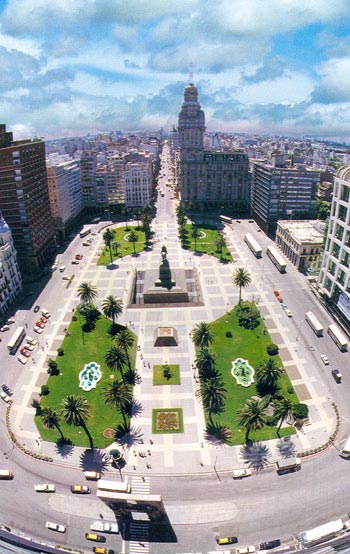
Plaza Independencia (Spanish for 'Independence Square') is the main public square of Montevideo, Uruguay. It was laid out in the 19th century on the site formerly occupied by the Citadel of Montevideo, marking the transition between the old fortified city and the modern urban expansion.
Situated in Central Montevideo, at the boundary with the Ciudad Vieja, the square has long served as a venue for major political demonstrations and official public ceremonies. Notable buildings facing the square include the Palacio Salvo, the Solís Theatre, the Estévez Palace, and the Executive Tower.
Following the demolition of the colonial fortifications after the consolidation of independence, the former walled city was opened to urban expansion. In 1837, the Ciudad Nueva (“New City”) was planned, and architect Carlo Zucchi laid out what would become Plaza Independencia, reportedly inspired by the Rue de Rivoli in Paris. During the 19th century, the square emerged as a focal point of national importance, particularly with the construction of the Estévez Palace, which served as the seat of the Uruguayan government.
At the beginning of the 20th century, French landscape architect Carlos Thays was commissioned to design the square’s landscaping, as the site had until then remained largely undeveloped. Thays introduced four French-style parterres with fountains and landscaped greenery, as well as a series of palm trees characteristic of his urban projects, which symbolically represent the Thirty-Three Orientals, leaders of the 1825 expedition that initiated Uruguay’s struggle for independence.
In 1923, during the presidency of Baltasar Brum, a monument to General José Gervasio Artigas was inaugurated. The monument consists of a 17-metre bronze equestrian statue set upon a granite base sculpted by Angelo Zanelli.
On 27 September 1974, during the civic-military dictatorship, the construction of an underground mausoleum beneath Plaza Independencia for the remains of José Gervasio Artigas was formally approved. His remains had been placed in the National Pantheon of the Central Cemetery in 1972, after being repatriated from Paraguay, where he had died in 1850.
Designed by architects Lucas Ríos Demalde and Alejandro Morón, the mausoleum features two broad granite staircases leading to an underground chamber housing the urn containing Artigas’s remains. A granite mastaba situated behind the monument above functions as a skylight for the subterranean space. The mausoleum was inaugurated and opened to the public on 19 June 1977—Artigas’s birthday, which is observed as a national holiday in Uruguay.
The site has a permanent honor guard from its body of soldiers (Cuerpo de Blandengues), the first in which Artigas served. The changing of the guard is a major ceremony and tourist attraction.
Hub AI
Plaza Independencia AI simulator
(@Plaza Independencia_simulator)
Plaza Independencia
Plaza Independencia (Spanish for 'Independence Square') is the main public square of Montevideo, Uruguay. It was laid out in the 19th century on the site formerly occupied by the Citadel of Montevideo, marking the transition between the old fortified city and the modern urban expansion.
Situated in Central Montevideo, at the boundary with the Ciudad Vieja, the square has long served as a venue for major political demonstrations and official public ceremonies. Notable buildings facing the square include the Palacio Salvo, the Solís Theatre, the Estévez Palace, and the Executive Tower.
Following the demolition of the colonial fortifications after the consolidation of independence, the former walled city was opened to urban expansion. In 1837, the Ciudad Nueva (“New City”) was planned, and architect Carlo Zucchi laid out what would become Plaza Independencia, reportedly inspired by the Rue de Rivoli in Paris. During the 19th century, the square emerged as a focal point of national importance, particularly with the construction of the Estévez Palace, which served as the seat of the Uruguayan government.
At the beginning of the 20th century, French landscape architect Carlos Thays was commissioned to design the square’s landscaping, as the site had until then remained largely undeveloped. Thays introduced four French-style parterres with fountains and landscaped greenery, as well as a series of palm trees characteristic of his urban projects, which symbolically represent the Thirty-Three Orientals, leaders of the 1825 expedition that initiated Uruguay’s struggle for independence.
In 1923, during the presidency of Baltasar Brum, a monument to General José Gervasio Artigas was inaugurated. The monument consists of a 17-metre bronze equestrian statue set upon a granite base sculpted by Angelo Zanelli.
On 27 September 1974, during the civic-military dictatorship, the construction of an underground mausoleum beneath Plaza Independencia for the remains of José Gervasio Artigas was formally approved. His remains had been placed in the National Pantheon of the Central Cemetery in 1972, after being repatriated from Paraguay, where he had died in 1850.
Designed by architects Lucas Ríos Demalde and Alejandro Morón, the mausoleum features two broad granite staircases leading to an underground chamber housing the urn containing Artigas’s remains. A granite mastaba situated behind the monument above functions as a skylight for the subterranean space. The mausoleum was inaugurated and opened to the public on 19 June 1977—Artigas’s birthday, which is observed as a national holiday in Uruguay.
The site has a permanent honor guard from its body of soldiers (Cuerpo de Blandengues), the first in which Artigas served. The changing of the guard is a major ceremony and tourist attraction.
Recent media