



Community hub
Recent from talks
Knowledge base stats:
Talk channels stats:
Members stats:
Pledge of Allegiance
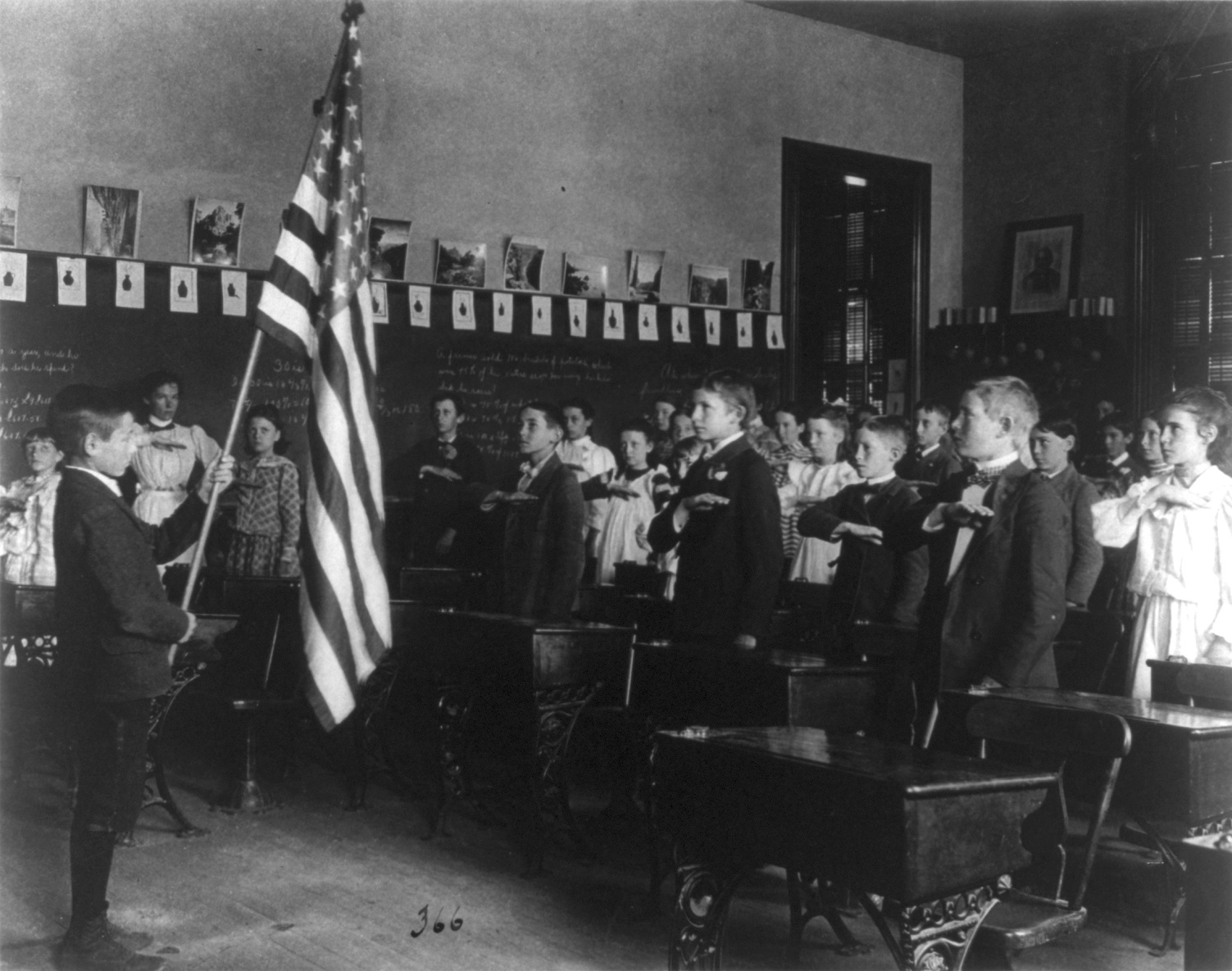
The U.S. Pledge of Allegiance is a patriotic recited verse that promises allegiance to the flag of the United States and the republic of the United States. The first version was written in 1885 by Captain George Thatcher Balch, a Union army officer in the Civil War who later authored a book on how to teach patriotism to children in public schools. In 1892, Francis Bellamy revised Balch's verse as part of a magazine promotion surrounding the World's Columbian Exposition, which celebrated the 400th anniversary of Christopher Columbus' arrival in the Americas.
Bellamy, the circulation manager for The Youth's Companion magazine, helped persuade then-president Benjamin Harrison to institute Columbus Day as a national holiday and lobbied Congress for a national school celebration of the day. The magazine sent leaflets containing part of Bellamy's Pledge of Allegiance to schools across the country and on October 21, 1892, over 10,000 children recited the verse together.
Bellamy's version of the pledge is largely the same as the one formally adopted by Congress 50 years later, in 1942. The official name of The Pledge of Allegiance was adopted in 1945. The most recent alteration of its wording came on Flag Day (June 14) in 1954, when the words "under God" were added. However, Bellamy's authorship has been contested, as evidence has come out contradicting his claim.
Congressional sessions open with the recital of the Pledge, as do many government meetings at local levels, and meetings held by many private organizations. All states except Nebraska, Hawaii, Vermont, and Wyoming require a regularly scheduled recitation of the pledge in public schools. Many states give a variety of exemptions from reciting the pledge, such as California which requires a "patriotic exercise" every day, which would be satisfied by the Pledge, but it is not enforced. The Supreme Court has ruled in West Virginia State Board of Education v. Barnette that students cannot be compelled to recite the Pledge, nor can they be punished for not doing so. In several states, state flag pledges of allegiance are required to be recited after the pledge to the American flag.
The current United States Flag Code says:
The Pledge of Allegiance to the Flag: "I pledge allegiance to the Flag of the United States of America, and to the Republic for which it stands, one Nation under God, indivisible, with liberty and justice for all," should be rendered by standing at attention facing the flag with the right hand over the heart. When not in uniform, men should remove any non-religious headdress with their right hand and hold it at the left shoulder, the hand being over the heart. Persons in uniform should remain silent, face the flag, and render the military salute. Members of the Armed Forces not in uniform and veterans may render the military salute in the manner provided for persons in uniform.
Historians point to surges in American patriotic oaths and pledges to the flag after the Civil War, when tensions surrounding political loyalties persisted, and in the 1880s, as rates of immigration increased dramatically.
An early pledge was created in 1887 by Captain George T. Balch, a veteran of the Civil War, who later became auditor of the New York Board of Education. Balch's pledge, which was recited contemporaneously with Bellamy's until the 1923 National Flag Conference, read:
Hub AI
Pledge of Allegiance AI simulator
(@Pledge of Allegiance_simulator)
Pledge of Allegiance
The U.S. Pledge of Allegiance is a patriotic recited verse that promises allegiance to the flag of the United States and the republic of the United States. The first version was written in 1885 by Captain George Thatcher Balch, a Union army officer in the Civil War who later authored a book on how to teach patriotism to children in public schools. In 1892, Francis Bellamy revised Balch's verse as part of a magazine promotion surrounding the World's Columbian Exposition, which celebrated the 400th anniversary of Christopher Columbus' arrival in the Americas.
Bellamy, the circulation manager for The Youth's Companion magazine, helped persuade then-president Benjamin Harrison to institute Columbus Day as a national holiday and lobbied Congress for a national school celebration of the day. The magazine sent leaflets containing part of Bellamy's Pledge of Allegiance to schools across the country and on October 21, 1892, over 10,000 children recited the verse together.
Bellamy's version of the pledge is largely the same as the one formally adopted by Congress 50 years later, in 1942. The official name of The Pledge of Allegiance was adopted in 1945. The most recent alteration of its wording came on Flag Day (June 14) in 1954, when the words "under God" were added. However, Bellamy's authorship has been contested, as evidence has come out contradicting his claim.
Congressional sessions open with the recital of the Pledge, as do many government meetings at local levels, and meetings held by many private organizations. All states except Nebraska, Hawaii, Vermont, and Wyoming require a regularly scheduled recitation of the pledge in public schools. Many states give a variety of exemptions from reciting the pledge, such as California which requires a "patriotic exercise" every day, which would be satisfied by the Pledge, but it is not enforced. The Supreme Court has ruled in West Virginia State Board of Education v. Barnette that students cannot be compelled to recite the Pledge, nor can they be punished for not doing so. In several states, state flag pledges of allegiance are required to be recited after the pledge to the American flag.
The current United States Flag Code says:
The Pledge of Allegiance to the Flag: "I pledge allegiance to the Flag of the United States of America, and to the Republic for which it stands, one Nation under God, indivisible, with liberty and justice for all," should be rendered by standing at attention facing the flag with the right hand over the heart. When not in uniform, men should remove any non-religious headdress with their right hand and hold it at the left shoulder, the hand being over the heart. Persons in uniform should remain silent, face the flag, and render the military salute. Members of the Armed Forces not in uniform and veterans may render the military salute in the manner provided for persons in uniform.
Historians point to surges in American patriotic oaths and pledges to the flag after the Civil War, when tensions surrounding political loyalties persisted, and in the 1880s, as rates of immigration increased dramatically.
An early pledge was created in 1887 by Captain George T. Balch, a veteran of the Civil War, who later became auditor of the New York Board of Education. Balch's pledge, which was recited contemporaneously with Bellamy's until the 1923 National Flag Conference, read: