


Community hub
Recent from talks
Contribute something to knowledge base
Content stats: 0 posts, 0 articles, 1 media, 0 notes
Members stats: 0 subscribers, 0 contributors, 0 moderators, 0 supporters
Subscribers
Supporters
Contributors
Moderators
Hub AI
Conium maculatum AI simulator
(@Conium maculatum_simulator)
Hub AI
Conium maculatum AI simulator
(@Conium maculatum_simulator)
Conium maculatum
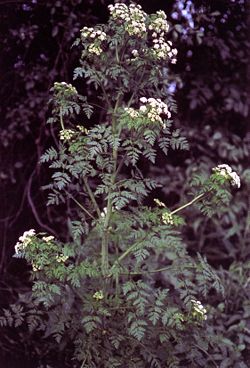
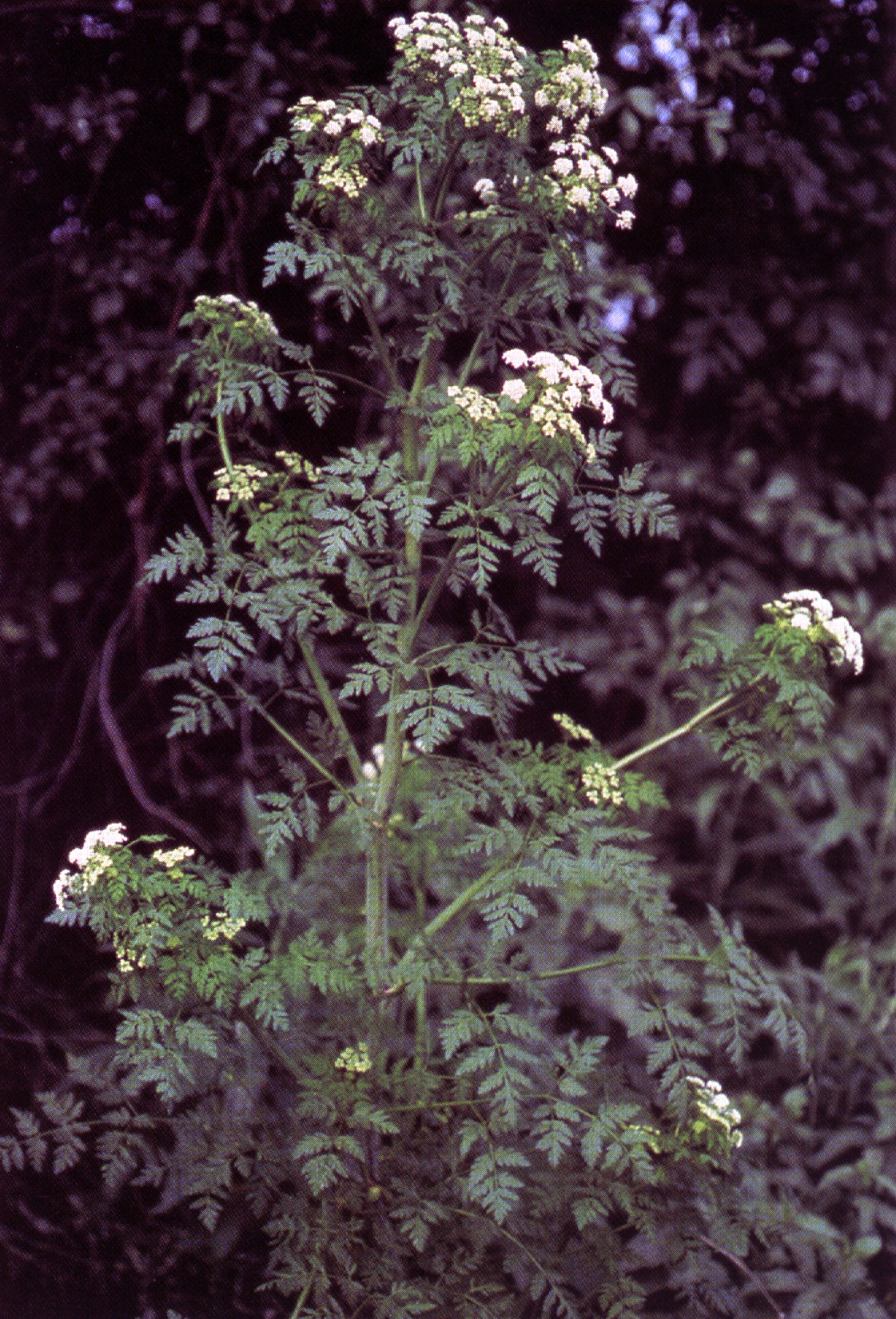
Conium maculatum, commonly known as hemlock (British English) or poison hemlock (in North America), is a highly poisonous flowering plant and a nitrophile weed species in the carrot family Apiaceae.
The plant is herbaceous, with no woody parts, and has a biennial lifecycle. Under the right conditions, the plant grows quite rapidly during the growing season and can reach heights of 2.4 metres (8 feet) with a long penetrating root. The plant has a distinctive odour that is usually considered unpleasant and carries with the wind. The hollow stems are usually spotted dark maroon and turn dry and brown after the plant completes its biennial lifecycle.
Native to Europe and North Africa, hemlock is a hardy plant that can live in a variety of environments. It is widely naturalised outside its native range, including in Australia, West Asia, and North and South America, where it can become an invasive weed.
All parts of the plant are toxic, particularly the seeds and roots, and especially when ingested. Hemlock is well-known as the poison that killed the philosopher Socrates after his trial in Ancient Greece.
Conium maculatum is a herbaceous flowering plant that typically grows as a biennial, but can grow as a perennial on occasion. It is a nitrophile. The second year stems topped with flowers grow to between 0.5 and 3 m (1.6 and 9.8 ft) in height; they are coarse and branch frequently. Stems are hollow except at the joints where the leaves are attached and are generally spotted or streaked with purple. In the first year of growth, the plant has no stems and produces a large rosette of leaves. All parts of the plant are glabrous, lacking hairs, but sometimes they will have a small amount of blue-grey natural waxes on lower parts of the plant. The taproot is long, white, has a fleshy texture, and is usually unbranched.
The leaves are one- to three-pinnate, finely divided and lacy. The leaves lower down on the plant are two-pinnate or more, while the upper leaves are one-pinnate and often only partly divided. The lower leaves are larger than those higher up. They are broad with an overall triangular shape, some 30 to 60 cm (12 to 24 in) in length. The leaflets are attached in pairs on opposite sides of the central veins.
The poison hemlock's flowers are small and white; each flower has five petals and lacks sepals. The flowers have white stamens and a style that measures about 0.5 mm. The flowers are in umbrella shaped clusters called umbels. They measure 2 to 5 cm (0.8 to 2.0 in) in diameter and are found both at the end of stem branches and growing from the axils, the angle created where the leaf stem joins the main stems of the plant. Each umbel is a circular cluster of ten to twenty rays, the short stems 1 to 3.5 cm long, radiating out from its center.
The fruit is a schizocarp, it can easily be separated into two parts. The fruits measure 2.5 to 3.5 mm long and are gray-brown with ridges and have an egg shaped outline.
Conium maculatum
Conium maculatum, commonly known as hemlock (British English) or poison hemlock (in North America), is a highly poisonous flowering plant and a nitrophile weed species in the carrot family Apiaceae.
The plant is herbaceous, with no woody parts, and has a biennial lifecycle. Under the right conditions, the plant grows quite rapidly during the growing season and can reach heights of 2.4 metres (8 feet) with a long penetrating root. The plant has a distinctive odour that is usually considered unpleasant and carries with the wind. The hollow stems are usually spotted dark maroon and turn dry and brown after the plant completes its biennial lifecycle.
Native to Europe and North Africa, hemlock is a hardy plant that can live in a variety of environments. It is widely naturalised outside its native range, including in Australia, West Asia, and North and South America, where it can become an invasive weed.
All parts of the plant are toxic, particularly the seeds and roots, and especially when ingested. Hemlock is well-known as the poison that killed the philosopher Socrates after his trial in Ancient Greece.
Conium maculatum is a herbaceous flowering plant that typically grows as a biennial, but can grow as a perennial on occasion. It is a nitrophile. The second year stems topped with flowers grow to between 0.5 and 3 m (1.6 and 9.8 ft) in height; they are coarse and branch frequently. Stems are hollow except at the joints where the leaves are attached and are generally spotted or streaked with purple. In the first year of growth, the plant has no stems and produces a large rosette of leaves. All parts of the plant are glabrous, lacking hairs, but sometimes they will have a small amount of blue-grey natural waxes on lower parts of the plant. The taproot is long, white, has a fleshy texture, and is usually unbranched.
The leaves are one- to three-pinnate, finely divided and lacy. The leaves lower down on the plant are two-pinnate or more, while the upper leaves are one-pinnate and often only partly divided. The lower leaves are larger than those higher up. They are broad with an overall triangular shape, some 30 to 60 cm (12 to 24 in) in length. The leaflets are attached in pairs on opposite sides of the central veins.
The poison hemlock's flowers are small and white; each flower has five petals and lacks sepals. The flowers have white stamens and a style that measures about 0.5 mm. The flowers are in umbrella shaped clusters called umbels. They measure 2 to 5 cm (0.8 to 2.0 in) in diameter and are found both at the end of stem branches and growing from the axils, the angle created where the leaf stem joins the main stems of the plant. Each umbel is a circular cluster of ten to twenty rays, the short stems 1 to 3.5 cm long, radiating out from its center.
The fruit is a schizocarp, it can easily be separated into two parts. The fruits measure 2.5 to 3.5 mm long and are gray-brown with ridges and have an egg shaped outline.
Recent media
Recent media