



Community hub
Recent from talks
Knowledge base stats:
Talk channels stats:
Members stats:
Polar amplification
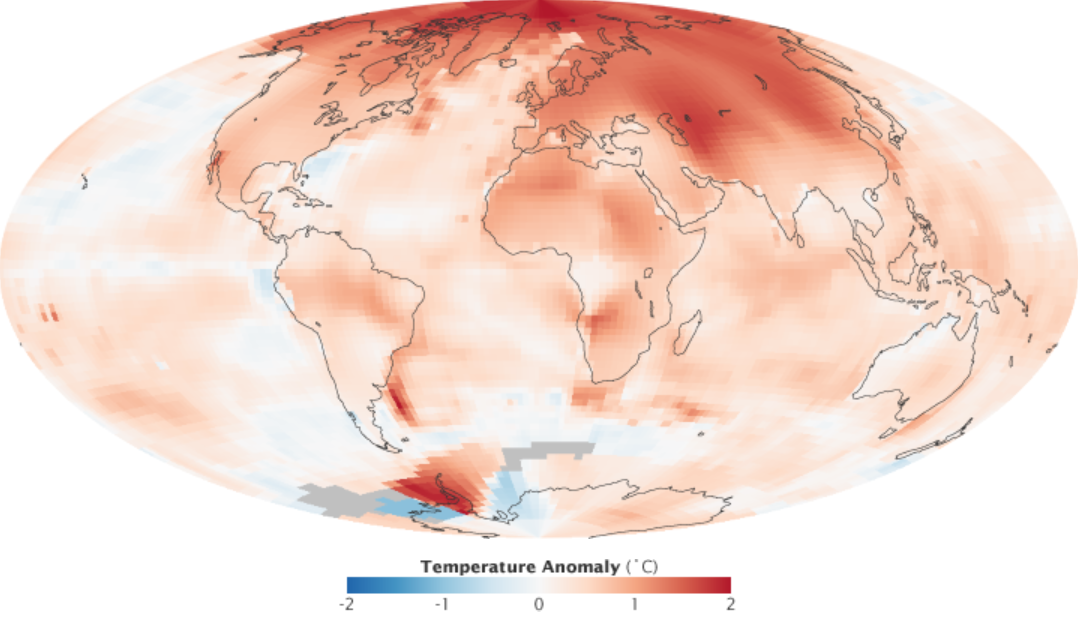
Polar amplification is the phenomenon that any change in the net radiation balance (for example greenhouse intensification) tends to produce a larger change in temperature near the poles than in the planetary average. This is commonly referred to as the ratio of polar warming to tropical warming. On a planet with an atmosphere that can restrict emission of longwave radiation to space (a greenhouse effect), surface temperatures will be warmer than a simple planetary equilibrium temperature calculation would predict. Where the atmosphere or an extensive ocean is able to transport heat polewards, the poles will be warmer and equatorial regions cooler than their local net radiation balances would predict. The poles will experience the most cooling when the global-mean temperature is lower relative to a reference climate; alternatively, the poles will experience the greatest warming when the global-mean temperature is higher.
In the extreme, the planet Venus is thought to have experienced a very large increase in greenhouse effect over its lifetime, so much so that its poles have warmed sufficiently to render its surface temperature effectively isothermal (no difference between poles and equator). On Earth, water vapor and trace gasses provide a lesser greenhouse effect, and the atmosphere and extensive oceans provide efficient poleward heat transport. Both palaeoclimate changes and recent global warming changes have exhibited strong polar amplification, as described below.
Arctic amplification is polar amplification of the Earth's North Pole only; Antarctic amplification is that of the South Pole.
An observation-based study related to Arctic amplification was published in 1969 by Mikhail Budyko, and the study conclusion has been summarized as "Sea ice loss affects Arctic temperatures through the surface albedo feedback." The same year, a similar model was published by William D. Sellers. Both studies attracted significant attention since they hinted at the possibility for a runaway positive feedback within the global climate system. In 1975, Manabe and Wetherald published the first somewhat plausible general circulation model that looked at the effects of an increase of greenhouse gas. Although confined to less than one-third of the globe, with a "swamp" ocean and only land surface at high latitudes, it showed an Arctic warming faster than the tropics (as have all subsequent models).
Feedbacks associated with sea ice and snow cover are widely cited as one of the principal causes of terrestrial polar amplification. These feedbacks are particularly noted in local polar amplification, although recent work has shown that the lapse rate feedback is likely equally important to the ice-albedo feedback for Arctic amplification. Supporting this idea, large-scale amplification is also observed in model worlds with no ice or snow. It appears to arise both from a (possibly transient) intensification of poleward heat transport and more directly from changes in the local net radiation balance. Local radiation balance is crucial because an overall decrease in outgoing longwave radiation will produce a larger relative increase in net radiation near the poles than near the equator. Thus, between the lapse rate feedback and changes in the local radiation balance, much of polar amplification can be attributed to changes in outgoing longwave radiation. This is especially true for the Arctic, whereas the elevated terrain in Antarctica limits the influence of the lapse rate feedback.
Some examples of climate system feedbacks thought to contribute to recent polar amplification include the reduction of snow cover and sea ice, changes in atmospheric and ocean circulation, the presence of anthropogenic soot in the Arctic environment, and increases in cloud cover and water vapor. CO2 forcing has also been attributed to polar amplification. Most studies connect sea ice changes to polar amplification. Both ice extent and thickness impact polar amplification. Climate models with smaller baseline sea ice extent and thinner sea ice coverage exhibit stronger polar amplification. Some models of modern climate exhibit Arctic amplification without changes in snow and ice cover.
The individual processes contributing to polar warming are critical to understanding climate sensitivity. Polar warming also affects many ecosystems, including marine and terrestrial ecosystems, climate systems, and human populations. Polar amplification is largely driven by local polar processes with hardly any remote forcing, whereas polar warming is regulated by tropical and midlatitude forcing. These impacts of polar amplification have led to continuous research in the face of global warming.
It has been estimated that 70% of global wind energy is transferred to the ocean and takes place within the Antarctic Circumpolar Current (ACC). Eventually, upwelling due to wind-stress transports cold Antarctic waters through the Atlantic surface current, while warming them over the equator, and into the Arctic environment. This is especially noticed in high latitudes. Thus, warming in the Arctic depends on the efficiency of the global ocean transport and plays a role in the polar see-saw effect.
Hub AI
Polar amplification AI simulator
(@Polar amplification_simulator)
Polar amplification
Polar amplification is the phenomenon that any change in the net radiation balance (for example greenhouse intensification) tends to produce a larger change in temperature near the poles than in the planetary average. This is commonly referred to as the ratio of polar warming to tropical warming. On a planet with an atmosphere that can restrict emission of longwave radiation to space (a greenhouse effect), surface temperatures will be warmer than a simple planetary equilibrium temperature calculation would predict. Where the atmosphere or an extensive ocean is able to transport heat polewards, the poles will be warmer and equatorial regions cooler than their local net radiation balances would predict. The poles will experience the most cooling when the global-mean temperature is lower relative to a reference climate; alternatively, the poles will experience the greatest warming when the global-mean temperature is higher.
In the extreme, the planet Venus is thought to have experienced a very large increase in greenhouse effect over its lifetime, so much so that its poles have warmed sufficiently to render its surface temperature effectively isothermal (no difference between poles and equator). On Earth, water vapor and trace gasses provide a lesser greenhouse effect, and the atmosphere and extensive oceans provide efficient poleward heat transport. Both palaeoclimate changes and recent global warming changes have exhibited strong polar amplification, as described below.
Arctic amplification is polar amplification of the Earth's North Pole only; Antarctic amplification is that of the South Pole.
An observation-based study related to Arctic amplification was published in 1969 by Mikhail Budyko, and the study conclusion has been summarized as "Sea ice loss affects Arctic temperatures through the surface albedo feedback." The same year, a similar model was published by William D. Sellers. Both studies attracted significant attention since they hinted at the possibility for a runaway positive feedback within the global climate system. In 1975, Manabe and Wetherald published the first somewhat plausible general circulation model that looked at the effects of an increase of greenhouse gas. Although confined to less than one-third of the globe, with a "swamp" ocean and only land surface at high latitudes, it showed an Arctic warming faster than the tropics (as have all subsequent models).
Feedbacks associated with sea ice and snow cover are widely cited as one of the principal causes of terrestrial polar amplification. These feedbacks are particularly noted in local polar amplification, although recent work has shown that the lapse rate feedback is likely equally important to the ice-albedo feedback for Arctic amplification. Supporting this idea, large-scale amplification is also observed in model worlds with no ice or snow. It appears to arise both from a (possibly transient) intensification of poleward heat transport and more directly from changes in the local net radiation balance. Local radiation balance is crucial because an overall decrease in outgoing longwave radiation will produce a larger relative increase in net radiation near the poles than near the equator. Thus, between the lapse rate feedback and changes in the local radiation balance, much of polar amplification can be attributed to changes in outgoing longwave radiation. This is especially true for the Arctic, whereas the elevated terrain in Antarctica limits the influence of the lapse rate feedback.
Some examples of climate system feedbacks thought to contribute to recent polar amplification include the reduction of snow cover and sea ice, changes in atmospheric and ocean circulation, the presence of anthropogenic soot in the Arctic environment, and increases in cloud cover and water vapor. CO2 forcing has also been attributed to polar amplification. Most studies connect sea ice changes to polar amplification. Both ice extent and thickness impact polar amplification. Climate models with smaller baseline sea ice extent and thinner sea ice coverage exhibit stronger polar amplification. Some models of modern climate exhibit Arctic amplification without changes in snow and ice cover.
The individual processes contributing to polar warming are critical to understanding climate sensitivity. Polar warming also affects many ecosystems, including marine and terrestrial ecosystems, climate systems, and human populations. Polar amplification is largely driven by local polar processes with hardly any remote forcing, whereas polar warming is regulated by tropical and midlatitude forcing. These impacts of polar amplification have led to continuous research in the face of global warming.
It has been estimated that 70% of global wind energy is transferred to the ocean and takes place within the Antarctic Circumpolar Current (ACC). Eventually, upwelling due to wind-stress transports cold Antarctic waters through the Atlantic surface current, while warming them over the equator, and into the Arctic environment. This is especially noticed in high latitudes. Thus, warming in the Arctic depends on the efficiency of the global ocean transport and plays a role in the polar see-saw effect.