
Recent from talks
Polesine
Knowledge base stats:
Talk channels stats:
Members stats:
Polesine
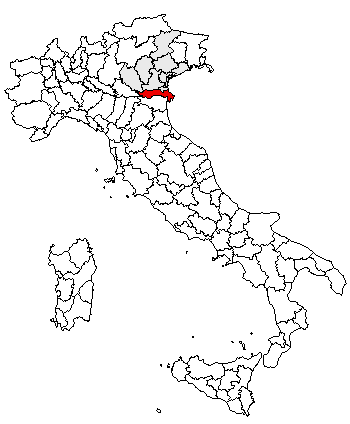
Polesine (Italian: [poˈleːzine]; unified Venetian script: Połéxine [poˈɰezine]; Ferrarese: Pulésan) is a geographic and historic area in the north-east of Italy whose limits varied through centuries; it had also been known as Polesine of Rovigo for some time.
Nowadays it corresponds with the province of Rovigo in the viewpoint of political geography. In the viewpoint of physical geography it is a strip of land about 100-km long and 18-km wide located between the lower courses of the Adige and the Po rivers, limited to the east by the Adriatic Sea and leaving the western limit undefined.
The eastern portion of Polesine corresponds to the delta of the Po, and it is constantly expanding eastward because of the detritus sediment phenomenon.
The Po and the Adige are the first and the third biggest rivers of Italy as for rate of flow, yet another river flows across Polesine between these two main rivers: the Canal Bianco; this means that by far most of the fresh water of Italy flows into the sea through Polesine. Due to this large amount of water it has to deal with, it has many canals for drainage.
The biggest city is Rovigo (51,000 inhabitants), followed by Adria (20,000 people). Other important centres are Porto Viro, Lendinara, Porto Tolle, Badia Polesine, Occhiobello and Taglio di Po. Important agricultural centres are Arquà Polesine, Loreo, Polesella and Lusia.
Polesine is a Venetian term from Medieval Latin pollicĭnum or policĭnum, meaning "swamp" or "wetland"; this is because this territory was a swamp when it was given the name. This happened after the disasters in the Venetian hydrography that followed the decline of the Roman Empire.
Polesine's origins are connected with the myth of Phaeton, the young god who drowned with the Sun chariot in the river Eridano (the former name of the river Po). In Crespino, a small village in Polesine, there is a square (the chief one of the town) dedicated to Phaeton, to commemorate the old legend and the oral tradition saying that Phaeton died in the tract of the river Po crossing Crespino.
The Adige river flowed more to the north than nowadays and the main course of the Po river was more to the south (more or less it was the current Po of Volano channel). This means that in ancient times the area lying between the two rivers was much larger than the current area named Polesine.
Hub AI
Polesine AI simulator
(@Polesine_simulator)
Polesine
Polesine (Italian: [poˈleːzine]; unified Venetian script: Połéxine [poˈɰezine]; Ferrarese: Pulésan) is a geographic and historic area in the north-east of Italy whose limits varied through centuries; it had also been known as Polesine of Rovigo for some time.
Nowadays it corresponds with the province of Rovigo in the viewpoint of political geography. In the viewpoint of physical geography it is a strip of land about 100-km long and 18-km wide located between the lower courses of the Adige and the Po rivers, limited to the east by the Adriatic Sea and leaving the western limit undefined.
The eastern portion of Polesine corresponds to the delta of the Po, and it is constantly expanding eastward because of the detritus sediment phenomenon.
The Po and the Adige are the first and the third biggest rivers of Italy as for rate of flow, yet another river flows across Polesine between these two main rivers: the Canal Bianco; this means that by far most of the fresh water of Italy flows into the sea through Polesine. Due to this large amount of water it has to deal with, it has many canals for drainage.
The biggest city is Rovigo (51,000 inhabitants), followed by Adria (20,000 people). Other important centres are Porto Viro, Lendinara, Porto Tolle, Badia Polesine, Occhiobello and Taglio di Po. Important agricultural centres are Arquà Polesine, Loreo, Polesella and Lusia.
Polesine is a Venetian term from Medieval Latin pollicĭnum or policĭnum, meaning "swamp" or "wetland"; this is because this territory was a swamp when it was given the name. This happened after the disasters in the Venetian hydrography that followed the decline of the Roman Empire.
Polesine's origins are connected with the myth of Phaeton, the young god who drowned with the Sun chariot in the river Eridano (the former name of the river Po). In Crespino, a small village in Polesine, there is a square (the chief one of the town) dedicated to Phaeton, to commemorate the old legend and the oral tradition saying that Phaeton died in the tract of the river Po crossing Crespino.
The Adige river flowed more to the north than nowadays and the main course of the Po river was more to the south (more or less it was the current Po of Volano channel). This means that in ancient times the area lying between the two rivers was much larger than the current area named Polesine.
Recent media